

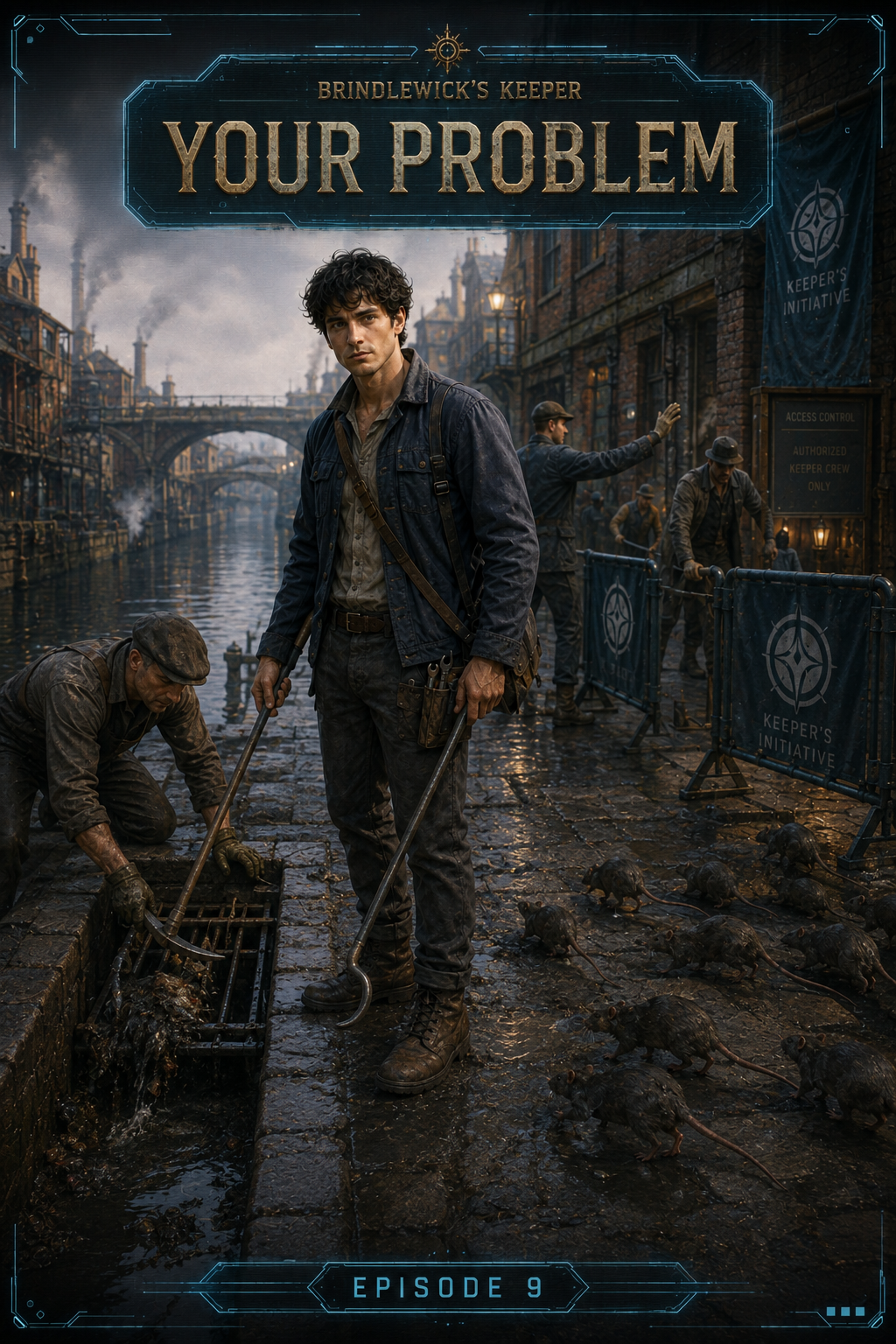
Calder watched the open path and waited for the next animal to choose a direction.
The rat nearest the service wall broke away from the others and angled toward the pedestrian route.
Calder lowered the scraper across its line.
The animal skidded, changed direction, and ran along the painted boundary instead.
He kept the hook extended on the other side, leaving the wall-side gap open.
The rat found it and disappeared behind the temporary panel a worker had begun setting farther down the lane.
Another rat followed, then doubled back when the panel shifted.
Calder moved the hook shaft into the opening before it could cut toward the pedestrian path.
The rat stopped, turned once in place, then retreated toward the service wall.
Calder let it go.
The goal was still the route.
A crew worker came toward him carrying a portable barrier panel under one arm.
"Hold the drainage edge."
Calder looked where the worker pointed.
The drainage edge ran just beyond the painted line, where the wall-side exit narrowed between grate five and a low service curb.
Calder shifted sideways.
The collection tray was in the wrong place for the new position.
He kicked it deeper into the marked work area and moved the scraper with it.
The worker lowered the barrier panel until one end met the curb.
"Keep this side open."
Calder understood why immediately.
Closing the wall-side gap would leave the rats with nowhere to go except back toward the route or under the workers' feet.
He angled the hook low across the near edge instead, creating a narrower channel that still let the animals retreat toward the drainage side.
The worker adjusted the panel.
One rat rushed forward before it was fully set.
Calder lowered the scraper.
The animal veered.
At the same moment, another rat squeezed toward the unfinished gap behind the panel.
Calder saw both movements at once.
He kept the scraper in place with his left hand and extended the hook shaft with his right.
The second rat reached the metal, recoiled, and turned toward the wall-side opening Calder had deliberately left clear.
The first rat followed it.
Neither reached the pedestrian route.
The worker shoved the panel into its final position.
"Hold there."
Calder held.
The lower opening remained visible beyond the service wall.
Wet stone darkened the edge around it. A streak of mud ran from the gap toward grate five.
For half a second, Calder thought he could see a second opening lower down.
He wanted to lean far enough to check.
He did not.
The worker beside him was tightening the barrier clamp.
The assessor had assigned Calder to the drainage edge.
The source still belonged to the channel crew.
Another rat emerged from the wall-side gap and tested the new route created by the panel.
Calder shifted the hook an inch.
The animal turned down the open side rather than toward the path.
The worker glanced at him.
"Good. Keep that lane."
Calder kept it.
The pressure changed as the barrier began doing some of the work his tools had been doing alone.
The animals were no longer spreading across the full lane.
They were being directed toward the open drainage side.
That made the next movement easier to predict.
It did not make the work automatic.
One rat tried to climb the base of the panel.
Another cut behind it toward the collection tray.
Calder stepped into the first line and lowered the scraper without striking.
The climbing rat dropped back to the ground.
He used the hook shaft to keep the second from slipping behind the tray.
Both turned toward the wall-side exit.
The worker pulled the tray farther away with one foot.
"Better there."
Calder nodded.
The assessor called from farther up the lane.
"Venn. Shift one position down. Support drainage edge."
Calder looked toward the next marked section.
A crew worker there was clearing loose debris from a narrow drain mouth while two rats moved along the wall behind him.
The assignment had changed again.
Calder picked up the scraper and hook.
He left the barrier panel where the crew worker had set it.
He left the lower opening alone.
Then he moved one position down.
The worker at the drain mouth glanced up as Calder approached.
"Keep them off me while I clear this."
Calder stepped into the new boundary.
The pedestrian route remained behind him.
The drainage edge ran along his right.
Two rats were already turning toward the worker's boots.
Calder lowered the scraper into their line and opened the hook toward the wall-side escape.
The rats split.
One retreated along the curb.
The other tried to cross behind Calder.
He pivoted and closed that path without leaving the marked area.
The animal turned back toward the drainage side.
Behind him, the worker kept clearing the drain.
Calder did not look toward grate five again.
The source was still there.
So was the problem he had actually been given.
So was the problem he had actually been given.
The worker at the drainage edge kept one knee braced against the curb and worked a narrow rake into the drain mouth.
“Hold the back side.”
Calder shifted the scraper across the gap behind him.
A rat that had been edging toward the worker’s boots stopped when the metal touched stone in front of it. Calder left the wall-side route open.
The animal turned and followed the curb away from them.
The worker pulled a fist-sized clump of weeds and silt from the drain mouth and dropped it into a bucket.
Water moved through the opening more freely.
“Again.”
Calder watched the lane while the worker set the rake back into the drain.
The rat traffic had thinned.
There were no longer four or five bodies shifting at once near the service wall. One rat moved along the curb. Another remained half hidden behind the barrier panel. The sounds below grate five had become intermittent.
Calder could see more of the lower opening now.
Wet tracks crossed the stone around it. Mud had been dragged up from somewhere below, leaving a dark fan across the base of the wall. Disturbed silt clung to one edge of the gap.
The marks suggested direction.
They also suggested that someone equipped to work the lower channel would be able to follow them.
Calder kept the scraper where it was.
A channel-crew worker came past carrying a short handled lamp and a clamped case.
The worker stopped at the service wall, crouched near the lower opening, and opened the case.
Calder did not try to see what was inside.
That was enough evidence that the source response had begun.
Beside him, the drainage worker pulled another clump free.
A rat shot from behind the panel.
Calder lowered the scraper across the pedestrian side before the animal could turn into the route.
The rat skidded and ran along the curb instead.
“Keep that side,” the worker said.
Calder kept it.
The drain mouth cleared another inch.
Water pulled loose grit through the opening with a soft rush.
The worker withdrew the rake and checked the flow.
“Almost.”
Calder looked down the drainage edge.
Only two rats remained in the immediate lane.
One crouched beside the service wall.
The other stood nearer the worker, body low and angled toward the narrow space behind his heel.
The worker set the rake into the drain for the final pass.
Both rats moved at once.
The one near the wall broke toward the pedestrian route.
The other darted behind the worker.
Calder closed the first line with the scraper.
The rat turned sharply.
He extended the hook shaft behind the worker without stepping around him.
The second rat reached the metal and recoiled.
For a moment the two animals were moving in opposite directions, each testing a different boundary.
Calder kept both tools low.
He did not close the wall-side exit.
The first rat found it.
It ran along the curb and disappeared past the temporary panel.
The second followed a heartbeat later.
Calder held his position.
He could still hear them moving beyond the wall-side edge, but they were no longer in the pedestrian lane or behind the worker.
The drainage worker pulled the rake free.
A final mat of roots and silt came with it.
Water surged through the cleared mouth and settled into a stronger, even flow.
The worker stood.
“Drain clear.”
Calder did not move yet.
The assessor had not released him.
The worker seemed to notice that and stayed where he was too.
Across the lane, the channel-crew worker at the lower opening raised the handled lamp and signaled to someone out of sight below the wall.
A second crew member brought over another case.
Calder could have asked what they had found.
He did not.
The answer would not change the work in front of him.
The assessor walked the lane once, looking first toward the service wall and then along the pedestrian route.
“Hold positions.”
Calder kept the scraper lowered.
Nothing came through the lower opening.
The stopped service cart waited behind the temporary boundary.
One of its workers had both hands resting on the rail.
Calder watched the drainage edge.
No movement.
He watched the gap behind the barrier panel.
Still clear.
The assessor waited.
The quiet interval lasted long enough that Calder became aware of how hard he was gripping the hook.
He loosened his hand without lowering it.
A worker farther up the lane called that the bridge side was clear.
Another answered from the service wall.
The assessor looked toward Calder’s position.
“Drainage edge?”
The worker beside Calder checked the drain mouth and then the curb behind them.
“Clear.”
The assessor nodded.
“Containment released. Reset the route.”
Calder straightened.
The worker beside him lifted the bucket and rake out of the marked area.
Calder carried the scraper and hook back toward the tray.
The temporary panel stayed in place while the channel crew continued working at the lower opening.
Nobody asked Calder to join them.
The pedestrian route reopened first.
A worker removed the temporary lane marker. The service cart began moving again, slowly at first, then at its ordinary pace once it passed grate five.
People who had been standing aside picked up cases and tools.
The yard resumed around the contained section.
Calder set the scraper and hook beside the collection tray.
The lower opening was still visible from where he stood.
A channel-crew worker had one arm braced against the service wall while another worked below the gap.
Whatever had driven the rats into the lane had not become Calder’s problem simply because he could see part of it.
The immediate hazard was over.
He had stayed where he was assigned until someone with authority told him to stop.
The assessor looked down at his slate.
Then he looked at Calder.
“Venn. Stay here.”
The other candidates were being directed back toward the staging area.
Calder remained beside grate five while the lane cleared around him.
The containment was finished.
The assessment of what he had done during it was about to begin.
The assessor waited until the last of the other candidates had crossed back through the staging gate.
Calder stayed beside grate five.
The channel crew was still working at the lower opening. One worker had the handled lamp braced against the service wall while another knelt beside the gap with a tool Calder could not identify from where he stood.
The assessor looked down at his slate.
“Grate three first.”
Calder waited.
“You hit resistance below the grate and stopped. You called it instead of forcing it. When I showed you the hinge, you adjusted and finished the task without repeating the same uncertainty.”
He marked something on the slate.
“Grate four. You kept the route open, moved the tools when the cart came through, and completed the grate without another correction.”
Another mark.
“Then grate five changed the assessment.”
Calder looked toward the painted line near the grate.
The yard had almost returned to its earlier rhythm. The service cart was gone. Workers moved cases along the reopened path. The temporary panel remained in place near the wall.
The assessor looked at him.
“You saw the animals come through, started toward the lower opening to trace the source, and I had to redirect you to the route.”
Calder nodded.
“I moved before the route problem was handled.”
The assessor studied him for a moment, then looked back at the slate.
“Correct.”
He made another mark.
Calder kept his hands at his sides.
The scraper and hook lay beside the collection tray where he had set them after containment was released.
The assessor continued.
“After the redirect, you stayed with the route. You did not chase the animals into the lower channel. You used the tools as barriers instead of striking. When the crew position changed, you moved with it. When drainage needed support, you held the edge until you were released.”
He paused.
“Why did you stop trying to trace the source?”
Calder looked toward the service wall.
The crew there had added a second lamp. Light now reached farther into the lower opening, but the angle still hid whatever lay beyond it.
“The route had become my assigned problem,” Calder said. “The channel crew had the equipment for the lower opening. I did not.”
The assessor waited.
Calder thought about the stopped cart, the workers who had moved aside, and the rat that had almost crossed behind the drainage worker.
“If I left the route to follow the source, someone else would have had to cover the hazard I had already been given. Or it would have been left open.”
The assessor nodded once.
“That’s the part I needed to hear.”
He entered something on the slate.
Calder watched the status field change.
CANDIDATE remained for a second.
Then it disappeared.
SUPERVISED FIELD TRIAL ELIGIBLE replaced it.
Calder read the line twice.
The assessor angled the slate toward him.
“You passed.”
Calder looked at the words again.
There was no permanent crew designation attached to them.
No independent clearance.
No open authority to take work outside supervision.
The result was narrower than that.
It was also enough.
“You’re cleared for supervised canal-support trial placement,” the assessor said. “You’ll work under a crew lead. Scope comes from the assignment. If conditions change beyond that scope, you report and wait for direction unless there is an immediate safety action already covered by procedure.”
Calder nodded.
The assessor tapped the slate once.
“Your mistake at grate five stays in the assessment record.”
Calder looked at the entry and nodded once.
The assessor continued without changing expression.
“A pass doesn’t mean you did everything right. It means you handled the work well enough, took correction, and did not turn one problem into three more.”
Calder looked back toward the lane.
The temporary barrier panel was still fixed near the service wall.
The lower opening was still occupied by the channel crew.
The source had not been explained to him.
He did not need the explanation for the result in front of him to make sense.
He had been assessed on what he did with the part of the problem that became his.
The assessor closed the evaluation screen and opened a second form.
A new heading appeared.
SUPERVISED CANAL-SUPPORT TRIAL.
Below it, several fields were still blank.
Calder looked at them.
The pass had been entered.
The next decision had not.
The assessor turned the trial form toward Calder.
“Supervised canal-support placement. It begins with assigned field work under a crew lead.”
Calder read the heading, then the status field beneath it.
The form was shorter than the registration terms had been.
That did not make the consequences smaller.
He moved past the description and found the supervision line.
“Crew lead retains assignment authority,” he read.
“Yes.”
Calder looked farther down.
He confirmed that reporting responsibility stayed with him for work he accepted and that scope changes had to come from the crew lead unless an established safety procedure applied before direction could reach him.
Calder kept reading.
The next section described trial duration and work status.
No permanent crew designation.
No independent repair authority.
No standing right to enter restricted channel spaces.
He looked up.
Calder confirmed that any accepted assignment had to be closed or handed off properly before he could stop taking work. The assessor confirmed that once current work was closed or transferred, Calder could decline further assignments.
Calder nodded.
That covered the part he cared about.
He could see more clauses below. Equipment responsibility. Attendance records. Incident reporting. Crew review intervals.
He did not keep digging for cases the form had not created yet.
The boundaries he needed were already visible: supervised work under defined assignment scope, no independent repair authority, and a clear exit once accepted work had been properly closed.
Calder put his thumb against the acceptance field.
The assessor waited.
Calder pressed.
The form asked for confirmation once.
He confirmed it, and the status line changed to TRIAL CANAL CREW: ACTIVE.
Calder looked at the words.
The designation was provisional, but it was work. He now had an active placement instead of an assessment slot or a future possibility.
The assessor closed the evaluation pane beneath it.
“You’re on trial status now. The first assignment is real field work.”
Calder looked toward the yard.
The containment area near grate five was still partly screened by the temporary panel. Channel workers continued around the lower opening, but the rest of the lane had resumed normal movement.
“Another exercise?” Calder asked.
“No.”
The assessor pointed toward the assignment station at the far side of the yard.
“Crew lead has a task waiting. You’ll get the handoff there.”
Calder looked at the scraper and hook beside the collection tray.
“Return those first?”
“Yes. Trial crews draw what the assignment requires.”
Calder picked up the issued tools.
The scraper had a new scrape along one edge where it had struck stone during containment.
The hook carried wet grit along the lower shaft.
He carried both back to the supply bench.
The worker there took the tools, checked them quickly, and marked them returned.
Calder removed the gloves last.
His hands felt lighter without them.
The status on his slate did not change.
TRIAL CANAL CREW: ACTIVE remained beneath his name.
He turned toward the assignment station.
A crew lead stood there with a field case open on the counter and a task form displayed between them.
Calder could not read the assignment from this distance.
He started across the yard.
The assessment was over.
The work had begun.