

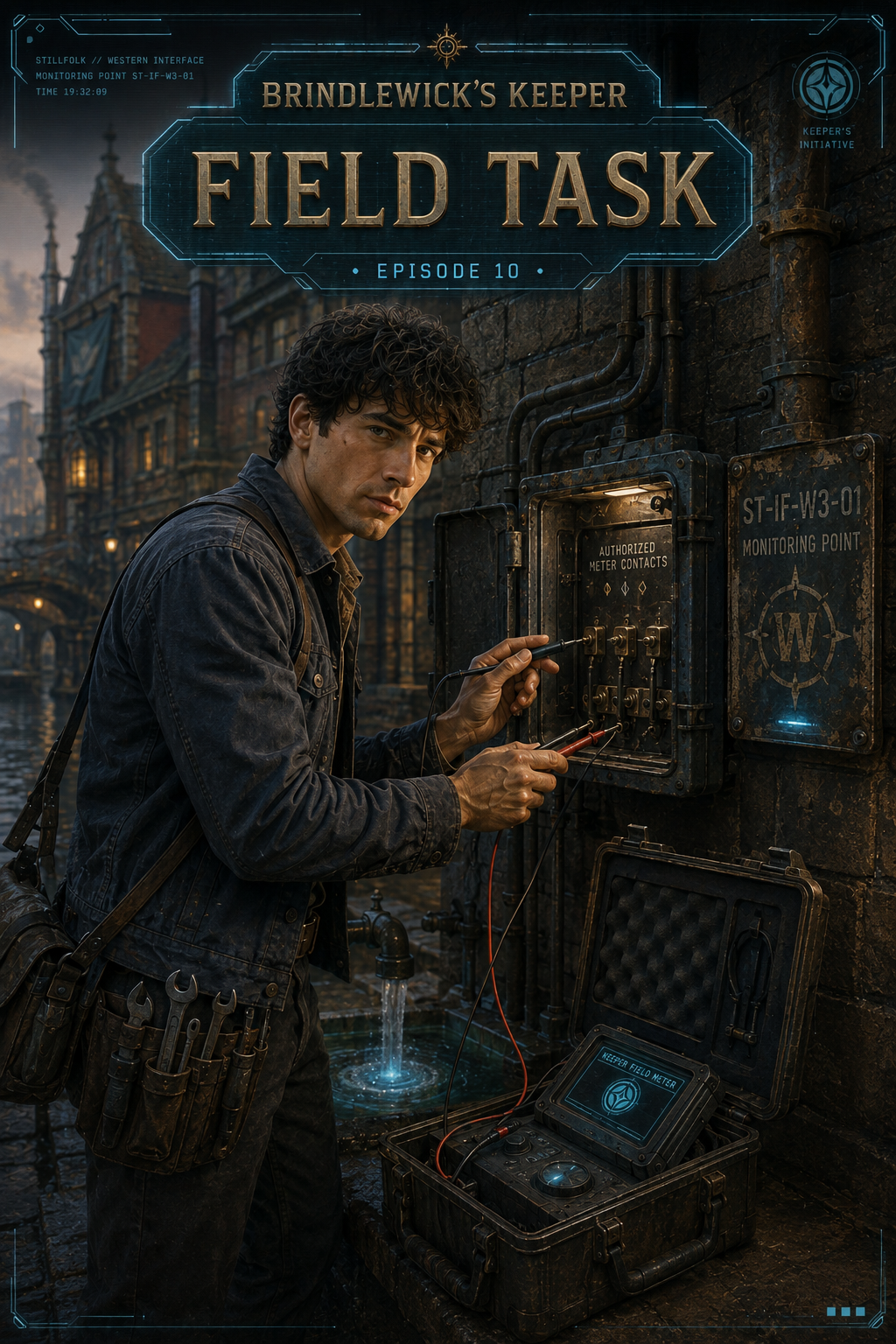
By the time Calder reached the assignment station, the crew lead had already turned the field case toward him.
The case was narrow and hard-sided, with a meter fitted into one half and several smaller compartments arranged around it. A work order stood open on the station display.
The crew lead tapped the heading.
“Utility fluctuation review. Stillfolk district interface.”
Calder’s attention caught on the district name before he could stop it.
Stillfolk.
He knew the word as a place before he knew it as a work reference. Streets, shared fixtures, service walls, doors with familiar wear at the handles. People who had known him before registration became a status line on a slate.
The crew lead continued.
“This is field work. You’re on supervised trial status, but the readings are real and the report goes into the service record.”
Calder looked back at the work order.
The assignment did not ask what he felt about the district.
It asked for verification.
The crew lead expanded the task pane.
“Three listed monitoring points. Verify field condition at each one, gather the assigned readings, inspect only inside marked authorization, and report what you find before anyone decides on repair.”
Calder read the sequence once.
The first monitoring point sat at the district interface nearest the western service route. The second and third followed the same utility line farther inward.
A fluctuation flag appeared beside all three.
He looked at the authorization field.
“Adjustment authority?”
“None on this assignment.”
Calder kept his eyes on the work order.
“If the cause is obvious?”
“You still report it. Supervising crew decides on repair unless there’s an immediate safety action already covered by procedure.”
Calder moved to the reporting section.
The crew lead pointed to the same field.
“Readings go here. Field observations go here. Anything outside the listed access points gets reported, not opened.”
Calder nodded.
The route code sat below the district name.
ST-IF-W3.
He read the first location reference beneath it.
The identifier was technical, but the district marker was not.
Stillfolk west interface.
He could picture the service wall before seeing the map.
The crew lead opened a small route pane anyway.
A line traced from the canal yard toward the district boundary.
Calder followed it with his eyes.
The route approached Stillfolk from the utility side rather than through the residential streets he would have used before.
That changed the angle, not the destination.
The crew lead closed the route pane.
“Questions before activation?”
Calder checked the work order again, confirming the three monitoring points, the required field-condition checks and readings, the authorization limits, and the instruction to report before any repair decision.
He did not need to reopen the registration terms.
He did not need to reconsider starter housing because the assignment happened to point toward Stillfolk.
He did not need to decide what he would say if he saw someone he knew.
None of those questions would change the first required action.
“Reporting channel is this one?” Calder asked, touching the marked field.
“Yes. It routes to your supervising lead.”
Calder moved his finger to the acceptance line.
“Then I understand the assignment.”
The crew lead unlocked the field case.
“Meter first.”
Calder opened the case fully.
The meter sat in a fitted cradle with two leads clipped beside it. A smaller compartment held an access key. Another contained a folding probe, seal tabs, and a plain inspection light.
The crew lead indicated each item without turning the handoff into a lesson.
“Meter. Access key. Inspection light. Probe only where the work order marks probe access. No covers beyond authorization.”
Calder checked the item list against the case.
Everything matched.
He lifted the meter once, felt its weight, and returned it to the cradle.
The screen was dark.
He did not power it on yet.
The first reading belonged at the first monitoring point, not at the assignment station.
The crew lead slid the access key into its clip and closed the smaller compartment.
“Carry the case sealed until you reach the first site. If the authorization marker doesn’t match the work order, stop and report.”
Calder nodded.
He checked the first monitoring point again.
ST-IF-W3-01.
The district reference was now attached to a task he had accepted.
That made the return toward Stillfolk different from walking back for manuals or deciding whether to visit.
He was going because a utility line had produced evidence of a problem and someone had assigned him to verify it.
The crew lead turned the station display toward him.
“Accept when ready.”
Calder read the scope one final time.
Nothing had changed.
He pressed the acceptance field.
The work order shifted from AVAILABLE to ASSIGNED.
Then the status beneath it changed again.
FIELD TASK: ACTIVE.
The crew lead closed the station copy and handed Calder the case.
The handle settled firmly into his palm.
“First point is the western interface marker. Get the readings. Stay inside scope. Send evidence before you make any conclusion about repair.”
Calder looked toward the yard gate.
Beyond it, the route turned toward Stillfolk.
He picked up the task slate with his free hand.
The district name remained at the top of the active order.
Stillfolk.
This time it was attached to work that belonged to him.
Calder stayed at the assignment station long enough to verify what he was carrying.
He set the field case on the counter and opened it against the active work order.
The meter was still seated in its cradle. Two leads were clipped beside it. The access key sat in its marked slot. The inspection light, approved probe, seal tabs, and first-point reference tag were all present.
Calder checked the meter casing for damage.
None.
He pressed the battery check without starting a reading sequence.
The indicator rose into the service range and held.
He released it.
The leads were intact at both ends. The probe folded and locked cleanly. The inspection light came on and went dark again when he tested the switch.
He returned everything to its assigned place.
The first monitoring point reference on the tag matched the work order.
ST-IF-W3-01.
He looked toward the crew lead.
"Readings and field observations both go through the supervising channel?"
"Yes."
Calder touched the access section on the task slate.
"If a cover isn't listed here, it stays closed."
"Correct."
He moved to the marker-verification line.
"And if the site marker doesn't match the work order, I stop and report before opening anything."
The crew lead nodded.
That settled the field boundaries.
Calder closed the equipment pane and saw another link beneath the work order.
FULL FLUCTUATION ARCHIVE.
A smaller line below it offered historical fault records, prior variance reports, and maintenance notes for the district interface.
His thumb hovered over the link.
The information was available.
It was also not the next required source of evidence.
The assignment had already told him what to do first: go to the listed points and determine what the system was doing now.
He left the archive closed.
If the readings showed a pattern that required a broader review, the supervising crew could ask for it then.
Calder locked the task slate.
The crew lead checked the field case one more time, then closed the lid.
A narrow seal strip clicked into place across the latch.
"Travel sealed. Open at the first monitoring point."
Calder took the case by the handle.
The weight was familiar now.
The task slate remained active in his other hand.
FIELD TASK: ACTIVE.
The crew lead stepped aside from the assignment station.
"You're released to route. First point, then report what you actually find."
Calder nodded.
He crossed the yard toward the gate.
Behind him, the assignment station moved on to another task. A worker carried an empty case toward the supply bench. Someone farther down the lane called for a replacement barrier panel.
The yard no longer had anything else for Calder to decide.
At the gate, he checked the route once.
The marked path turned west from the canal district, followed the service road past a line of low retaining walls, and approached Stillfolk from the utility side.
He started walking.
The field case swung slightly with each step.
For the first block, the canal yard remained visible behind him through gaps between service buildings. The route bent after the next retaining wall, and the yard dropped out of sight while the Stillfolk district marker remained fixed at the top of his active order.
Calder kept the fault archive closed and followed the marked service road toward ST-IF-W3-01, carrying the sealed field case in one hand and the live task slate in the other.
The service road narrowed as Calder approached the Stillfolk western interface.
The district announced itself before the residential streets came into view.
A shared utility wall ran along the road on his right, patched in three different shades of stone. Older access hatches sat lower to the ground than the ones near the canal yard. Some carried fresh service stamps. Others had been painted over and remarked so many times that only the newest identifiers were easy to read.
Calder knew the construction without needing the route slate to tell him where he was.
He had walked beside walls like these for years without thinking about what sat behind them.
Now the active work order kept the utility line visible in a different way.
ST-IF-W3-01 remained at the top of the task pane.
He stayed on the marked service route.
The field case remained sealed in his right hand.
A district marker appeared at the next junction, followed by a shared water fixture set into a recessed wall alcove.
Someone was using it.
A Stillfolk resident stood with one hand on the control lever and a metal container under the spout.
The water came out in a steady stream for a second, dropped to a thin run, then surged again hard enough to strike the bottom of the container and splash over one side.
The resident released the lever.
The flow stopped.
She looked at the field case in Calder's hand, then at the task slate.
"You here for that?"
Calder looked at the fixture.
The work order did not list it as a monitoring point.
It was close enough to the first point to matter as an observation.
"I'm here to take readings at the western interface and report what I find."
The resident glanced back at the fixture.
"So you're fixing it?"
"I don't have repair authority on this assignment."
Her mouth tightened.
Calder did not add a promise to make the answer feel better.
He looked at the fixture again.
"How long has it been pulsing like that?"
"Since this morning. Maybe earlier. I noticed it after first meal."
Calder opened the field-observation section of the task slate.
"Continuous?"
"No. It settles sometimes. Then it starts again."
He entered the report exactly as that.
RESIDENT OBSERVATION: shared fixture near western interface. Uneven flow reported since morning, possibly earlier. Intermittent pulsing. Source: resident statement.
He did not place the report in the instrument-reading field.
The distinction mattered.
He had seen one pulse himself.
The resident had supplied duration and intermittence.
Neither fact told him the cause.
Calder looked at the resident.
"Has anyone opened the service cover here or adjusted anything?"
She shook her head.
"Not that I saw."
Calder added that as a second resident observation with the same source label.
He did not infer that no one had touched the system.
The answer only established what she had seen.
The resident rested the container against her hip.
"Should we stop using it?"
Calder checked the assignment scope.
There was no safety closure instruction attached to the fixture.
No warning marker showed on the route pane.
"I haven't been given a stop-use order. If the fixture becomes unsafe or the flow changes in a way that creates an immediate hazard, use the district reporting channel. I'm sending the evidence I collect through the service crew."
The resident looked at him for another second.
Then she nodded once.
Calder did not stay to turn the exchange into a larger explanation.
He checked the first monitoring-point marker.
The route reference placed ST-IF-W3-01 just beyond the fixture, around the next section of wall.
He closed the observation pane.
The field case was still sealed.
He lifted it again and continued along the service road.
Behind him, the resident tested the fixture once more.
The water struck the container in two uneven surges.
Calder heard it, but he did not stop.
He had already recorded what he could support from that encounter.
The first instrument reading was still ahead.
At the next bend, the monitoring marker came into view.
ST-IF-W3-01.
Calder kept walking toward it with the sealed field case and the resident report saved separately from the measurement fields.
The monitoring marker stood waist-high against the service wall.
Calder stopped before it.
ST-IF-W3-01 was stamped into the metal faceplate.
He looked at the task slate.
ST-IF-W3-01.
The district code matched.
He checked the authorization band beneath the marker.
FIELD TRIAL ACCESS: METER POINT ONLY.
The same restriction appeared on the active work order.
Only then did Calder set the field case down.
A painted rectangle marked the approved work area in front of the panel. He placed the case entirely inside it and broke the travel seal.
The lid opened.
He removed the meter first, then the two leads, the access key, and the inspection light.
The probe stayed in its compartment.
The seal tabs stayed where they were.
Calder set the meter on the flat edge of the case and opened the task slate to the first monitoring point.
The measurement field was still empty.
Below it, the resident report remained saved under field observations.
Uneven flow reported since morning, possibly earlier. Intermittent pulsing. Source: resident statement.
Calder left it there.
He turned to the access panel.
The outer cover sat flush against the wall. The seal line was intact. No water leaked from the edges. No warning indicator showed on the marker.
He ran the inspection light across the visible fittings.
No scorch marks.
No cracked housing.
No movement in the panel face.
Nothing required an emergency action before the assigned reading.
Calder checked the authorization band again.
Meter point only.
He inserted the access key into the approved lock.
The key turned once and stopped.
A narrow section of the panel released with a soft click.
Calder opened it only as far as the hinge allowed.
Inside, two marked contacts sat behind a shallow protective lip.
The identifier beside them matched the work order.
W3-01 INPUT.
He did not touch anything yet.
Calder set the inspection light where it illuminated the contacts without blocking the work area.
Then he powered on the meter.
The screen came alive and ran its startup check, showing the battery in service range, the lead ports ready, and no reading yet acquired.
He connected the leads to the meter body.
The measurement field on the task slate remained blank.
Calder compared the panel label, W3-01 INPUT, with the slate entry ST-IF-W3-01 and confirmed that the district code, point number, and authorization all agreed.
Behind him, somewhere around the bend, the shared fixture pulsed again.
He could hear the change in pressure as water struck metal, softened, then surged.
Calder did not turn around.
The resident report was already recorded.
The system in front of him was where the next piece of evidence belonged.
He took the positive lead in his right hand and the return lead in his left.
The contacts waited inside the open panel.
Calder brought both leads forward until their tips hovered just short of the marked points.
The meter screen waited for its first field value.