

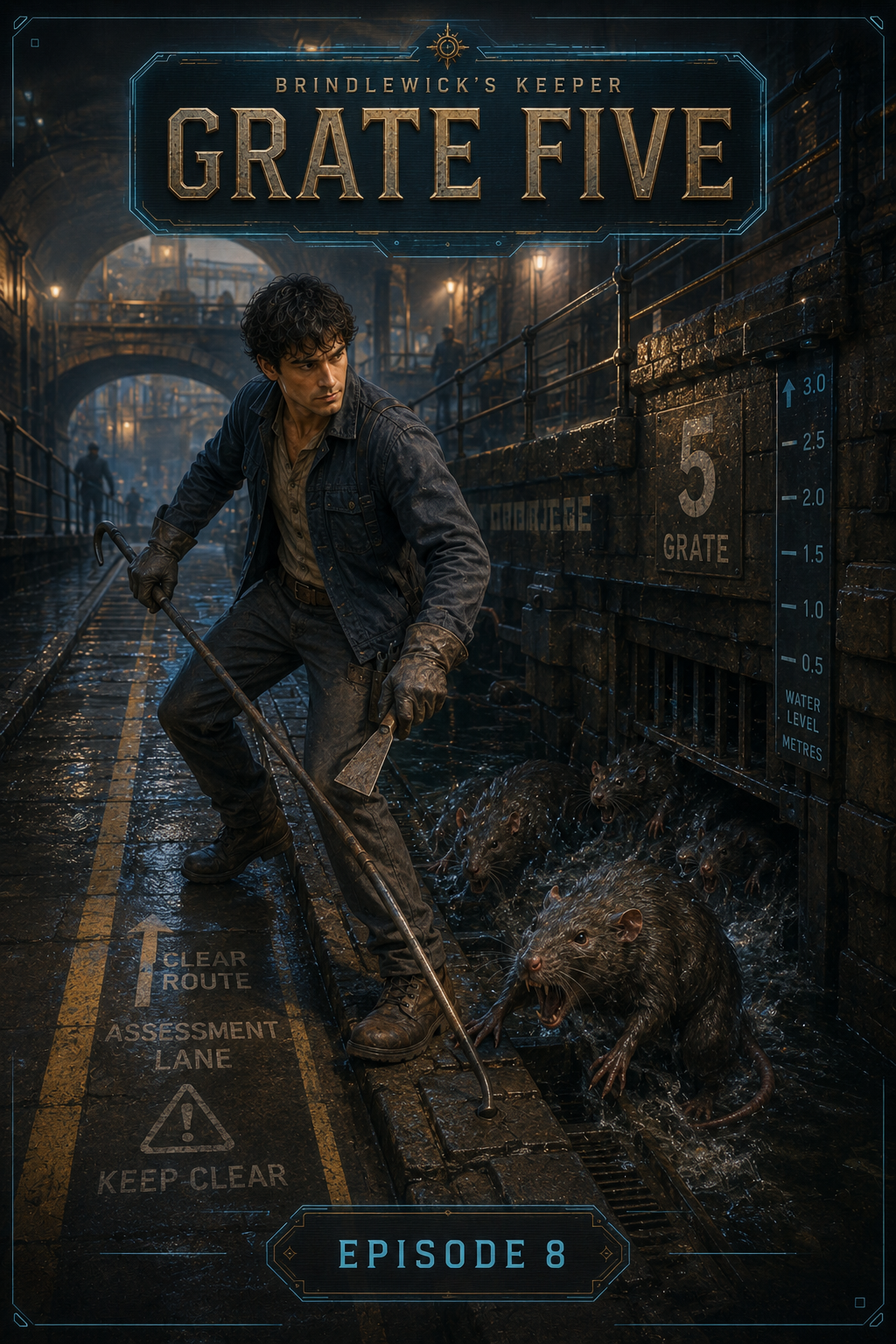
The assessor looked down at his slate, then lifted his head toward the staging roof.
“Assessment group. With me.”
Calder stood with the others.
Nobody spoke as they crossed the yard behind him.
The assessor led them past the first shed and through a gate marked ACTIVE WORK LANE. Beyond it, the ground narrowed between a shallow service channel and a raised pedestrian path. Metal grates sat at intervals along the channel edge, each with a painted number beside it.
A worker at a supply bench handed out gloves and simple tools as the candidates passed.
When Calder reached the front, the worker gave him a pair of heavy gloves, a short scraper, and a hooked implement with a narrow shaft and blunt curve at the end.
Calder weighed the hook once in his hand.
No mechanism. No hidden control. No reason to ask what it did before someone told him.
He put on the gloves.
The assessor stopped near the first marked grate and turned to the group.
“Each of you gets one lane position at a time. Clear loose surface debris. Keep the walking route open. Lift only material that moves cleanly. If something is wedged below the grate, stop. If water starts backing up, stop. Call me. Do not reach below the grate.”
He pointed to the painted boundaries along the path.
“Tools stay inside your marked area unless I move you. Pedestrian route stays clear.”
The instructions ended there.
Calder looked down the lane.
The work was ordinary enough that he could see all the ways to complicate it.
Loose debris could be scraped toward one side too quickly and block the path. A hook could be left where someone might step on it. Something caught below could look almost free and invite one harder pull.
He looked back at the assessor.
“If material lifts partway and then catches below, that counts as wedged?”
“Yes.”
The assessor did not add an example.
Calder nodded.
That was the boundary he needed.
The assessor assigned positions by grate number.
“Venn. Three.”
Calder moved to grate three.
The marked work area was narrow, with the channel on his right and the pedestrian route on his left. The grate itself was wider than his shoulders and set flush into dark stone. Water moved beneath it with a low, steady sound.
A thin layer of leaves, grit, and stringy plant matter had collected along the upstream edge.
Calder set the scraper and hook inside the painted boundary.
He checked the walking route once.
Clear.
Then he crouched and started with the loose material nearest the edge.
The scraper was stiffer than he expected. It caught under a mat of wet leaves and lifted them as one heavy clump.
Calder moved the clump into the collection tray beside the grate.
He did not sweep across the whole surface at once.
The instruction had been to clear loose debris. He worked section by section, moving only what released without resistance.
A pair of workers came down the pedestrian path carrying a long case between them.
Calder stopped before they reached him and pulled his elbows inside the boundary.
They passed without breaking stride.
When the route was clear again, he resumed.
The assessor moved behind the candidates without announcing where he was.
Calder could hear brief corrections from farther down the lane about staying inside the line, using the collection tray, and stopping at resistance.
Calder kept his attention on grate three.
A narrow twig had lodged across two bars. He lifted it with the hook. It came free immediately.
Into the tray.
A wad of paper clung to the upstream edge. The scraper took it cleanly.
Into the tray.
The water below continued moving at the same level.
Calder shifted to the far side of the grate.
Something dark lay beneath the remaining leaves.
He cleared around it with the scraper until a strip of fabric appeared, sodden and twisted through the bars.
Most of it rested on top of the grate.
One end disappeared below.
Calder set the scraper down and took up the hook.
He slid the curve beneath the fabric and lifted slowly.
The strip rose several inches.
Then it stopped.
Calder held the hook steady.
The resistance was firm, but the fabric had already moved enough to make the rest look close.
A harder pull might free it.
He changed the angle slightly.
The fabric shifted another fraction and caught again.
Below the grate, something gave a faint metallic tap.
Calder stopped moving the hook.
He could feel how easy it would be to turn the pause into another test.
A little more pressure.
A different angle.
One attempt to see whether the resistance changed.
The instruction had not been to determine how wedged something was.
Resistance below the grate counted as wedged.
Calder lowered the fabric until the strain came off the hook.
He left the tool in place so the material would not slip farther down.
Then he raised his free hand.
“Grate three. Caught below.”
The assessor looked over from the next position.
Calder checked the channel level and the walking route, then reported that the water was not backing up and the route was clear.
The assessor started toward him.
Calder stayed where he was.
The strip of fabric remained half exposed beneath the hook.
It still looked solvable.
That no longer mattered.
He had reached the condition he had been told to stop at, and for the first time in the assessment, the choice that mattered was whether he would accept that boundary when the unfinished work was still directly under his hand.
The assessor came to grate three and crouched beside Calder without taking the hook from his hand.
“Show me where it catches.”
Calder lifted the fabric only until the resistance returned.
“There.”
The assessor leaned closer to the grate, looking through the bars instead of pulling on the material.
“Drain hinge.”
He pointed with two fingers toward a dark metal joint below the grate.
“The strip is looped around it. You stopped in the right place.”
Calder kept the hook still.
The assessor reached to the side of the grate and opened a narrow service catch Calder had not noticed. The hinge shifted enough for the trapped fabric to slacken.
“Lift now.”
Calder raised the hook.
The fabric came free without resistance.
The assessor closed the service catch again.
“If you had levered harder from above, you could have loaded the hinge against its stop and jammed the drain hardware.”
Calder looked at the hinge through the grate.
The movement had been small enough that he would not have guessed where the strain was going.
He nodded once.
The rule had not been arbitrary.
More importantly, he did not need to build a theory around every kind of hidden mechanism that might exist beneath a grate.
Resistance below still meant stop, and that was enough for the assessor to stand and return the task to him.
“Finish the grate.”
Calder pulled the sodden strip the rest of the way up and dropped it into the collection tray.
He returned to the scraper.
The remaining debris was loose. He cleared the upstream edge, checked the corners, and removed a clump of plant matter that had settled against one bar.
Water continued moving beneath the grate without rising.
A worker approached along the pedestrian path carrying a case under one arm.
Calder shifted both tools farther inside the painted boundary before the worker reached him.
The worker passed.
Calder checked the path behind him.
Clear.
He looked at the grate again.
No loose debris remained on the surface.
The water line held steady.
“Grate three complete,” he said.
The assessor glanced at the grate, then at the path.
“Good. Four.”
Calder picked up the hook, scraper, and collection tray.
He did not feel relieved enough to mistake the stopped fabric for a problem he had barely escaped.
It had been part of the work.
He had found the boundary, stopped, and been shown why the boundary existed.
That was information he could use.
Grate four sat farther down the same lane where the channel bent slightly toward a service bridge.
Calder stepped into the new marked area and placed the tools inside the paint line.
The grate carried more leaf debris than grate three but less stringy material.
He checked the pedestrian route.
Clear.
Then he checked the water level below.
Moving normally.
The assessor had not followed him all the way to the grate.
Calder noticed that only after he had already picked up the scraper.
He started with the loose surface debris.
A wet clump released cleanly and went into the tray.
The next patch came free in two pieces.
Calder shifted his position so the hook remained behind his heel rather than near the walking route.
He did not look back to see whether the assessor had noticed.
The instruction had already been given.
The work in front of him was enough.
Calder kept working at grate four.
The assessor had moved farther down the lane, speaking to another candidate. He did not repeat the procedure.
Calder did not need him to.
The scraper stayed inside the painted boundary. The hook rested beside the tray with its curved end turned away from the walking route. Calder cleared the loose material in the same order he had used at grate three, taking the surface first and leaving anything that resisted.
A heavy clump of leaves came free from the upstream edge.
Calder lifted it into the tray, then looked through the grate.
The water below moved at the same level.
He went back to the surface.
The next patch was thinner. It scraped free in a wet sheet and folded over itself against the tray wall.
Calder checked the channel again.
Still moving.
No one told him to check.
That mattered.
At grate three, every uncertain point had felt like a place where he might be about to cross a line he could not see. Here, the line was still there, but he had already learned how to find it.
He worked until the upstream edge was mostly clear.
A rumble came from behind him.
Calder turned his head.
A service cart was approaching along the pedestrian route, pushed by a worker with both hands on the rear rail. The cart was wider than the cases workers had carried past grate three and took up most of the marked walking lane.
Calder was halfway through lifting another clump.
He lowered it back onto the grate.
Then he moved the scraper, hook, and collection tray farther inside his painted work area.
The cart reached his position.
The worker did not slow.
Calder stepped back from the edge of the route and held still until the cart passed.
One of its wheels struck a shallow seam in the stone and gave a hard knock.
Nothing in Calder's work area shifted.
When the cart had cleared him, he looked down the route in both directions.
Open again.
He resumed.
The clump he had lowered came free cleanly on the second lift.
Into the tray.
Calder worked along the final section of the grate.
A few narrow strands of plant matter had caught between the bars, but they lifted without resistance. He removed them with the hook and checked the water below after the last one.
The level had not risen.
The flow no longer pushed debris back toward the upstream edge.
Calder set the hook down.
He looked at the pedestrian route.
Clear.
Then he looked over the grate surface.
Clear enough for the task as given.
He raised his hand.
"Grate four complete."
The assessor came over from the next lane position.
He glanced at the tray, the grate, the water beneath it, and the space Calder had left along the walking route.
He did not crouch.
He did not point anything out.
"Five. Same rules."
Calder nodded.
He picked up the scraper and hook, then lifted the collection tray with both hands.
The contents had grown heavier than he expected. Wet leaves and grit shifted toward one corner as he carried it down the lane.
Grate five sat just beyond the bend near a low service wall.
Calder stepped inside the new painted boundary and set the tray where it would not narrow the pedestrian route.
The hook went beside it.
The scraper stayed within reach.
He checked the water first.
The channel moved under the grate in a steady dark sheet.
Then he checked the surface.
Leaf debris had collected along one edge. There was less of it than at grate four.
Calder crouched.
He started with the scraper.
The first pass lifted a thin layer of leaves and grit.
He moved it into the tray.
The next pass exposed the metal bars beneath.
A faint sound came from below.
Calder paused as a brief clatter sounded beneath the grate, then stopped.
He looked through the grate.
Water moved between the bars.
No material was visibly caught below.
No water was backing up.
The walking route remained clear.
Calder waited another second.
The sound did not repeat.
He returned to the scraper.
Another strip of debris came free.
He cleared it into the tray and shifted a little farther along the upstream edge.
The clatter came again.
This time it was lower and farther beneath the grate, irregular enough that Calder could not tell whether it belonged to loose hardware, something moving in the channel, or activity somewhere beyond the service wall.
He stopped with the scraper held above the grate.
Nothing in the procedure told him to investigate an unidentified sound by itself.
The water was still moving.
Nothing was wedged under his tool.
The route was open.
Calder lowered the scraper to the next patch of loose debris.
The routine still held.
For the moment.
Calder lowered the scraper to the next patch of loose debris.
The routine held for one more pass.
Then something struck the underside of grate five hard enough to make the metal jump beneath his hand.
Calder came upright.
The sound was followed by a dragging scrape from the lower opening beyond the service wall.
This time the movement was visible.
A dark shape shoved through the gap beneath the wall, flattened for a second against the wet stone, then surged forward.
Rat.
Too large.
Its shoulders were broad enough that Calder first thought the opening had forced its body out of proportion. Then a second animal pushed through behind it.
A third followed.
The first rat hit the edge of the work lane and veered toward the pedestrian route.
Calder's attention snapped back to the lower opening.
More movement.
If he could see where they were coming through, he could see what was driving them out.
He took one step toward the service wall.
"Venn. Route first."
The assessor's voice cut across the lane.
Calder stopped.
The first rat had already reached the edge of the walking route.
"Keep them off the path. Use what you have. Do not follow anything into the lower channel."
The order was specific enough to settle the question of what he should do next.
Calder shifted the scraper into both hands and moved sideways, putting himself between the rat and the open route.
He did not swing.
He lowered the broad edge toward the stone and used it to close the easiest line past him.
The rat checked, claws skittering on the wet surface, then turned toward the channel edge.
A second animal burst from the opening and ran the other direction.
Calder snatched the hook from beside the tray and extended it low, using the shaft to widen the barrier without stepping outside his marked area.
Behind him, a worker shouted for the service cart to stop.
Wheels knocked once against stone and went still.
The assessor was moving now, directing two workers farther down the lane.
"Hold that junction. Keep the bridge clear."
The yard changed shape around the animals.
People who had been moving equipment stopped where they were. One worker pulled a case off the walking route. Another swung a low gate across a service opening.
Calder kept his eyes on the two rats nearest him.
The first had turned back toward the grate.
The second was testing the edge of the painted boundary, nose low, body tense.
A third shape scraped through the opening.
Then a fourth.
Calder wanted to look past them.
The lower gap was still active.
Something had changed down there.
A blockage. A nest. A broken barrier. A pressure change.
The source was close enough to imagine and entirely outside the instruction he had been given.
One of the rats lunged toward the walking route again.
Calder dropped the hook shaft across the line in front of it.
The animal recoiled and snapped at the metal.
He held steady.
The hook was a boundary in his hands, and he used it to deny the route without striking the animal.
The rat turned away.
"Good. Keep them moving off the path," the assessor called.
Calder shifted with it.
He used the scraper to close one opening and the hook to discourage another, leaving the animals a route back toward the channel edge without trapping them between himself and the wall.
The movement demanded more attention than the grate work had.
Every time one animal turned, another changed direction.
The wet stone reduced their traction but also made Calder's own footing less certain.
He shortened his steps.
The service cart remained stopped behind him.
No one tried to push past.
The walking route was still clear of animals.
That was the problem he had been assigned.
Another scrape sounded from the lower opening.
Calder's eyes flicked toward it.
The assessor saw him look.
"Source belongs to the channel crew. You have the route."
Calder looked back at the rats.
A division of work as clean as the painted line around the grate had just been made explicit.
The source could matter more and still belong to someone else.
He adjusted the scraper as one rat tried to cut behind the collection tray.
The tray itself had become part of the obstacle pattern. Calder kicked it deeper inside his marked area so the animal could not use it as cover near the route.
The rat changed direction.
A worker farther down lowered a temporary panel across the lane entrance.
Another worker moved toward the service wall with equipment Calder did not recognize.
Calder did not follow them with his eyes.
The rat in front of him charged the gap between scraper and hook.
He closed it.
The animal spun away.
For several seconds, everything compressed into feet, tools, stone, and movement.
Calder stayed inside the line.
He kept the route clear.
He used what was already in his hands.
He did not chase the animals toward the lower opening.
Then one of the rats climbed onto the edge of grate five.
Its weight rattled the metal.
Another animal crowded behind it.
Calder shifted the scraper sideways, blocking the route while leaving the channel edge open.
The first rat dropped away from the grate.
The second followed.
They moved along the service wall instead of toward the pedestrians.
Calder let them.
His task was to keep them from becoming a hazard where people were moving.
Behind the wall, metal struck metal.
A worker called for a barrier clamp.
The assessor answered without leaving the lane.
Calder heard only enough to know that the source response had started.
It did not belong to him.
The next rat darted toward the open route.
Calder stepped across its line and lowered the hook.
It stopped short.
For one suspended second, he and the animal faced each other over the painted boundary.
Then it turned back toward the channel edge.
Calder moved with it, keeping the route open behind him.
The grate-five assessment had become a live problem with incomplete information, moving hazards, and a boundary that mattered more because the larger answer was visible just beyond it.
Calder kept the scraper low.
Another rat came through the opening.
This one did not run immediately. It crouched near the wall, wet fur slicked close to its body, while two others crossed in front of it.
Calder shifted the hook to block the nearest route gap.
The assessor called for a second barrier panel.
Workers moved into position farther down the lane.
No one told Calder the source had been found.
No one told him the spill was finished.
The route in front of him remained his responsibility.
The crouched rat suddenly broke left.
Calder moved with it.
The hook struck stone once as he lowered it across the animal's path.
The rat turned back toward the service wall.
Calder reset his footing.
More scraping sounded below grate five.
He did not look down.
He watched the open path and waited for the next animal to choose a direction.