

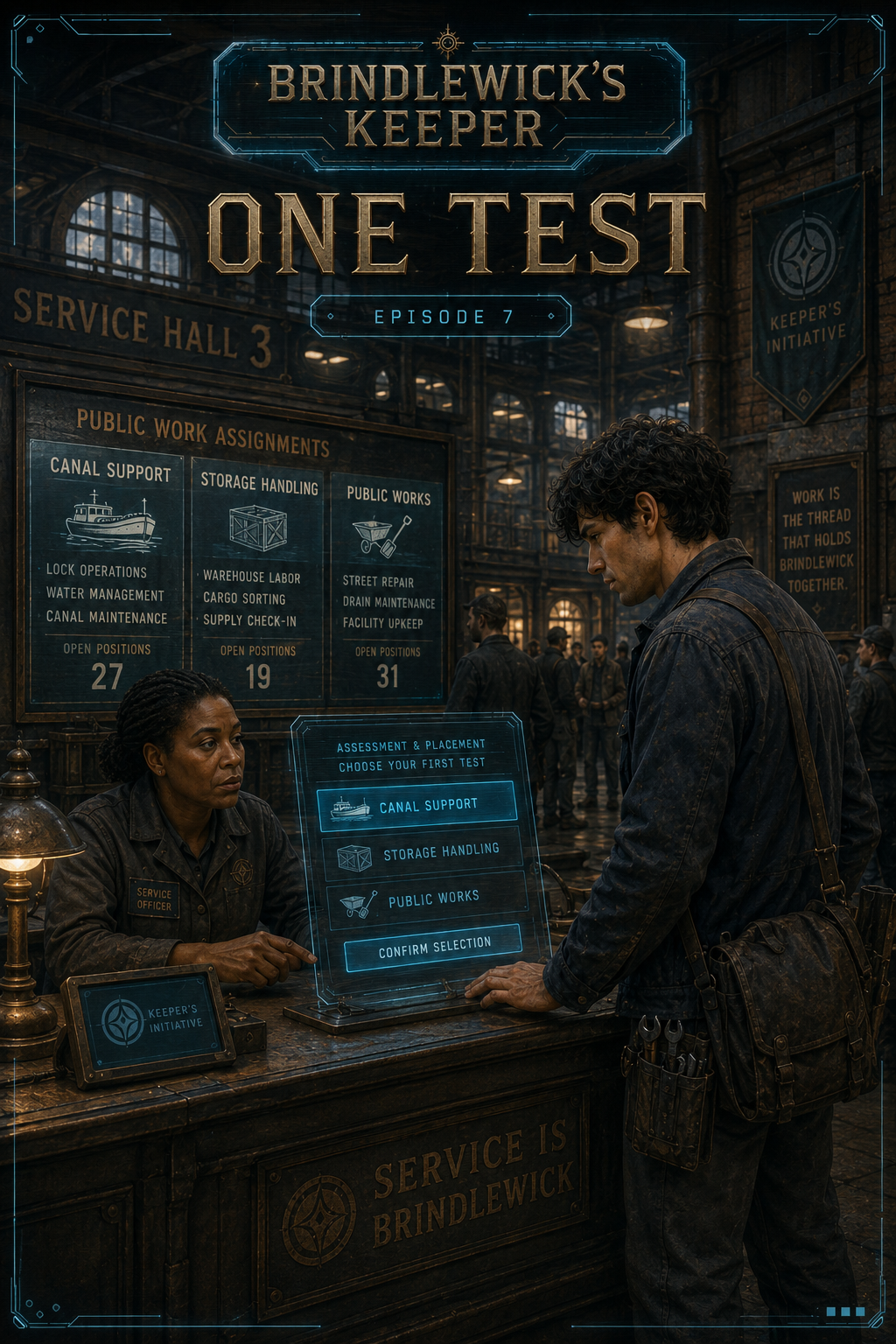
Service Hall 3 was busier than Calder expected.
The route marker had brought him to a broad public room lined with boards, counters, and suspended displays. People crossed between them carrying work tags, folded forms, tool cases, and sealed packets. Several stood in small queues. Others leaned close to listings and moved their fingers down long columns of openings.
Calder stopped just inside the entrance.
The scale of the board struck first.
Maintenance. Transit. Canal. Records. Storage. Utility response. Public intake. Sanitation. Building services. Survey work. Temporary civic labor. Apprenticeship routes. Credentialed technical placement.
There were more categories beneath those.
He felt the familiar pressure to understand the whole field before choosing where to stand.
Calder looked down at the work-access page he had brought from BR-7C-214. It confirmed Service Hall 3, work access, and that the hall was open today.
That was still the condition in front of him.
He crossed to the nearest staffed counter.
The clerk there glanced at his registration reference and opened a work-access pane.
"Placement, training, or assessment?"
"Assessment, if that means I can be tested on something I can actually do now."
The clerk looked back at him.
"That narrows it."
She touched the pane and several categories disappeared.
Calder watched them go.
He asked what had been removed. The clerk showed him that anything requiring a license, advanced civic standing, prior Brindlewick service, or a completed training record had been filtered out.
The remaining list was still longer than Calder wanted.
She turned the pane so he could read it.
Entry assessment routes included storage handling, canal support, basic utility observation, supervised records processing, public works labor, and several maintenance intake tracks.
Calder began reading the descriptions.
Most of them started with titles such as Junior Support Candidate, Provisional Service Intake, or Supervised Operations Entry.
The words told him almost nothing.
"What does this one actually do?" he asked, pointing to storage handling.
The clerk opened the duty summary and explained that it involved moving marked loads, following route instructions, verifying labels, reporting damage, and keeping staging areas clear. Utility observation involved reading service indicators, recording conditions, identifying obvious mismatches, and reporting before intervention.
That one held his attention for half a second longer than the others.
Then Calder moved on.
For records processing, the clerk described supervised intake, document matching, exception marking, and routing.
She leaned against the counter.
"You can open the full descriptions if you want."
Calder looked at the board.
He did want.
That was the problem.
Every route had schedule notes, advancement paths, qualification ladders, placement probabilities, training requirements, and district demand reports attached to it. He could spend the rest of the day comparing them and still have reasons to postpone a choice.
He touched the edge of the pane but did not open any of the expanded sections.
"Which of these can I show up for, perform under supervision, and leave without committing to the whole field?"
The clerk straightened.
"Assessment routes, mostly. That's what they're for."
"Then keep those."
She filtered again.
The list shortened.
Calder read more carefully this time.
Storage handling required lifting and route work inside enclosed facilities.
Canal support required outdoor field movement, safety compliance, equipment placement, and response to crew direction.
Utility observation involved reading service conditions and recording them accurately but had fewer open assessment windows.
Public works labor was broad enough that the actual tasks varied by posting.
The maintenance intake route required a training prerequisite Calder did not have.
Calder pointed at that one.
"Remove it."
The clerk did.
Calder also asked her to remove records processing. When she questioned the choice, he explained that he wanted his first test to put him somewhere other than a desk matching forms, and that this was enough information for him to choose another route first.
She removed it.
Three options remained prominent: storage handling, canal support, and public works labor.
Calder stared at the three.
His mind immediately began constructing comparisons.
Storage work might have more predictable hours.
Canal work might lead into maintenance or utilities later.
Public works might expose him to more departments.
He could ask which one had better retention.
He could ask which crews were easier to transfer out of.
He could ask whether one route would make later housing applications simpler.
Calder stopped.
None of those questions changed what he needed today.
He needed a next step that produced evidence.
He asked what happened if he took an assessment and either decided the work was wrong for him or failed it. The clerk explained that he could decline placement after a successful assessment, and that a failed assessment might allow a later retry or a different route depending on the posting. She also confirmed that neither registration nor housing depended on the outcome.
Calder nodded once.
That was enough for now.
He looked back at the three remaining routes.
A line beside canal support showed an open assessment window for tomorrow's second reporting period. Storage handling had an opening later in the week. Public works listed no fixed task until assignment.
Calder opened the canal duty summary.
It required moving through active field areas, following safety rules, handling equipment where directed, observing conditions, and carrying out crew instructions. He could picture concrete ways to get those wrong: miss a boundary marker, place something in the wrong position, overlook a condition, or fail to follow a supervisor's direction.
A real assessment could expose those mistakes immediately.
Calder read the line again.
"Canal support," he said.
The clerk opened the assessment page.
"You want to reserve it?"
Calder looked at the button marked RESERVE WINDOW.
He had not come here intending to choose canal work.
He had come here intending to find something concrete enough to test.
The canal assessment was that.
He did not press the button yet.
"Show me the conditions first. Only the conditions for taking the assessment."
The clerk's mouth twitched as though she had expected that.
She opened a short panel.
Calder leaned closer.
For the first time since entering Service Hall 3, the work search no longer looked like a field he had to understand all at once.
It had become three practical tests, and one of them was ready to be examined closely enough to choose.
The assessment conditions filled less than half the pane.
Calder read them from the top.
No prior canal credential required.
No existing crew affiliation required.
Assessment participation did not create a placement obligation.
He read the third line twice, then looked at the clerk.
"This is a trial of the work, not an assumption that I already know it?"
"Correct."
She expanded the task summary.
The assessment covered movement through active field areas, compliance with safety instructions, basic equipment handling, observation, and response to crew direction. The wording was plain enough that Calder could picture the difference between doing each thing correctly and not doing it correctly.
He leaned closer.
"No hidden training prerequisite?"
"No. If there were, it would be listed here."
Calder checked the panel again.
Nothing appeared beneath the qualification line.
He let that answer stand.
The clerk moved to the next section before he could ask about advancement, transfer rules, or long-term canal certification.
ASSESSMENT OUTCOME.
A failed assessment was recorded against the assessment route only. It did not alter registration status. It did not alter starter-housing status. It did not bar applications to unrelated entry routes.
Calder stopped on the housing line.
He asked what a successful result actually required. The clerk explained that passing only made him eligible for placement consideration and did not obligate him to accept a job.
That was useful.
The possibility of failure had edges.
The possibility of success did too.
Neither one reached backward and undid the things he had already established.
Calder looked at the three remaining route tabs at the side of the display: storage handling, canal support, and public works labor.
He could still reopen any of them.
He could compare whether storage work was steadier. He could ask whether public works created better access to other departments. He could spend the afternoon building a map of every consequence that might follow a choice he had not made yet.
The canal assessment conditions were already sufficient for the decision in front of him.
Calder touched the route tab again.
"Show me the next window."
The clerk opened scheduling.
The first available slot was tomorrow, second reporting period.
CANAL DISTRICT ASSESSMENT YARD.
REPORTING MARGIN: FIFTEEN MINUTES EARLY.
Calder read the location reference.
The district was farther from BR-7C-214 than Service Hall 3 had been, but the route was public and direct enough to save to his active list.
He checked the arrival requirement.
"Fifteen minutes early means marked present fifteen minutes before start, or physically at the yard by then?"
"At the reporting desk by then. They mark you present after you check in."
Calder nodded.
The clerk expanded the preparation note.
Closed footwear. Work-suitable clothing. No personal tools required. Registration link required at check-in. Safety equipment issued on site.
That was all.
Calder waited for another section to open.
Nothing did.
"No preparation packet?"
"There's an optional overview."
The clerk reached toward the display.
Calder stopped her.
"Does it contain something I need to know before I arrive?"
She checked the note.
"No. General canal structure, crew roles, terminology, that sort of thing."
"Then leave it closed."
The clerk's hand withdrew.
Calder looked at the assessment page again.
The appointment was tomorrow in the second reporting period, with a fifteen-minute arrival margin.
He could remember that without turning the night into a study session for a job he had not been offered.
The thought of leaving the optional material unopened still pulled at him.
If he read it, he might recognize more terms tomorrow. If he recognized more terms, he might look more prepared. If he looked more prepared, perhaps the assessor would judge him differently.
Then another possibility followed it.
If the assessment was meant to show how he handled instruction, arriving with half-learned terminology could be worse than arriving ready to listen.
Calder let the optional tab remain untouched.
He turned back to the outcome section.
Failing would not cost him housing.
Passing would not bind him to the crew.
Nothing in the assessment altered his registration.
The rest belonged to tomorrow.
"Reserve it," Calder said.
The clerk slid the pane toward him.
"You have to confirm it yourself."
At the bottom of the page, the button still read RESERVE WINDOW.
Calder placed his finger over it.
For a second, he remembered the appointment room before registration, when nearly every decision had led to another question because nothing yet had been real enough to constrain the possibilities.
Here, the time, place, task category, and consequences were all specific enough to act on.
Calder pressed the button.
The pane changed to show the window reserved under Calder Venn at the Canal District Assessment Yard for tomorrow's second reporting period, with instructions to report fifteen minutes early.
A schedule marker appeared in his active record.
Calder stared at it longer than he needed to.
Until that moment, work had been something he was searching for.
Now there was a place that expected him.
The clerk closed the reservation pane on her side.
"If you need to cancel, use the schedule marker before the reporting cutoff."
Calder opened the cancellation rule, read the cutoff once, and closed it again.
He did not ask what happened if the canal district had an emergency tomorrow.
He did not ask whether bad weather changed the assessment.
He did not ask how many people usually failed.
Those conditions did not exist yet.
He saved the route reference.
The active schedule remained visible at the top of his record, marking tomorrow's second reporting period.
Calder looked back across Service Hall 3.
The boards were still full of jobs he knew almost nothing about.
The fact no longer felt like a problem he had to solve before leaving.
He had chosen one test.
Tomorrow, the test would answer something the board could not.
By the time Calder returned to BR-7C-214, the assessment marker had settled into his active schedule as if it had always belonged there.
He closed the door behind him and put the work-access page on the table.
The reservation opened first, showing tomorrow's second reporting period at the Canal District Assessment Yard with instructions to report fifteen minutes early.
Calder checked the route once against the saved location.
Matched.
He opened the preparation note.
Closed footwear. Work-suitable clothing. Registration link required. Safety equipment issued on site.
Nothing had changed since Service Hall 3.
He did not reopen the public placement board.
He did not compare the canal route to storage handling or public works.
The choice had already produced the next task.
Calder crossed to the storage cabinet and took out the clothes he had worn into Brindlewick.
Too formal for field work.
He set them aside and checked what the housing assignment had included for ordinary wear.
The trousers were plain and sturdy enough. The shirt would do. The shoes were closed and had more grip than the pair he had arrived in.
He put them together at the foot of the bed.
Then he opened his registration record and moved the access reference to the top of his active pane.
The action took seconds.
Calder stared at the rest of the packet anyway.
The optional canal overview was still available, covering crew structure, common terminology, the canal district map, and equipment categories.
He could read all of it before sleep.
He could probably read most of it twice.
Calder closed the tab.
The assessment had not asked him to arrive knowing those things.
It had asked him to arrive able to listen, follow direction, handle what he was given, and report what he observed.
Reading beyond that would make him feel prepared.
It would not necessarily make him more useful.
He saved the route to the assessment yard and set the departure marker far enough ahead to cover the public route plus the required arrival margin.
The room returned to quiet.
Calder looked toward the empty shelf.
The manuals were still with Neria.
He would message before going back for them.
That problem had not disappeared.
It also was not the problem he had to solve tonight.
He put the work-access page beneath the registration reference so both would be ready when he left.
The table was already beginning to look less like an object he had been assigned and more like something he used.
One side held the packet.
The center held tomorrow.
Calder sat down and checked the saved route again.
BR-7C-214 to Canal District Assessment Yard.
The path crossed two residential corridors, a public lift, and a canal-district transfer walkway before reaching reporting.
He noted the first transfer point and closed the route.
There was no reason to memorize every turn.
He had already learned what happened when he trusted a district name instead of checking the actual prefix.
Tomorrow, he would follow the live markers and verify when something failed to match.
He did not need to rehearse the city in advance.
Calder stood and went to the window.
Across the gap, a resident was fastening a cover over a narrow balcony rack. Two floors below, someone wheeled a cart into a service doorway and disappeared inside.
The city had moved through another part of its day while Calder chose a place within it.
Tomorrow, somewhere beyond the roofs, a clerk at a reporting desk would have his name on a list.
The thought made the room feel different again.
Its privacy still held, but the room no longer felt complete by itself.
Calder went back to the table.
He checked the reporting time one final time and calculated when he needed to leave.
The route estimate gave him enough margin.
He set a departure reminder.
That was all the morning required from him now.
He closed the assessment material.
For several seconds, the unopened optional overview remained visible as a small tab at the edge of the pane.
Calder dismissed it.
The table went blank except for the packet and the registration reference.
He left the clothes where he had set them.
He left the shoes beneath the bed.
He left the route closed.
The preparations were finished because the actual requirements had been met.
Calder turned off the table light.
The room did not become empty when the light went out.
His coat was in the cabinet.
His packet was on the table.
Tomorrow's clothes waited at the foot of the bed.
And in his active schedule, the canal assessment remained fixed in place.
For the first time since arriving in Brindlewick, the next day had a shape someone else would notice if he failed to meet it.
Calder lay down without opening the work board again.
The departure reminder woke Calder before it sounded a second time.
For a few seconds he lay still, looking at the ceiling of BR-7C-214 and listening to the building wake around him.
Someone crossed the corridor outside. Water moved through the wall. A door opened and shut farther down the passage.
Calder sat up.
The clothes he had set out the night before were still at the foot of the bed.
He dressed without reopening the assessment packet.
The registration reference was where he had left it. The work-access page was beneath it. His route marker remained active.
Nothing had changed overnight.
Calder put on his coat, checked the departure time once, and went to the door.
The corridor was brighter than it had been the night before.
He stepped out and pulled BR-7C-214 closed behind him.
The latch caught.
Calder tested the handle once.
Held.
His hand dropped away.
He did not open the housing record.
He did not check guest access.
He did not test the lock again.
The room could wait for him without being watched.
Calder started toward the lift.
The first section of the route was familiar enough now that he moved through it without checking every marker. He passed the laundry court, crossed the residential junction, and reached the public lift with several other residents already waiting.
The lift arrived full.
Two people stepped out carrying tool cases. Three others shifted inward to make room.
Calder entered with the rest.
The route marker directed him down two levels and east toward the canal transfer.
When the doors opened, the crowd split.
Calder followed the flow until a group of workers stopped beneath a hanging sign and blocked most of the view ahead.
He could see only the bottom edge of the route marker he needed.
For a moment, the old instinct surfaced.
He could go back to the lift and take the alternate corridor shown in his saved route.
He could open the route record and zoom the whole district map.
He could ask one of the workers whether the canal transfer was still this way.
Instead, Calder waited.
The group shifted as one of them finished speaking.
The full marker came into view.
CANAL TRANSFER EAST.
The live prefix matched his route.
Calder continued.
The transfer walkway narrowed between two service buildings before opening above a lower water channel.
The first sight of the canal district was less dramatic than the word canal had made him expect.
There was no broad ceremonial waterway or clean line through the city.
There were channels, gates, spillways, service bridges, lock mechanisms, drainage cuts, inspection paths, and equipment platforms laid into the district wherever function demanded them.
Wet stone darkened the lower walls.
A cart loaded with bundled hose moved across one service bridge.
Two workers in marked coats stood beside a gate housing while one pointed into an open panel and the other wrote something on a slate.
Farther down, a crew hauled a narrow barrier into place along the edge of a maintenance path.
The people here moved with deliberate attention to routes, tools, and one another's working space.
Most wore work tags visible at the shoulder or chest. Several carried equipment that made everyone else give them room without discussion.
Calder looked at his route marker.
His job was still arrival.
He kept walking.
The district signage shifted among canal service, lock maintenance, pump access, public-route, and authorized-crew markings.
Calder stayed with the public route until a marker for assessment reporting appeared on a post beside a gated yard.
CANAL WORK REPORTING.
An arrow pointed through an open pedestrian entrance.
He checked the time.
He still had eighteen minutes before the assessment window.
The reporting margin required fifteen.
Calder went in.
The yard contained three long sheds, a covered staging area, and several fenced equipment bays. A narrow channel ran behind the far fence with a maintenance platform crossing it.
None of the visible activity seemed arranged for candidates.
A crew rolled a wheeled pump assembly past the staging area.
Someone inside one of the sheds called for a pressure key.
A worker at a bench was checking the seals on a row of metal cases.
Calder found the reporting desk beneath a sign near the first shed.
A woman in a dark canal-service coat held out her hand before he spoke.
"Registration link."
Calder gave it to her.
She opened the assessment list.
His name appeared midway down the pane under the canal-support entry assessment. She touched the line, and his status changed to PRESENT.
That simple word affected him more than the reservation had.
Reserved meant the place existed for him later.
Present meant later had arrived.
The clerk returned his reference.
"Wait under the covered staging area. The assessor will call the group."
Calder glanced toward the staging area.
Six people were already there.
Some wore newer clothing than his. One had work boots with reinforced toes. Another held a folded notebook but was not writing in it.
"Anything I need before they call us?" Calder asked.
"If you needed it before check-in, it was in the posting. Safety gear is issued after the assessor takes you in."
Calder nodded.
He did not ask what the first task would be.
The clerk had already returned to the list.
Calder crossed the yard.
Under the staging roof, the candidates had spread themselves along a bench and the rail beside it.
Nobody introduced themselves.
One person rolled their shoulders as if loosening them for work. Another stared toward the equipment bays. A third kept reading the same section of a small card.
Calder took an open place near the end of the bench.
From there he could see the canal channel beyond the fence.
Water moved beneath the maintenance platform in a steady dark line.
A crew member crossed above it carrying a hooked pole over one shoulder.
Calder felt the optional overview waiting in his record.
He could still open it.
He could still learn the names of the equipment before the assessor arrived.
He left it closed.
The assessment was not going to measure how well he had guessed the lesson in advance.
If they gave him a tool, he would listen to how it was supposed to be used.
If they gave him a boundary, he would stay inside it.
If they asked him to report what he saw, he would report what he saw.
That was enough to arrive with.
A door opened at the far end of the first shed.
Conversation under the staging roof stopped.
A man wearing an assessor tag stepped into the yard with a slate in one hand.
He looked down the list of names, then toward the waiting candidates.
Calder sat forward.
For the first time since he had entered Brindlewick, nobody here cared whether he had understood the terms well enough to choose.
They were about to find out whether he could do what he was told.