

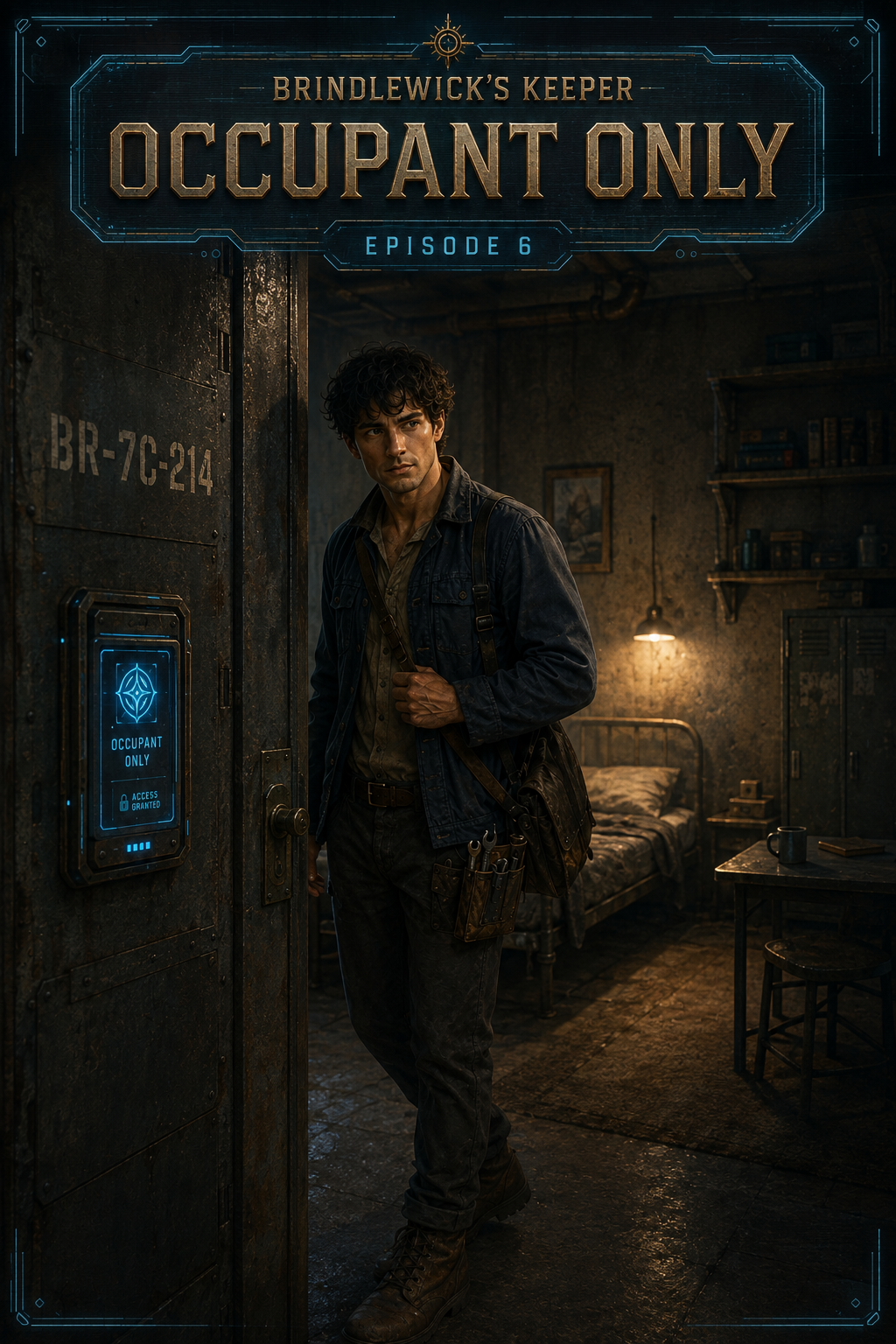
The access light stayed on.
Calder raised his hand again, but this time he touched the control marked LOCK.
The panel changed immediately to show the room secured under his occupant authority.
He put his hand on the handle and pulled.
The door held.
Calder let go.
A resident came down the corridor carrying a bundle of folded towels, glanced once at the lit panel, and stepped around him without slowing.
No clerk appeared to confirm that he had used the control correctly. No system message asked him to prove why he wanted the door locked. The corridor continued around him as though securing a room were ordinary enough not to deserve attention.
Calder looked at the panel again.
It still showed the room secured. He touched UNLOCK, watched the status change to occupant access available, and tested the handle again.
This time it gave.
He did not open the door.
Instead, he locked it again.
Calder pulled once more.
The handle stopped against the lock.
He held it there for a moment, applying enough pressure to satisfy himself that he was not simply feeling resistance from the latch.
The door stayed shut.
He released it.
The second test felt almost unnecessary.
That was useful too.
He opened the room access record.
The record listed Calder Venn as occupant, guest access disabled, and no secondary occupant assigned.
The same conditions remained attached to the room while it was locked.
Calder read the lines slowly.
He had known what occupant-only meant when the clerk showed him the assignment. He had understood the civic rule during orientation. He had even known what the access panel was supposed to do when it recognized him in the corridor.
The handle made the distinction harder to turn back into theory.
The room stayed closed because he had told it to stay closed.
He switched back to the full access record.
The defined emergency and authorized maintenance procedures remained exactly where orientation had placed them, separate from routine room access.
Calder did not reopen those policy details.
Nothing in the live door state contradicted what he had already learned.
Routine access did not appear simply because another person lived in the same building. No guest permission had activated itself when the room became occupied. No second resident appeared on the record after assignment.
Calder locked the door one more time and looked down the corridor.
A few doors away, someone stepped out carrying an empty laundry basket. Farther beyond, another access panel chimed softly and admitted a resident without drawing anyone else's attention.
The building was full of doors doing the same work.
That mattered more than Calder expected.
This was not a special privacy demonstration arranged because he had asked too many questions during orientation. No one was watching to see whether the room made him feel reassured.
Calder rested one hand against the wall beside the frame.
For a moment he remembered Neria reaching past him for a drawer while he tried to keep his place in a manual, her boots scraping the floor near the entry, and the way either of them could cross the whole room in three steps.
He shifted his hand on the wall and looked back at the locked door.
There were days when shared had been easier than alone.
There were other days when Calder had wanted a door that meant he could stop accounting for somebody else's movement without asking them to leave.
He looked at BR-7C-214.
The door had no opinion about whether wanting that had been selfish.
It simply obeyed the setting.
Calder unlocked it again and tested the handle. It released. He locked it once more, felt the handle hold, then unlocked it a final time.
The sequence was so ordinary now that he felt faintly ridiculous for repeating it.
He did not mind.
Calibration had taught him that a repeated test was useful when it answered a specific question. The question here had been whether privacy survived contact with the actual room.
It did.
There was no need to keep asking the door.
Calder closed the access record.
He put his hand on the handle and stopped with his thumb resting against the latch.
The corridor behind him remained active. Footsteps passed. A door opened somewhere out of sight. Someone called a name from farther down the hall and received an annoyed answer from inside another room.
All of it belonged to the building.
None of it belonged inside BR-7C-214 unless he opened the door and carried it in with him.
That thought landed differently from the housing terms.
The housing terms told him what rights and conditions existed.
The handle told him where the room began.
Calder pressed the latch.
The door opened inward.
He waited just long enough to make sure the panel did not change to any new access state.
It still showed occupant access active with guest access disabled.
He stepped across the threshold.
The corridor noise flattened and receded behind the closed walls, leaving voices and footsteps farther away than they had been in the hall.
He turned back.
The access panel was visible through the open frame.
Calder pulled the door closed from inside.
The latch caught.
For the first time since arriving in Brindlewick, there was no clerk, registrar, technician, route marker, or passing resident in the same space with him.
Calder stood with one hand still on the interior handle.
He did not need to test the door again.
He had already answered that question.
Only then did he turn toward the room.
The room was smaller than Calder had imagined from the housing packet.
That was the first thing he noticed once he stopped looking at the door.
The second was that nothing in it needed to move for him.
A narrow bed stood against the far wall. A table occupied the space beneath the window, with one chair tucked under it. Two shallow shelves had been built into the wall beside a storage cabinet. A washstand sat behind a half partition near the entry.
Calder crossed to the table and set his packet down.
No one told him he had taken the wrong side.
He pulled out the chair and sat.
The table did not already contain somebody else's cup, notes, repair parts, or unfinished meal. He spread the packet open across the surface and still had room beside it.
Calder rested both hands on the table.
The room remained quiet enough that he could separate the sounds beyond the walls: footsteps, something wooden scraping across a floor above him, a voice passing in the corridor too blurred to make out.
None of it required his attention.
He stood again and opened the storage cabinet.
Empty.
Calder checked the lower compartment, then the upper.
Also empty.
He put his coat inside.
The decision took less than a second.
At Neria's, hanging anything had involved knowing what already lived on the hook, whether she would need it first, whether moving one thing would make something else harder to reach. Most of the time neither of them had discussed those choices because they had learned each other's habits well enough to work around them.
Calder closed the cabinet.
He crossed to the bed and pressed one hand into the mattress.
Firm enough.
He sat on the edge.
The bed did not need to fold away to clear walking space. No shared trunk sat beneath it. No stack of Neria's things occupied the corner nearest the wall.
He stood and looked around again.
The room was modest enough that the inspection should have ended quickly.
Instead, Calder kept finding small decisions waiting for no one except him.
The packet could stay on the table.
His coat could stay in the cabinet.
The chair could face the window or the wall.
The light could remain on after he finished reading.
He crossed from the bed to the table, then back again, without having to angle around another sleeping space or lower his steps for anyone else.
Calder moved the chair six inches to the left.
Then he stopped.
There had been no reason to move it.
He put it back.
The absurdity of the correction almost made him smile, but the feeling passed before it became anything larger.
He was testing the room the same way he had tested the door.
The difference was that the room did not answer with a status line.
It answered by allowing him to choose without negotiation.
Calder returned to the shelves.
The lower one would hold papers easily. The upper was deep enough for books and manuals.
He measured the space with his hand out of habit.
About right.
He could put the maintenance manuals there.
Calder's hand stayed against the shelf.
The manuals were still with Neria.
He had left them because carrying the whole stack to the eligibility appointment would have been ridiculous, and because at the time there had been no room to carry them to.
Now there was.
The shelf waited.
Calder crouched to check its depth again.
He knew the largest manual would fit.
That was not the problem.
He stood.
For the first time since entering the room, the empty space felt less like freedom and more like evidence.
His things were not all here.
Some of them still belonged to a life arranged around another person.
He crossed back to the table and opened the packet, though he did not read it.
At Neria's, the manuals had occupied the lower shelf beside the stove because it was the only place wide enough for them. Neria had complained once that the largest volume collected grease along the top edge. Calder had moved the stack, discovered the alternative shelf warped under the weight, and put them back two days later.
After that, she had stopped complaining about the grease and started wiping the covers when she cleaned the stove.
Calder looked toward the empty shelf in BR-7C-214.
No grease would reach it here.
No warped board would force the manuals back into somebody else's kitchen space.
The advantage was obvious.
So was the distance.
He could send Neria a message now.
The thought arrived cleanly enough that Calder almost acted on it.
Instead he got up and opened the storage cabinet again.
His coat was exactly where he had left it.
He closed the cabinet.
He adjusted the packet on the table until its edge aligned with the grain.
Then he stopped.
He knew what he was doing.
There was nothing else in the room that needed verification.
The shelf was empty because the manuals were elsewhere.
Neria was elsewhere too.
Calder sat down.
The quiet settled around him differently now.
When he had wanted privacy, he had imagined relief from interruption. A place where he could leave a page open, choose when to speak, and close a door without making that choice against another person.
All of that was here.
The room worked.
That did not make the old room disappear.
Calder looked at the shelf once more.
He could fill it later.
He could fill the whole room later.
But replacing the empty space with something convenient would not change why it was empty now.
The manuals were still at Neria's because he had left them there.
He had left them there because this room had not existed yet.
Now it did.
Calder opened his message pane.
He did not type immediately.
The room around him remained entirely his to arrange.
That made the next choice his too.
Calder looked at the open message pane until the empty field began to feel like another thing he was avoiding.
He typed Neria's name.
Then he stopped.
The room around him was quiet enough that he could hear a door close somewhere down the corridor.
Calder put both hands on the table and started again.
Registration's complete. Starter housing is active. The manuals are still with you. When can I come back for them?
He read the message once.
It did not explain why he had registered.
It did not explain the room.
It did not explain why having a door he could close had mattered enough to make the leaving real.
Calder sent it before he could turn the pickup into an argument that Neria had not asked to have.
The reply did not come immediately.
He closed the pane, opened it again, then made himself leave it alone.
The empty shelf remained where it was.
Calder stood and crossed to the window.
The view was narrower than he expected. Most of it was another residential wall across a gap between buildings, with two levels of walkways crossing through the open space. A resident on the upper level was shaking dust from a rug. Below, someone pushed a handcart under the covered passage and disappeared around a corner.
The city kept moving without reference to whether Neria had answered him.
Calder returned to the table.
The message indicator changed.
He opened it.
Neria's reply contained two sentences.
The manuals are still here. Tell me before you come back.
Calder read them again.
There was no accusation in the words.
There was no invitation either.
He leaned back in the chair.
Before today, coming back had not required notice. The old room had been somewhere he returned because his things were there and because Neria expected, in some ordinary daily way, that he might walk through the door.
Now she had asked him to tell her first.
The request was reasonable.
That did not make it weightless.
Calder opened the reply field.
He typed, I will.
Then he kept going.
I checked the door myself. It works the way they said it would. I needed to know I would actually have somewhere that was mine.
He stared at the paragraph.
None of it answered Neria's message.
The longer response explained himself to a person who had not asked for an explanation.
It also turned the manuals into an excuse for reopening the decision.
Calder deleted everything after I will.
That looked too abrupt.
He added: I can come tomorrow afternoon. I'll message before I leave.
He read it once.
Then he sent it.
Neria's answer came more quickly this time.
Calder looked at the single-word reply, closed the pane, and set both hands flat on the table.
He could not tell whether the brevity meant irritation, acceptance, fatigue, or nothing more than that Neria had no reason to type more.
He knew better than to choose one interpretation because it hurt less.
The empty shelf was still empty.
The manuals had not moved.
Nothing between him and Neria had been solved.
But the next contact had a shape now.
He would tell her before he came back.
He would collect the manuals.
He would leave again.
The old room had changed without either of them naming the change directly.
Calder looked around BR-7C-214.
His coat hung in the storage cabinet. His packet lay open on the table. The door behind him was closed under his own access setting.
This room was where he was staying now.
The other room was somewhere he could still go, but not simply enter as though nothing had happened.
Calder rested his fingertips against the edge of the table.
For several moments he did nothing.
The quiet no longer felt provisional.
It also did not feel complete.
He looked once more at the empty shelf, then closed the message pane for good.
Calder left the message pane closed.
For a while, he did nothing more important than move the packet from the center of the table to the left side.
He set the chair where he actually wanted it instead of where it had happened to be when he arrived. He opened the storage cabinet, shifted his coat one hook farther over, and closed the door again.
Then he sat.
The room did not feel transformed by any of it.
That was the point.
He could hear someone walking in the corridor. A pipe clicked behind the wall as water moved through it. Somewhere above, a chair dragged across a floor and stopped.
Calder did not measure how much quieter the room was than the corridor.
He did not check the access panel.
He left the packet open and read three pages without looking at the door.
By the fourth page, BR-7C-214 had stopped behaving like proof.
It had become a place where he could put something down and expect to find it there when he came back.
Calder reached the end of the page and looked up.
Nothing needed him.
The thought arrived without warning.
He frowned at it.
The room was secure. His registration was active. He had a bed, a table, storage, and an address.
Tomorrow afternoon, he would message Neria and collect the manuals.
After that, the day remained blank.
Calder turned another page.
The packet held general information about residency, services, and newcomer access. He had read most of it already.
There was nowhere he had to be in the morning.
No supervisor expected him.
No work crew had his name on a list.
No one in Brindlewick would notice if he spent the entire next day inside BR-7C-214 reading material he had already checked twice.
Calder sat back.
At Neria's, even the cramped routines had imposed shape. Water had to be heated at certain times because of the building supply. Groceries had to be bought before the evening crowd. Repairs turned up whether either of them wanted them. Neria had her own schedule, and living beside it forced Calder to know what part of the day he was in.
Here, the room gave him exactly what he had asked it to give him.
It did not give him a reason to get up.
Calder looked toward the empty shelf.
The manuals would fill some of it.
They would not fill the day.
He bent over the packet again and flipped back to the contents.
The work-access section was near the end.
Calder had marked it during orientation and then left it alone because registration, housing, and first entry had been the immediate problems.
Those problems were no longer immediate.
He opened the section.
The first page listed several ways new registrants could enter practical work: public placement boards, supervised assessments, temporary civic labor, and direct applications to registered crews.
Calder read the headings once.
His eyes started moving toward the detailed eligibility notes beneath each one.
He stopped himself.
The immediate question was not which path would be best six months from now.
The immediate question was where he could go next.
He scanned for location and access information.
Public placement boards were available in each service district.
Supervised assessments required an appointment or an open assessment window.
Direct crew applications required a specific crew reference.
Temporary civic labor could be joined from rotating notices, but the packet warned that assignments varied sharply in duration and skill requirements.
Calder tapped the placement-board entry.
A nearby service hall offered newcomer work access and assessment scheduling.
That was enough to make one decision.
He copied the location into his active route list.
Then he closed the detailed occupation index before he could start comparing every trade in Brindlewick.
The old impulse was already there.
He could research canal work, maintenance, transport, records, utilities, inspection, storage, construction, civic intake, and a dozen other categories before leaving the room.
He could learn which placements had the highest retention rates.
He could compare schedules.
He could map the service districts against housing access and calculate walking times.
Calder looked at the route he had just saved. It identified Service Hall 3 for work access and showed that it was open today.
That was a condition that existed.
He stood.
The chair scraped once against the floor.
Calder folded the work-access pages back into the packet and left the rest on the table.
For a moment, he considered taking the entire thing.
He did not need the entire thing.
He took the work-access page and his registration reference.
His coat came out of the cabinet.
Calder put it on and looked around the room.
The bed was made because nobody had used it yet.
The shelves were mostly empty.
The packet remained where he had placed it.
Nothing about the room objected to being left.
That mattered too.
Privacy was useful because he could close the door and know what waited behind it.
It was not useful if he stayed behind the door simply because he had worked hard to get one.
Calder went to the entry.
He opened the door and stepped into the corridor.
A resident carrying a basket moved past before he had finished turning around.
Calder pulled the door shut.
The latch caught, and one test of the handle confirmed that it held.
His hand stayed on the handle for half a second longer than necessary.
Then he let go.
He did not open the housing record.
He did not check guest access.
He did not test the lock again.
BR-7C-214 had already answered those questions.
Calder started down the corridor.
At the laundry court, a resident shoved a bundled sheet against the top of an overfilled cart until one corner slipped loose, then caught it before it hit the floor. Farther ahead, someone called for a lift and swore when the indicator skipped a floor.
Calder followed the route markers toward the service hall.
For the first time since registration, the next thing he wanted was not another assurance about what he was allowed to keep.
He wanted somewhere to go because someone there had work that needed doing.
At the end of the corridor, he turned toward the stairs and kept walking.