

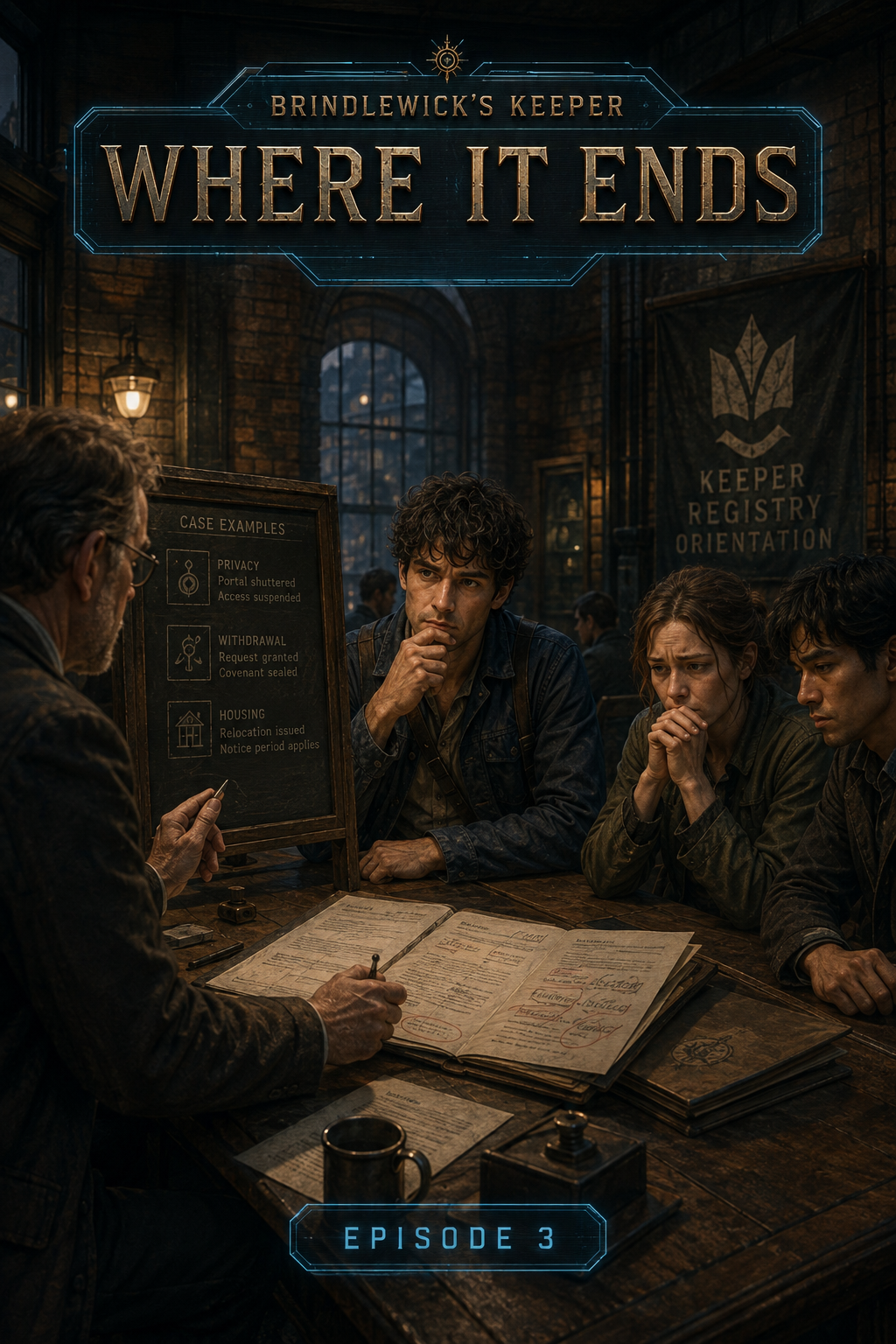
The civic orientation room had six chairs arranged around a low table and no lectern.
Calder took the seat nearest the door.
Two other applicants were already there. One had the information packet open to the privacy section. The other kept rubbing the edge of a sleeve between finger and thumb while looking at nothing in particular.
A registrar entered carrying a thin slate and set it flat on the table where everyone could see it.
"I'm not going to read the packet to you," she said. "You had that before today. We're going to use cases instead. If you think the answer is obvious, say why. If you think it depends on something, say what."
Calder looked at the slate.
That was closer to calibration than he had expected.
There was no switch under his thumb here. No sensor trace waiting to prove that an answer had arrived late. The only way to test the rules was to follow them into specific situations and see where the boundaries actually appeared.
The registrar opened the first case.
A player had accepted temporary work repairing a public gate. The work office already knew the player's character name, current certifications, schedule, and payment account. The office wanted the player's registered civil identity as part of ordinary hiring.
The applicant with the open packet answered first.
"The character record should be enough to verify qualification."
"Usually," the registrar said. "A specific legal or safety requirement can change that. Ordinary preference does not."
Calder read the case again.
The distinction was smaller than the word privacy had sounded at home.
A public office could not ask for the protected identity simply because someone preferred having it. The exception needed a reason that belonged to the work or the law rather than to convenience.
Calder glanced at the packet but did not open it.
He already knew the section number.
The registrar changed the slate.
The second case involved a serious accident while a player was operating civic equipment. The public character record identified the player, but an investigation required contact with the registered person responsible for the account.
Calder answered before either of the other applicants.
"Then the protected identity can be disclosed."
"Through the authorized process," the registrar said. "For the defined purpose and to the authorized recipient."
Calder looked at the disclosure note that appeared beneath the case.
That was the boundary he had wanted.
The privacy did not vanish because someone important asked. It could be crossed under a stated condition, through a stated process, for a stated reason.
The applicant rubbing the sleeve edge stopped.
"So it isn't actually private."
The registrar turned toward them.
"It is protected from ordinary access. It is not protected from every lawful disclosure under every circumstance."
The applicant's fingers closed on the fabric again.
"That's not what I thought protected meant."
Calder looked from the applicant to the slate.
The same answer that had made the rule more usable for him had made it less acceptable to someone else.
He understood why.
Calder wanted the exception narrow enough that he could point to it. The applicant across from him appeared to want an exception that did not exist at all.
The registrar did not try to convince either of them that the distinction should feel reassuring.
"If that boundary changes your decision," she said, "write it down. That's what this room is for."
The applicant opened their packet and made a note beside the privacy section.
Calder watched them write.
At home, he had treated his own uncertainty as though enough information would eventually force a single reasonable conclusion. The orientation room was making that harder to believe.
The words on the slate did not change depending on who read them.
The consequence did.
For Calder, the existence of a named exception made the protection more credible because it told him where the promise ended.
For the other applicant, the same exception weakened the promise because it proved the protection was not absolute.
Neither reading required the registrar to change the rule.
Calder looked down at his own notes.
Privacy had been one of the largest words on the page when he wrote it at home.
Now it had edges.
That did not make the rule harmless.
It made the decision his.
The registrar closed the privacy case and opened the next scenario.
"Now let's talk about withdrawal," she said.
Calder shifted his attention to the slate.
One question had narrowed enough to set down.
The next one had not.
The registrar changed the slate.
The next case began with a player who had already accepted civic work.
The assignment was active. Payment had begun accruing. The player held two pieces of issued equipment, and a complaint connected to the work had been filed but not yet resolved.
Then the player decided to withdraw from participation.
The applicant with the open packet frowned.
"They can just leave?"
"They can withdraw from player participation," the registrar said. "That does not erase obligations already created."
The case expanded.
Calder read the consequences in order.
Payment already earned remained owed to the player. Issued equipment still had to be returned. Accepted work had to be transferred or closed according to the assignment rules. The complaint remained under review until the process ended.
None of those lines said the player had to stay registered until someone else was satisfied with the outcome.
Calder leaned closer to the slate.
"So withdrawal ends participation, not consequences."
"Correct."
The applicant rubbing the sleeve edge looked at the same list, one finger still resting beside the privacy note they had written earlier.
"I care more that stopping is still possible at all."
Calder glanced at them.
The registrar did not turn the comment into a debate. She enlarged the withdrawal case instead.
"Then test that part," she said. "What here would force the player to remain registered?"
The applicant studied the work assignment and the unresolved complaint. The registrar clarified that the work had to be transferred or closed and the complaint could continue through its own process, but neither one required the player to remain registered while those obligations were resolved.
Calder followed each distinction.
At home, voluntary participation had sounded too broad to trust. A promise that he could leave meant very little if every obligation attached to registration could quietly become a reason he was not allowed to leave yet.
This case drew a different line.
Leaving did not make previous actions disappear.
Previous actions did not automatically become a reason to keep participating forever.
The registrar added another detail.
The player had completed most of the assignment but still had one inspection record open and one tool unreturned.
"Can withdrawal be refused until those are finished?" Calder asked.
"Withdrawal from player participation cannot be converted into indefinite continuation because an obligation exists," the registrar said. "The obligation remains enforceable through the process attached to it."
Calder read that answer twice.
He pointed to the open record and the unreturned tool. "Those still have to be resolved, but they do not create a new requirement to keep participating in unrelated work."
The registrar confirmed the distinction.
Calder's hand relaxed against the edge of the packet.
The obligation had a subject: a tool, a record, a complaint, an accepted assignment. Each one could be named, and each one could end.
The sleeve-rubbing applicant shifted in their chair.
"What if somebody keeps finding new things that count as unresolved?"
The registrar looked toward them.
"Then the player can challenge whether those things are valid obligations under the rules that created them. Withdrawal does not give an office authority to invent new obligations after the fact."
The applicant stopped rubbing the sleeve.
"That's the part I was worried about."
Calder understood the difference between their questions now.
The applicant wanted proof that the exit could not be moved farther away every time they approached it.
Calder looked at the list and said, "I need to know exactly what follows me through the exit, and when each part ends."
The registrar turned the slate so the obligation list filled the center of the table.
"Try another version. The player has returned the equipment, transferred the work, received all payment owed, and the complaint has been resolved. What obligation remains from this case?"
Calder scanned the list again. Every item was closed.
"None," he said.
The registrar cleared the slate. "Then nothing in this case requires continued participation."
The applicant with the sleeve released a breath through their nose.
Calder looked down at his own notes.
Withdrawal had been one of the words he underlined twice at home.
He had imagined it as a door with conditions hidden behind it.
Now the conditions had labels.
If he took work, he had to close the work properly. If he held someone else's equipment, he had to return it. If a complaint existed, leaving did not erase the process. If none of those things existed, the system did not create a substitute reason to keep him inside.
The applicant across from him tapped the edge of the table once.
"I still like the clean-exit part better than the responsibility part."
Calder looked up.
"I like knowing the responsibility has an end."
The applicant considered him for a moment, then looked back at the slate.
"Those aren't the same thing."
"No."
They were close enough to share a rule and different enough to make the rule matter for different reasons.
The registrar opened the next case.
"Now we add restart continuity."
Calder closed the withdrawal section in his packet without rereading it.
He knew what the boundary was now.
Leaving could be real without making consequences unreal.
That was enough to move on.
The registrar opened the restart case.
A player's character state had been reset after a qualifying event. The player still held a civic permit and still owed one piece of issued equipment back to the system.
Calder read the case twice.
"The reset doesn't clear those?"
"No," the registrar said. "Character-state changes do not erase the player record or civic obligations already created."
The slate separated the two layers.
Character state: reset.
Player continuity record: active.
Civic permit: active pending review.
Equipment loan: unresolved.
Calder looked at the lines.
He had expected the reset to erase more.
The registrar added another condition.
The restart had changed the player's current physical state enough that the work tied to the permit could no longer be performed safely under the old qualification.
The applicant with the open packet frowned.
"Then why does the permit stay active?"
The registrar tapped the review line.
"The permit record persists because it exists. Qualification is reassessed against the player's current condition. The old qualification does not force continued approval."
Calder looked back at the status list.
That sounded familiar.
During calibration, a setting that had once been acceptable stopped being useful the moment the actual response disagreed with it. The answer had been to test the condition that actually existed.
"So the obligation can persist while the qualification changes," Calder said.
"Correct."
The player still had to return the equipment and close whatever process belonged to the permit. None of that required the system to pretend the player could safely perform the same work after the reset.
The sleeve-rubbing applicant leaned toward the slate.
"And if the reset made the player better qualified?"
"Then the current condition would still be the basis for reassessment."
Calder looked at them.
The principle did not favor keeping access or removing it. It followed the condition that existed now.
The registrar cleared the case.
"Last withdrawal example."
A new scenario appeared.
The player had no active work assignment, no civic equipment outstanding, no unresolved complaint, no legal hold, no payment issue, and no open process requiring closure.
The registrar looked around the table.
"What prevents withdrawal?"
No one answered immediately.
Calder scanned the list again.
There was nothing left to carry through the exit.
"Nothing," he said.
"Correct."
The sleeve-rubbing applicant's shoulders dropped.
They read the case one more time, then leaned back for the first time since orientation began.
Calder noticed because the privacy exception had tightened them in the opposite direction.
The registrar did not point that out.
She simply left the clean-exit case visible long enough for everyone to read it again.
Calder did.
Nothing prevented withdrawal once actual obligations were resolved.
Restart did not erase responsibility.
Changed conditions could alter qualification.
The player record carried what had actually happened without forcing the present to behave as though nothing had changed.
Calder looked down at his notes.
The rules were beginning to fit together in a way the packet had not managed by itself. Privacy limited ordinary access while allowing defined lawful disclosure. Withdrawal ended participation without erasing existing consequences. Restart changed character state without erasing the continuity record. Qualification followed current conditions rather than historical entitlement. And when no obligation remained, withdrawal had an actual endpoint.
The sleeve-rubbing applicant closed the privacy section of their packet but kept the withdrawal page marked.
Calder understood that too.
The same rules could answer different fears at different times.
He no longer needed them to produce the same emotional result for everyone at the table.
He only needed to know whether they answered the questions that could still change his own decision.
The registrar cleared the slate.
"Now ask the questions that would matter before consent. Not everything you might want to know later. The ones that could still change whether you continue today."
Calder opened his notes.
The remaining list was shorter than it had been when he entered the room.
The registrar left the blank slate in the center of the table.
"Only the questions that could still change your decision today," she said.
Calder opened his packet to the first page of notes.
Most of the page had been written before he arrived: privacy, withdrawal, existing obligations, restart continuity, qualification after change.
Each word had seemed large enough to conceal something when he wrote it at home.
Now he drew a line through them one by one because he knew where each one stopped.
He turned the page.
Housing remained.
Calder looked at the registrar.
"Starter housing. What makes someone eligible?"
The registrar brought up the housing section.
Eligibility depended on registration status, current housing need, and the conditions attached to the starter program. The placement was not permanent. It could be reviewed if those conditions changed.
Calder followed the language to the part he had marked twice.
"If registration continues and housing eligibility doesn't?"
"Then the housing eligibility can end without ending registration," the registrar said. "That starts the notice and transition process."
The sleeve-rubbing applicant leaned forward again.
"How much notice?"
The registrar opened the defined schedule and showed the group where the notice period changed depending on the reason for the eligibility decision and the kind of placement involved.
Calder read the dates and the review conditions.
There was no promise that the room would remain his as long as he wanted it.
There was also no rule allowing the housing office to decide in the morning that he no longer qualified and expect him gone by afternoon.
The placement had a beginning condition, a review process, a notice requirement, and a transition procedure.
Calder turned back to his notes.
"And if somebody thinks the eligibility decision is wrong?"
The registrar showed him the review path.
The answer matched the packet.
So did the notice language.
So did the part he had disliked most when he first read it: starter housing was conditional.
He had wanted to know whether that condition concealed a trap.
It did not.
It concealed a condition.
Calder almost smiled at the stupidity of the distinction, except it was exactly the sort of distinction that had kept him awake.
He wrote four words beside the housing section.
ELIGIBILITY. REVIEW. NOTICE. TRANSITION.
Then he stopped.
The sleeve-rubbing applicant was still reading the housing schedule.
"I don't know if that's enough for me," they said.
The registrar nodded.
"Then it isn't enough for you yet."
No one corrected them. The registrar simply waited while the applicant kept the housing page open.
Calder looked down at the four words he had written.
For him, they were enough.
The condition did not need to be permanent. It needed to be visible before he entered it.
The registrar closed the housing section.
"Anything else that could change whether you proceed today?"
The applicant with the open packet asked about a payment schedule. The registrar answered and directed them to the exact clause.
The sleeve-rubbing applicant asked to keep their privacy note open for individual review.
Then the room went quiet.
Calder looked through his own packet from the beginning.
There were still dozens of things he did not know.
He did not know whether Brindlewick would feel like a place he could live in or a place he would merely visit through procedure.
He did not know whether work would be easy to find.
He did not know whether he would regret registering after the novelty wore off.
He did not know what Neria would say when she learned he had crossed the threshold she had refused to cross for him.
None of those questions belonged to the registrar.
No rule could answer them before he lived long enough to find out.
Calder turned back to the first page.
He had arrived with the idea that one more fact might still rescue him from having to choose.
That possibility had been disappearing all afternoon.
Calibration had removed the physical uncertainty he could actually test. Orientation had narrowed the civic terms until the boundaries were specific enough to evaluate.
What remained was not missing information.
It was consequence.
The registrar checked the slate.
"Individual review is ready for the next applicant."
Calder looked at the others.
The sleeve-rubbing applicant kept one hand on the privacy page.
The applicant with the open packet was still comparing two payment clauses.
Neither of them looked ready to move.
Calder did.
He closed the packet.
The sound was small in the quiet room.
The registrar looked toward him.
"You want to go next?"
Calder put one hand over the notes he had spent days making.
He could reopen them.
He could ask the housing question again using different words. He could return to privacy and invent another edge case. He could make the absence of certainty look like the presence of unfinished research.
None of that would change the terms he had just tested.
"Yes," he said.
The registrar indicated the door at the far side of the room.
Calder stood.
He left the packet closed as he crossed the room.
At the door, he glanced back once.
The sleeve-rubbing applicant was writing something new beside the privacy section.
Calder understood why they were staying.
He also understood why he was leaving.
The difference was no longer information.
It was choice.
He opened the door to individual review and stepped through.