

Three days later, Calder arrived at the eligibility office with the information packet tucked under his arm and enough notes in the margins to make the original printing look provisional.
The receptionist checked his appointment reference, confirmed his name, and directed him to medical screening without asking whether he was excited to be there.
Calder noticed that.
The screening itself took less than twenty minutes. A clinician checked his identification, asked about conditions relevant to immersion, confirmed the medication list he had already submitted, and ran a handful of routine measurements. No unexpected warning appeared. No one found a reason to halt the application. No one tried to turn that absence into encouragement.
When the clinician finished, she closed the record and said, "You're cleared for calibration."
Calder glanced at the status line before he stood.
MEDICAL SCREENING: COMPLETE.
"That's all?"
"For this stage. If calibration raises something medical, support can bring us back in. Otherwise you're done here."
There was no speech about what registration could do for him. No reassurance that most applicants loved their first entry. No attempt to hurry him toward the next room while he was still deciding whether the current one had hidden anything.
Calder picked up the packet.
That made calibration easier to distrust properly.
The medical screening had been ordinary enough that he did not need to waste suspicion on it. Calibration was different. He had read the safety explanation at home, but a document could only tell him what the system was supposed to do. It could not prove what would happen when his body and the equipment disagreed.
A technician met him in the next room.
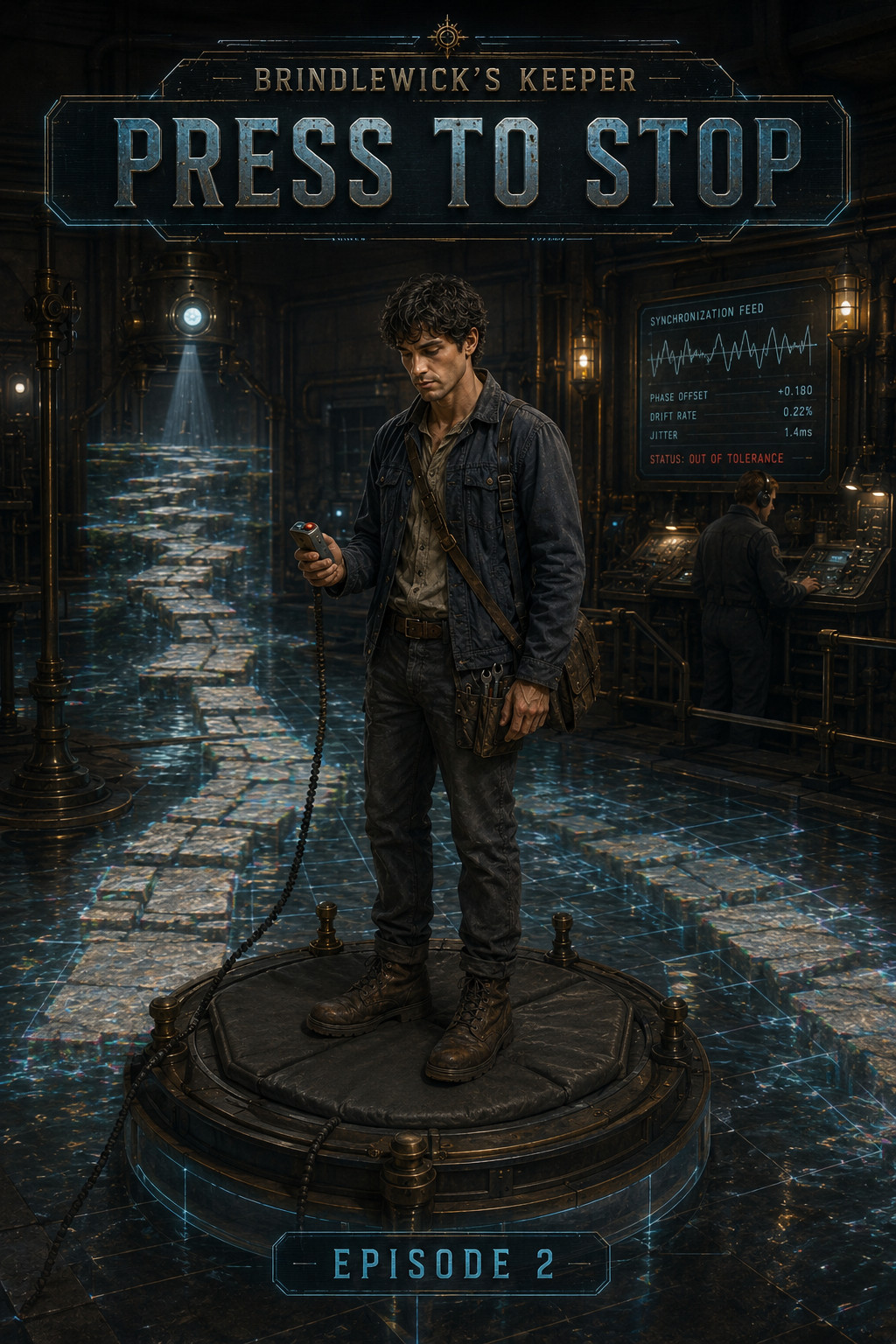
The space was nearly empty. A padded platform occupied the center beneath a ring of sensors. A narrow display showed his name, several inactive status fields, and one instruction in larger text.
STOP IF ANYTHING FEELS WRONG.
The technician handed him a compact switch connected to the calibration system.
"Keep this under your thumb," she said. "Press it and the session stops. You don't need permission."
Calder turned the switch over once in his hand.
There was no cover over it. No confirmation catch. No second control on the technician's side that he could see.
He asked what the switch actually stopped. The technician explained that it ended the active calibration sequence, dropped projection, stopped motion feedback, and marked the session interrupted immediately.
Calder looked at the empty platform.
The sensors had not been attached yet. The display still read READY FOR CALIBRATION.
He pressed the switch.
A tone sounded.
The display changed at once.
SESSION INTERRUPTED.
The technician did not sigh or ask why he had done it before they started. She reached to her console, confirmed the interruption, and reset the session.
The status returned to READY FOR CALIBRATION.
Calder watched the change all the way through.
He asked whether the same interruption control remained available once projection started and whether using it counted against completion. The technician told him it stayed available through linked safety sequences, including calibration and first-entry procedures, and that using it was not a failure condition even if part of a sequence had to be repeated.
That answer mattered almost as much as the switch working.
A stop control that technically functioned but punished him for using it would only move the pressure somewhere less visible.
Calder looked at the status display again.
READY FOR CALIBRATION.
The system had stopped because he told it to stop. The technician had reset it because he asked a question, not because she needed him to pretend the test had not happened.
That was more useful than the paragraph in the packet.
He stepped onto the platform.
The technician attached the first wrist sensor, then another near his ankle. Calder kept the switch in his right hand while she checked the fit and asked about pressure and numbness. He reported neither, though she adjusted one strap anyway after checking the reading.
Calder watched the display populate as the wrist and lower-body sensors linked while the orientation baseline remained pending.
"We'll start with simple movement mapping," the technician said. "Reach, turn, step, follow the marker. Nothing immersive yet."
Calder nodded.
He could feel the temptation to ask three more questions before the first movement began. How much lag was acceptable. Whether a partial interruption could leave motion feedback active. Whether the safety layer had a manual override somewhere he could not see.
Those questions were not useless.
They were also not the next test.
He had already established one fact the packet could not give him.
The control in his hand stopped the system.
If something later felt wrong, he would not have to decide whether he was allowed to interrupt. He would only have to decide whether what he felt was wrong enough to use the tool he had already tested.
The technician activated the first mapping field.
A marker appeared in front of him.
"Reach toward it when you're ready."
Calder settled his thumb over the interruption switch and raised his hand.
The first mapping exercises gave Calder nothing to object to.
A marker appeared at shoulder height. He reached toward it, stopped when his fingertips met the projected boundary, and brought his hand back. The mapped hand moved with him. No visible lag followed the motion.
The technician shifted the marker to his left.
Calder turned.
The room stayed where it belonged.
"Again," she said.
He repeated the turn, faster this time.
Still clean.
The next sequence added a step. Pressure changed under his boots as the platform simulated movement while the projected reference point advanced with him. Calder watched the step, the pressure response, and the visual shift arrive close enough together that his body accepted the movement without argument.
He did not press the interruption switch simply because the experience was unfamiliar.
That mattered too.
A control was only useful if he could distinguish between discomfort that meant stop and novelty that meant pay attention.
The technician advanced the sequence.
The gray walls disappeared behind a projected stone walkway suspended over moving water.
Calder could still find the room if he looked for the edges, but the scene occupied most of his vision. The path ahead was narrow enough to make balance relevant without requiring anything difficult.
"Take two steps when you're ready," the technician said.
Calder looked down at the walkway.
The stone texture held steady. Water moved beneath both sides in a broad current. The platform under his feet remained level.
He stepped forward.
The water pulled sideways.
His body reacted before his thoughts caught up.
Calder stopped with his weight split between both feet.
The walkway itself had not moved. The platform had not tilted. But the current below accelerated toward his right at the same moment the far edge of the scene seemed to arrive a fraction late.
His stomach tightened.
He turned his head back toward center.
The far wall caught up after the movement.
There.
Calder held still.
The mismatch was not severe.
That was almost worse.
If the scene had lurched violently or the platform had thrown him off balance, the answer would have been obvious. Stop. Report it. Reset.
This felt manageable.
He could probably continue.
A few more steps might give his senses time to adjust. The technician had already spent time calibrating him. Stopping now would interrupt the sequence over something he could still stand through.
The old answer arrived quickly because it had been useful in plenty of other rooms.
Do not make a tolerable problem into everybody else's delay.
Calder looked at the switch under his thumb.
He did not press it yet.
Instead he chose one more test.
"I'm going to repeat the step," he said.
The technician answered without changing the sequence. "Go ahead."
Calder shifted back to his starting position and fixed his attention on three things: the stone edge ahead of him, the motion of the water below, and the pressure under his right foot.
He stepped.
The same error returned.
This time he was ready for it.
The current surged sideways as the scene adjusted. When Calder turned his head, the far edge lagged behind and then snapped into alignment a fraction later.
His stomach tightened harder.
The sensation was no longer an impression he might talk himself out of. He had reproduced it.
Calder pressed the interruption switch.
The water vanished.
The stone walkway dropped out of view.
Motion feedback under his feet stopped immediately.
The plain gray calibration room returned around him.
SESSION INTERRUPTED.
Calder stayed still until his balance settled.
The technician did not restart anything.
"Tell me exactly what happened."
Calder pointed toward where the walkway had been.
"On the forward step, the current pulled right while the path stayed still. Then when I turned my head, the far edge arrived late. It caught up after I stopped moving."
The technician opened the movement trace.
Several lines appeared across the display, each tracking a different part of the calibration sequence. One timing trace separated sharply from the others during his head turn, and she enlarged it.
A timing line broke away from the others during his head turn.
The technician expanded two traces.
"Depth correction is arriving late here," she said. "The motion layer is compensating before that correction lands. That's why the water feels like it's pulling sideways."
Calder looked at the lines.
The fault existed on the display.
Not because he had insisted hard enough. Not because the technician had decided his discomfort deserved accommodation. The sequence had produced a measurable mismatch at the same point where his body had objected.
"How much late?" he asked.
She showed him the timing difference.
It was small.
Small enough to explain why he had been tempted to keep walking through it.
"Would it settle if I kept going?"
"Maybe your body would compensate," the technician said. "The calibration would still be wrong."
Calder looked at her.
That answer landed more sharply than the interruption itself.
The system did not need him to become better at tolerating the error.
The error needed correction.
The technician selected the relevant settings but did not change them yet.
"I can adjust the depth timing and reduce the motion compensation. Then we repeat the same movement."
Calder looked at the interruption status still displayed beside his name.
The stop had done exactly what the packet promised. More importantly, it had left the problem visible long enough to identify.
"Change it," he said.
The technician adjusted the values.
Calder watched both numbers update.
When she finished, she looked at him rather than starting the projection automatically.
"Ready to test it again?"
Calder settled his thumb back over the switch.
This time the question was no longer whether he could stop the system when something felt wrong.
He had done that.
The next question was whether a correction would hold when he deliberately returned to the movement that had failed.
"Ready," he said.
The stone walkway returned.
Calder did not move.
The water below ran in the same broad current as before. The far edge of the projection held steady. Nothing in the scene announced that the timing values had changed.
That was useful.
If the correction worked, he wanted the difference to come from the movement itself rather than from expecting the room to feel better.
The technician waited at the console.
Calder set his feet where they had been before the interruption and looked at the same section of walkway.
"Same step," he said.
She nodded.
He moved forward.
The platform changed pressure under his foot.
The water continued in its own direction.
The far edge stayed where it belonged when he turned his head.
Calder finished the movement and stopped.
His stomach did not tighten.
He turned back the other way, then repeated the head movement once more at a slightly faster speed.
Still clean.
The technician glanced at the trace.
"Correction is holding."
Calder looked at the walkway.
One successful pass was not enough.
"Reset it. Same settings."
The technician did not ask whether that was necessary. She returned the sequence to the beginning.
Calder stepped back into position and matched the pace and head turn he had used when the fault first appeared.
If the first clean pass had happened because he moved more cautiously after the failure, the error might return when he repeated the motion normally. If his body had simply adapted, the trace might still show the same timing problem even if the sensation felt less obvious.
He took the step again.
The response stayed synchronized as he turned his head, and the far edge remained fixed instead of arriving late.
He repeated the movement at the same pace he had used when the fault first appeared.
The correction held.
Calder let his shoulders loosen and looked to the technician.
"Continue," he said.
The technician advanced the calibration.
The remaining sequences were less dramatic.
Hand tracking required him to follow a moving reference through several angles. Communication testing introduced a short spoken exchange against a shifting visual field. Orientation recovery moved him through a controlled transition and asked him to identify fixed reference points after the scene changed.
Calder used the same standard he had established on the walkway.
If something felt unfamiliar, he observed it.
If something behaved incorrectly, he tested whether the error repeated.
The distinction kept him from treating every new sensation as a fault.
It also kept him from dismissing one when it mattered.
During a control-response check, his left-hand movement felt loose near the end of a turn.
The mapped hand reached the target, but the last part of the motion seemed to float farther than his actual hand had moved.
Calder stopped.
This time he did not wait for the sensation to become severe.
He pressed the interruption switch.
The active field disappeared.
SESSION INTERRUPTED.
The technician opened the response settings.
"What did you feel?"
"The end of the left turn kept moving after my hand felt finished."
She checked the trace.
This time the timing lines remained aligned.
The technician opened a different setting.
"This isn't a synchronization fault. Your control tolerance is wider on that movement."
She showed him the range.
The system was accepting a larger difference between the mapped response and his physical endpoint before treating the movement as complete.
"Can I change it?" Calder asked.
"Yes. That's a user setting."
She moved the control to his side of the display.
Calder adjusted the tolerance down one step.
"Run it."
The movement field returned.
He repeated the turn.
The mapped hand stopped sooner.
Closer, but still slightly loose.
Calder adjusted the value again.
He tested the movement a second time.
The response finished with his hand.
Calder held the position for a moment, then returned to neutral.
"Leave it there."
The technician saved the setting.
He looked at the interruption switch under his thumb.
During the walkway test, he had waited, repeated the error, and then stopped. This time the control had been under his thumb before the question fully formed.
He had stopped because a response did not match what he expected, identified the cause, changed the relevant condition, and tested it until the result held.
There was no reason to keep examining the same setting after that.
Calder let the rest of the calibration continue.
The process no longer felt like a single large question about whether the system could be trusted.
It had become a series of smaller questions with answers he could verify.
When one of them was answered, he could move on.
The technician brought up the remaining synchronization and recovery checks.
Calder settled his thumb over the interruption switch again.
He no longer held it like an emergency exit.
It was simply one of the controls available to him while he finished the work.
The final calibration sequences were less dramatic than the walkway failure, and Calder preferred them that way.
The technician moved him through another orientation recovery, a communication check, and two synchronization passes under changing visual conditions. Calder watched for the same kinds of disagreement he had learned to recognize earlier, but nothing repeated the sideways pull or the loose control response.
When the scene changed, he found the fixed reference points and recovered his orientation without needing the interruption switch. When the communication field shifted around him, his voice reached the technician without delay. When the hand and foot tracking sequences repeated under different loads, the mapped responses ended where his physical movements did.
The status display filled one line at a time.
MOVEMENT SYNCHRONIZATION: VERIFIED.
COMMUNICATION: VERIFIED.
INTERRUPTION CONTROL: VERIFIED.
ORIENTATION RECOVERY: VERIFIED.
Calder read each result as it appeared.
He did not ask to repeat every passing sequence.
That would have been another way to avoid finishing.
The tests that mattered had already shown him what happened when something failed and what happened when a correction held. These checks were doing what they were supposed to do. Nothing in them gave him a new reason to stop.
The technician ended the active field and the plain calibration room returned around him.
"That's the full sequence," she said.
Calder looked at the display.
CALIBRATION: COMPLETE.
She began removing the sensors from his wrists and ankle.
"What happens if the equipment changes later?" Calder asked. "Or if one of these settings stops feeling right after today?"
The technician set the first sensor into its tray.
"You can recalibrate. You don't have to wait for a scheduled review if something changes. Report the problem and support can reopen the relevant settings."
Calder turned the interruption switch over in his hand before giving it back.
"And the settings follow the player record?"
"The safety and accessibility settings that need to. Your public character information doesn't include your full medical or calibration history."
That moved the question out of this room.
Calder handed her the switch.
The technician placed it beside the other equipment and brought up the completed calibration summary.
He read it from the top.
The first interruption had worked before the system was even active. The walkway fault had appeared in the trace where his body said something was wrong. The correction had survived repeated testing. The loose response had turned out to be an adjustable tolerance, and he had changed it himself until the movement matched.
None of that told him whether every part of registration deserved trust.
It told him something narrower and more useful.
This part had controls he could use, faults he could report, and corrections he could verify.
Calder closed the calibration summary.
The technician opened the door to the corridor.
A sign across from the room pointed left.
CIVIC ORIENTATION.
Calder picked up his information packet.
Before calibration, the questions had been physical. Would the system stop when he told it to stop? Would it adapt if the projected body and his own senses disagreed? Would he be expected to tolerate a bad fit because the procedure had already begun?
He had answers now.
The next room held a different kind of uncertainty.
Privacy. Withdrawal. Housing. Existing obligations. What the institution could know, what it could disclose, what followed him if he left, and which promises had conditions attached.
Those answers could not be tested by making the water move wrong.
Calder stepped into the corridor and stopped beneath the sign.
He opened the packet to the civic section, checked that his questions were still marked, then closed it again.
He did not need to reread the answers he had already proved in calibration just because another decision was waiting.
The technician closed the door behind him.
Calder turned left toward CIVIC ORIENTATION.