

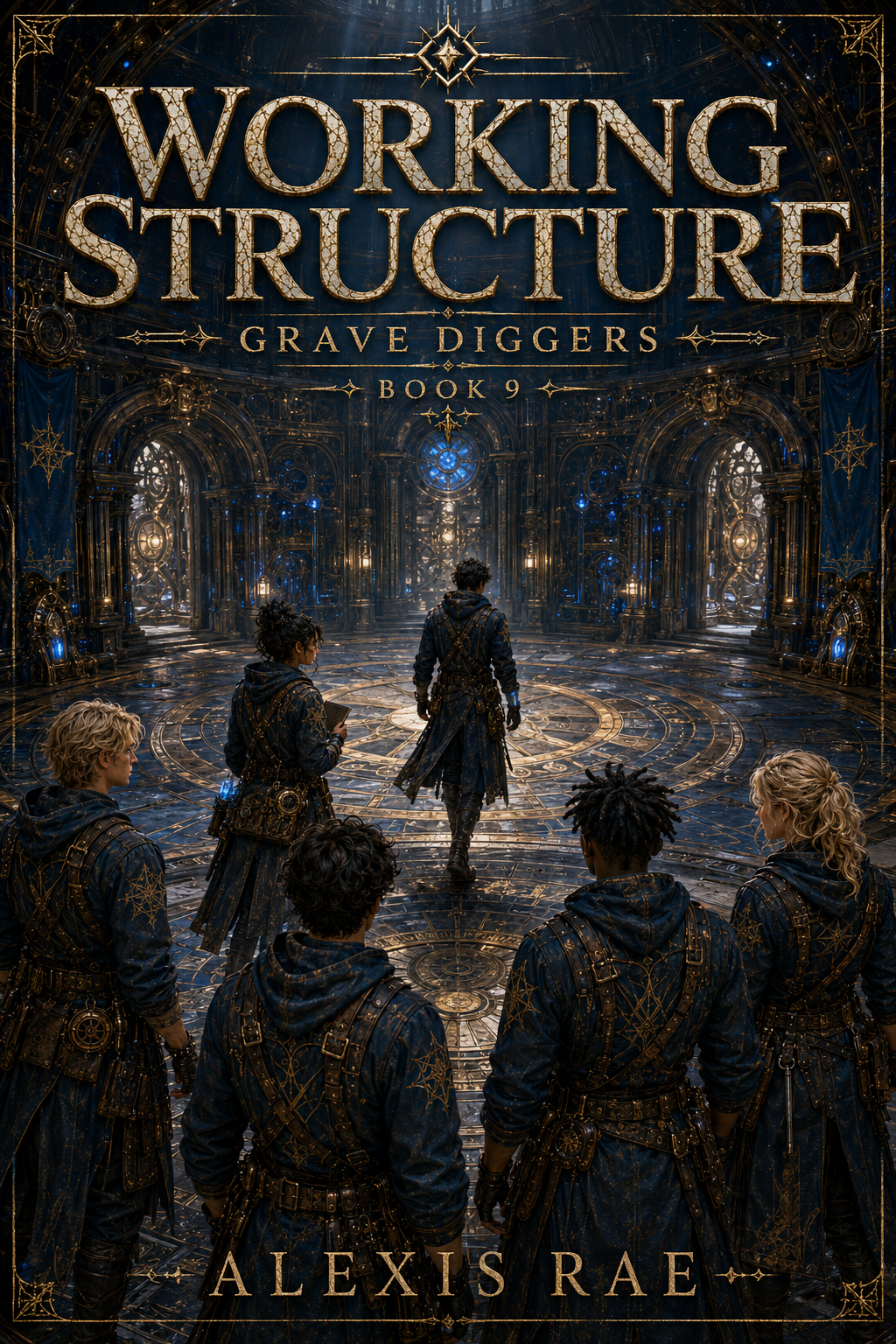
David broke the silence first.
“Straight through is still the path I would choose.”
Melody looked across the circular chamber.
The straight path remained obvious in exactly the least useful way.
Loria studied the blank walls.
“I cannot support it symbolically.”
Bram looked at the pale floor between the threshold and the chamber center.
“I have no immediate hazard evidence there.”
He glanced at Melody.
“That is not the same as safe.”
“Noted.”
Joss listened toward the nearest seam.
“No active mechanism state.”
Lucan looked at the six openings, then at the distances between them.
“If we enter in a line, we lose options. If we spread too early, we lose support.”
Melody wrote each claim on a separate line.
David: willing to commit straight.
Loria: no symbolic support.
Bram: no immediate hazard evidence.
Joss: no current mechanism constraint.
Lucan: preserve options through movement order.
No answer.
Enough to move.
Lucan pointed to David.
“Three steps. Stop whether anything happens or not.”
Then to Melody.
“You follow one step behind. Everyone else holds the threshold.”
David nodded.
Melody did not.
She was already calculating what the move would cost.
Three steps would place David near the chamber’s centerline.
Her one-step follow would keep the threshold reachable.
The others could still redirect toward any of the adjacent openings.
The move would change geometry without pretending to choose the exit.
Melody wrote:
Decision 1: limited forward commitment.
Preserves retreat.
Preserves lateral options.
Creates new sightlines.
David stepped into the chamber.
One.
Nothing.
Two.
The pale floor stayed blank.
Three.
He stopped.
Melody took her assigned step behind him.
The chamber changed.
A hairline seam appeared beneath David’s left heel and ran sideways instead of forward.
It crossed the chamber toward an opening two positions clockwise from the straight path.
At the same time, a faint shadow formed along the base of the wall behind Loria.
The shadow had no established channel meaning; it simply marked a new chamber response after their movement.
Melody wrote before anyone named it.
Choice → changed state.
David looked down.
“Well. Straight through has opinions now.”
Melody ignored the phrasing and looked at Loria.
“What can you support?”
Loria studied the new seam.
“It links David’s current position to the clockwise opening. I cannot say whether that means route, warning, or relationship.”
Bram shifted only his head.
“The floor between David and that opening is still behaviorally quiet, which makes it usable for the moment without making it safe.”
Joss listened again.
“Still no mechanism constraint.”
Melody added:
New option: clockwise opening gains relationship evidence.
Straight path loses exclusivity.
Hazard remains unresolved.
Mechanism still non-limiting.
Lucan looked at the changed chamber.
The geometry was already different.
From the threshold, the clockwise opening had looked weaker because it required a lateral crossing.
From David’s new position, the angle shortened.
Melody saw it at the same time Lucan did.
“The first move changed the second decision.”
Lucan nodded.
“That is the point.”
He pointed to Bram.
“Two steps in, left of Melody. Loria, one step right but stay at the threshold. Joss holds. David stays.”
Bram moved first.
The hairline seam brightened.
Loria shifted right.
The faint shadow behind her disappeared.
A pale notch appeared at the base of the clockwise opening.
Melody wrote:
Decision 2 begins before Decision 1 is validated.
Bram inward-left.
Loria threshold-right.
Seam strengthens.
Clockwise notch appears.
David looked toward the new opening.
“That is becoming a better argument.”
“Not yet,” Melody said.
He glanced back.
“Still not enough?”
“Enough to continue the chain. Not enough to pretend the chain is over.”
Lucan checked the spacing.
“The next move cannot preserve every option.”
The sentence changed the pressure in Melody’s head more than any symbol would have.
Up to now, each step had kept retreat available.
The next one would cost something.
She looked at the ledger.
Decision 1 had opened evidence.
Decision 2 had strengthened one alternative.
Neither had proven anything.
Lucan pointed to David.
“Shift one step clockwise. Hold there. If the seam stays active, deepen.”
David looked at the faint notch.
Then at Bram.
“Floor?”
“Quiet.”
At Loria.
“Meaning?”
“Relationship, not instruction.”
At Joss.
“Mechanism?”
“Nothing limiting.”
David looked at Melody last.
She had no final model to give him.
Only the state they had made together.
“Your move changes what we can know next,” she said.
David stepped clockwise.
The seam held.
The pale notch widened.
The straight path behind him dimmed at the threshold.
Melody wrote:
Decision 2 changes Decision 3.
Forward option weakens.
Clockwise option becomes more reachable.
Retreat narrows.
Lucan moved immediately.
“Bram, follow David’s angle. Melody, center. Loria in. Joss last.”
They entered the chamber in the new order.
The six were no longer standing at the edge of a problem.
They were inside a sequence whose earlier choices had already changed the later ones.
The seam under David’s foot brightened again.
Then a second line appeared beyond it, farther clockwise.
Too far to reach without another commitment.
David looked at Lucan.
Lucan looked at Melody.
Melody looked at the ledger.
There was still no certainty to add.
Only the next consequence.
She turned the page enough to make room.
“Keep the chain live.”
David looked at the second line farther clockwise.
The chamber had already taken away the luxury of pretending the next move existed by itself.
Melody kept the ledger open.
Decision 3.
Current state first.
David stood one step clockwise from the original centerline.
Bram held the angle behind him.
Melody occupied center.
Loria and Joss were fully inside the chamber now.
The threshold behind them had dimmed.
Retreat still existed, but not cleanly.
Lucan pointed toward the farther line.
“David, deepen toward that mark. Bram, take the floor read on his outside edge. Loria, stop looking for direction. Find out what makes the chamber answer. Joss, hold until you have an actual constraint.”
David moved first.
The farther line brightened.
Bram shifted to the outside of David’s angle.
A faint dark band appeared across the pale floor, not blocking them so much as narrowing the space in which the next step could happen.
Bram studied its movement. “Boundary is tracking our angle without advancing yet.”
Loria turned away from the line itself and studied the chamber wall where its endpoint met the stone.
She changed her focus once.
Nothing.
Again, lower.
A pale notch appeared at the base of the wall.
“There. The response follows the investigation, not the route.”
Melody wrote:
David deepens → line brightens.
Bram outside angle → boundary appears.
Loria changes inquiry → wall notch appears.
Lucan stepped between Melody and Joss and adjusted their spacing by half a pace.
The farther line extended.
At Joss’s left, a seam clicked.
He looked down.
A narrow plate had lifted a finger-width from the floor.
“I can lock that before it rises farther.”
Lucan did not answer immediately.
Melody looked at the rest of the chamber.
David’s line was still extending.
Loria’s notch had begun to spread horizontally.
Bram’s dark boundary held its distance.
Joss crouched near the plate without touching it.
“Actionable,” he said. “Not limiting yet.”
Melody wrote the distinction.
David took another step.
The line carried him farther clockwise.
The wall notch opened into a shallow vertical slit.
Bram’s boundary moved inward by two inches.
“Window narrowing.”
Joss watched the plate rise another fraction.
Still no touch.
Lucan moved Loria one step forward and Melody half a step back.
The line stayed live.
The slit widened.
Bram’s boundary stopped.
Melody wrote:
Joss waits.
Other responses mature.
Available mechanism remains non-limiting.
David glanced toward him.
“You are enjoying this too much.”
Joss did not look away from the plate.
“I am enjoying being correct without touching it.”
Melody kept writing.
The chamber gave them one more step.
David took it.
The farther line turned toward an opening Melody had barely considered from the threshold.
At the same moment, the floor plate beside Joss snapped upward another inch.
A second click answered from beneath the chamber.
The pale line flickered.
Loria’s slit narrowed.
Bram’s dark boundary jumped inward.
“Now it is limiting,” Bram said.
Joss was already moving.
Lucan shifted Melody into Joss’s vacated spacing before the formation could open.
“Smallest intervention,” Lucan said.
Joss dropped to one knee beside the raised plate.
“There is a catch under the lip.”
He reached under, pressed once, and released.
The plate stopped rising.
He did not force it down.
The second click ceased.
David’s pale line stabilized.
Loria’s slit reopened.
Bram’s boundary slowed.
Melody wrote:
Mechanism becomes limiting.
Joss local arrest only.
Route state preserved.
Lucan changed the formation again before Joss returned to his old position.
“Stay forward-right,” he said. “Bram, move inward. Loria, hold the slit. David, keep commitment shallow until the new geometry settles.”
They adjusted.
The strongest pale continuation ahead of David dimmed.
A weaker line appeared near his left foot instead.
It angled toward a narrow opening half-hidden behind the chamber curve.
David studied the weaker line while Loria and Bram checked the conditions around it.
Loria said, “It has less visual support.”
Bram kept his eyes on the dark boundary. “The hazard window is better on that side.”
Joss checked the plate. “Mechanism is stable.”
Lucan checked the formation.
“And we can actually reach it from here.”
Melody looked at the current state.
The obvious line had been stronger before Joss acted.
It was also built for a geometry that no longer existed.
The weaker route belonged to the chamber they had now.
“Commit to the state we have,” she said.
David shifted toward the faint line.
Nothing happened.
Lucan moved Bram another half-step inward.
Loria lowered her investigative focus to the base of the hidden opening.
The faint line brightened.
David deepened.
The line extended.
The dark boundary behind Bram slowed further.
Joss kept both hands clear of the plate.
The hidden opening widened.
Melody wrote:
Unlikely route viable only under current configuration.
David commits after ensemble changes state.
Lucan raised one hand.
“Move on the next stable count.”
Bram watched the boundary.
“Stable.”
Loria watched the opening.
“Response holding.”
Joss listened.
“Mechanism quiet.”
David looked at Melody.
She checked the line, the spacing, the boundary, the opening, and the plate.
There was no final proof.
There was enough coordination.
“Go.”
David crossed first.
Lucan sent Bram after him, then Loria.
Melody moved next.
Joss came behind her.
Lucan crossed last.
The chamber changed around each passage.
The pale line shortened behind David.
The dark boundary shifted toward the space Bram had just left.
The wall slit narrowed after Loria passed it.
The floor plate clicked once as Joss moved beyond it.
Lucan changed order twice before all six reached the hidden opening.
No one held the same function for more than the current need required.
Melody stopped writing names.
She wrote the chain.
Commitment changes geometry.
Geometry changes hazard window.
Hazard window changes investigation.
Investigation exposes opening.
Mechanism threatens state.
Narrow intervention preserves state.
Reallocation creates viable weak route.
Commitment carries group through.
David reached the hidden opening.
Beyond it, the dark passage sloped upward.
A line of daylight showed at the far end, bright and ordinary against the stone.
Bram crossed the threshold behind him.
The chamber boundary stopped moving.
Loria stepped through.
The wall slit vanished.
Melody crossed.
The ledger page stayed blank for two steps because she was watching the opening instead.
Joss followed.
The floor plate in the chamber dropped flat with a final click.
Lucan came through last.
The hidden opening sealed behind them.
For one count, all six stood in the rising passage.
Then David started upward.
No one stopped him.
The passage ended at a broad stone arch.
They crossed beneath it together.
The Maze Works fell away behind them.
Open air hit Melody’s face.
She looked back once.
The arch was already dark.
No route line remained.
No hazard boundary.
No signal.
No mechanism.
Nothing to assign ownership to.
She opened the ledger and wrote the last chain from memory as a sequence of shared changes rather than a single winning method.
David read over her shoulder.
“Does that mean we passed?”
Melody looked ahead.
Academy stone terraces rose beyond the exit.
Several figures were waiting there.
One held a slate.
Another had a stack of folded evaluation sheets.
Lucan noticed them too.
“The maze is over.”
Bram watched the waiting staff.
“That does not answer his question.”
Melody closed the ledger.
No.
It did not.
The figure with the slate stepped down from the terrace.
“Six names,” she said. “One record.”
The person beside her began handing out the folded sheets.
David took his first and looked for a score.
Melody did the same.
There was no score at the top.
There was a sequence.
Entry points.
Interventions.
Delays.
State changes.
Crossed responses.
The first page listed actions in narrow columns beside the information available when each action occurred.
Melody found her own early notes reflected there in a cleaner hand.
Current-state model attempted before interaction effects established.
She read the next line.
Useful inputs present outside active model.
Her pencil hand tightened around the folded edge.
The evaluator tapped the slate.
“The Maze Works does not grade only for correct local action.”
Joss had already unfolded his sheet all the way.
His eyes moved quickly.
“It recorded intervention timings, including the ones I chose not to take.”
The evaluator nodded. “It recorded decisions under available information.”
David looked up from his page.
“So it recorded non-actions.”
Lucan unfolded his sheet more slowly.
“Formation changes too.”
“Every change that altered another student’s available options.”
Melody looked back at her page.
A later section had been marked with a different notation.
Technically valid action.
Useful in isolation.
Reduced group information when treated as sufficient.
The note appeared more than once.
David had one as well.
Joss had several.
Lucan had one where a formation preserved movement but blocked a useful sightline.
Loria had one where a signal interpretation became too narrow.
Bram had one where a hazard exclusion prevented a test that later proved necessary.
The evaluator let them read.
Melody preferred that to explanation.
The sheets did not need help making the pattern unpleasantly clear.
David held his page toward the light.
“My route choice was correct here, but you still marked it as degraded.”
The evaluator looked at the line he indicated. “Because you had access to information that would have made the same commitment safer and more useful to the group, and you did not incorporate it.”
David looked back at the page.
He did not argue.
Loria found another marked section.
“This says my interpretation was accurate, so the failure was procedural rather than interpretive.”
The evaluator nodded. “You treated accurate interpretation as if accuracy ended the question.”
Loria read that line twice.
Bram folded his sheet back one panel.
“They separated technical competence from system performance.”
The evaluator looked at him.
“That is close.”
Melody kept reading.
The earlier pages were divided by person.
The later pages were not.
Instead, the record began grouping actions by dependency.
Commitment altered geometry.
Geometry altered hazard behavior.
Hazard behavior altered investigative value.
Investigative change altered route viability.
Mechanism restraint preserved developing state.
Reallocation maintained access to multiple methods.
She knew those chains.
She had written versions of them herself.
But the academy record included something hers did not.
It marked when one person changed how they used a strength because another person’s information made the old use insufficient.
Melody found the first such mark beside Lucan.
Reallocation executed before role fixation.
Then Joss.
Available intervention withheld until limiting condition emerged.
Then David.
Commitment adjusted to ensemble-created viability rather than apparent route strength.
Then Loria.
Investigative method changed in response to hazard behavior.
Then Bram.
Hazard read revised from exclusion to responsive-system behavior.
Then her own.
Model shifted from channel ownership to interaction, then to transition, then to chained decision state.
The evaluator stepped closer.
“The early record shows six competent students attempting to solve one unknown system.”
She turned the slate so they could see it.
A simple set of marks ran down the left side.
Separated at first.
Then crossing.
Then crossing too often to remain separate.
“The later record shows something else.”
Joss studied the marks.
“Dependencies.”
“Yes.”
Lucan looked from the slate to their sheets.
“Not hierarchy.”
“No.”
David glanced at Melody.
She kept her eyes on the slate.
The evaluator touched one crossing point.
“This was the first moment where a student changed a technically competent method because another student’s method changed the problem itself.”
Melody recognized the point.
The glass section.
Lucan’s spacing change.
Loria’s shifted investigation.
Bram’s moving boundary.
The record did not name one of them as the cause.
It named the dependency.
The evaluator moved her finger farther down.
“From here onward, your successful decisions become increasingly difficult to attribute to one person without misrepresenting the decision.”
Melody looked at her own sheet again.
That was true of the final chamber.
David had committed.
Lucan had allocated.
Joss had waited, then acted.
Loria had changed the question.
Bram had changed what the hazard meant.
Melody had tracked the current state.
Remove any one of those and the chain became a different chain.
The evaluator turned the slate back toward herself.
“The Maze Works was not designed to discover which of you could impose the best method on an unknown system.”
Bram’s mouth tightened slightly.
“What was it designed to discover?”
“How you behave when a competent method stops being sufficient.”
No one spoke for a moment.
Melody looked down at the record again.
There were failures on it.
Real ones.
There were correct choices that had produced worse states.
There were delays that had preserved useful states.
There were interventions that had mattered only because someone else had first changed the conditions around them.
There were places where her model had been accurate and still incomplete.
The academy had kept all of it.
Not just the escape.
The evaluator lifted the folded stack still in her hand.
“These are individual extracts.”
Then she tapped the slate.
“This is the combined evaluation.”
David looked at the slate.
“Combined how?”
“Cohort-level.”
Lucan’s attention sharpened.
“We were not assigned as a cohort.”
“No.”
The evaluator looked across all six of them.
“You were observed as one.”
Melody felt the distinction settle before she had a useful category for it.
The exercise had ended.
The record had not.
The evaluator continued.
“Clearing the Maze Works is part of your result. The decision pattern that produced the clearance is the part the academy considers materially significant.”
Loria looked at the slate again.
“Significant for what?”
The evaluator gathered the remaining sheets into one hand.
“That is the next decision.”
She turned toward the upper terrace.
A second academy official was waiting there with a single document instead of six.
Melody looked at the combined slate in the evaluator’s hand.
They had entered the maze as six separate problems.
The academy had recorded what happened when they stopped behaving that way.
Now it intended to do something with the result.
The second official came down the terrace with the single document tucked beneath one arm.
Melody watched the paper instead of the person carrying it.
One document meant the academy had already decided the level at which it intended to act.
The official stopped beside the evaluator and looked across all six of them.
“Your individual records remain individual,” he said. “Your Maze Works result does not.”
Lucan shifted his attention from the document to the official.
“What changes?”
The official held out the page.
At the top, six names appeared beneath one heading.
WORKING COHORT DESIGNATION.
Melody read the line twice.
David read it once, then looked at the official. “For academy use, how binding is that?”
“You may still receive individual instruction, individual evaluation, and individual assignments. But where the academy determines that a problem involves interacting systems, incomplete information, or uncertain conditions, this group may be assigned, assessed, or retained together.”
Joss looked from the document to his individual sheet.
“So technical performance stays individual, and this record sits beside it rather than replacing it.”
“Yes.”
Loria stepped closer to the document.
“Does the designation alter investigative access?”
“Potentially, when an assignment requires the cohort rather than an individual student. Access follows assignment authority.”
Bram folded his evaluation sheet once.
“If the academy needs only one of us, it can still separate the group?”
“It can. The designation is persistent as a recognized working structure, not exclusive.”
Bram accepted that without looking pleased by it.
Lucan pointed to the heading.
“Who leads?”
“No standing leader is created by this result.”
That caught Melody before she could decide whether she had expected another answer.
Lucan’s expression barely changed.
“Then command authority remains assignment-specific.”
“Yes.”
David looked at the official.
“And if we disagree?”
“The Maze Works record gives the academy no reason to prevent that.”
The official turned the document slightly so the lower section was visible.
Melody saw the justification field.
Adaptive performance under uncertainty.
Cross-method correction.
Decision improvement through conflicting useful inputs.
No dominant-method recommendation.
The last line sat there with particular efficiency.
No dominant-method recommendation.
The evaluator with the slate spoke again.
“You are not being preserved as a cohort because you reached agreement easily.”
Melody looked at David.
He was still reading the heading.
The evaluator continued.
“You are being preserved because your methods repeatedly exposed limits in one another, and because your later decisions improved when you treated those limits as useful information.”
Joss glanced at the dependency marks on the slate.
“So the irritating part is structurally relevant.”
The evaluator did not smile.
“Yes.”
Melody looked back at the document.
Lucan took it first.
He read the assignment language from top to bottom, then handed it to Loria.
Loria checked the access and scope clauses before passing it to Joss.
Joss stopped at the evaluation section.
Bram checked duration and separation conditions.
David read the designation line again and passed the page to Melody last.
She took it.
Six names.
One designation.
Her own name did not sit above the others.
Neither did Lucan’s.
The order was alphabetical.
That should not have mattered.
It did, slightly.
Melody read the justification field again.
Adaptive performance under uncertainty.
The phrase was broad enough to become inconvenient later.
She looked at the official.
“How long does the designation remain active?”
“Until revised by faculty review, superseded by a later cohort decision, or ended by academy authority. It extends beyond this exercise.”
The distinction landed cleanly.
The Maze Works had ended behind them.
This had begun after.
The official took a stylus from the evaluator and marked the lower corner of the document.
“Designation entered.”
Nothing magical flashed.
No bell sounded.
The page simply changed status in the academy record.
Melody knew enough about institutions to understand that this was worse than spectacle.
It was durable.
The official returned the document to the evaluator.
“Further instructions will be issued through your normal schedules.”
David looked at the five of them.
“So we are officially a problem set.”
No one answered him.
Melody watched the document disappear beneath the evaluator’s slate.
She had entered the Maze Works expecting a system she could model.
She had left with the academy placing her inside one.
David’s commitments would keep changing the field before her model was complete.
Lucan would keep reallocating the structure she had just learned.
Joss would keep finding mechanisms whose importance depended on timing.
Loria would keep changing the question when the evidence changed.
Bram would keep refusing to let a clean category outrank observed behavior.
And the academy had now created reasons for all of that to remain her problem.
Melody looked at the five of them again.
The designation did not make them certain.
It made them recurring.
The official stepped aside and opened the terrace path back toward the academy.
The six remained where they were for one moment longer.
Not because anyone had ordered them to stay.
Because, for the first time, leaving separately would have been a decision with institutional meaning.
David moved first when the terrace path opened.
Not far.
Just enough to make Lucan shift half a step to keep a pair of older students from cutting between them.
“Left,” Lucan said.
David went left without argument.
Joss unfolded his individual evaluation again as he walked.
“This wording is annoyingly precise.”
Bram glanced over.
“Which wording?”
“May be assigned, assessed, or retained together.”
He tapped the line with one finger.
“Those are three different powers.”
Loria leaned closer without breaking stride.
“Assessment could apply even if the assignment begins individually.”
Joss looked at her.
“Yes.”
Bram frowned at the paper.
“And retained together could mean they keep us on a problem after they would normally split a group.”
David looked back over his shoulder.
“So the designation becomes most useful to them when leaving would be convenient for us.”
Lucan redirected him around a descending faculty pair.
“Forward.”
David faced forward again.
Melody listened.
Her first impulse was to divide the statements by category.
Authority.
Evaluation.
Duration.
Operational constraint.
The categories came easily.
Too easily.
She slowed her pencil before it reached the page.
The categories were not independent. Each new reading changed the practical meaning of the others.
Melody left the page blank.
They reached the first broad landing above the Maze Works.
Three stairways climbed from it toward different academy courts.
Students moved through all three.
Lucan stopped long enough to read the traffic.
“Central stair is fastest.”
Bram looked at the crowd funneling down it.
“Central stair clears in waves. Six of us will stall near the arch.”
David pointed toward the right stair.
“Less crowded.”
Loria looked at the posted placard beside it.
“It passes the records court.”
Joss lifted the evaluation sheet.
“Which may answer whether this designation already exists in the student registry.”
Lucan looked at the central stair again.
“We were told further instructions would come through normal schedules.”
David looked at the right stair.
“We were not told not to look.”
Melody felt the old shape of the problem forming.
Fastest route.
Most informative route.
Lowest congestion.
Institutional relevance.
She could rank them.
She knew how.
Instead she looked at Bram.
“What matters about the crowd?”
“Central stair is clearing in waves. We would move fast for half the climb and then stop near the arch.”
At Loria.
“What does the records route change?”
“It may give us information before our schedules update. It may also give us nothing.”
At Joss.
“What would you do with the information if it exists?”
“Compare it to the evaluation language before the academy adds interpretation around it.”
David nodded toward the right.
“That sounds useful enough.”
Lucan did not move.
“It also adds time.”
Melody looked at him.
“Does time matter yet?”
Lucan checked the sun, the terrace traffic, then the nearest bell tower.
“No immediate constraint.”
She wrote one line.
No immediate time constraint.
Then stopped.
David looked at the page.
“That is all?”
“For now.”
Bram gave the right stair another look.
“Then I prefer the route with less crowd and more information.”
Loria nodded.
“So do I.”
Joss folded the evaluation sheet.
“Same.”
Lucan looked at David.
David nodded toward the right stair. “That works for me.”
Lucan started toward the right stair.
The others followed.
Melody fell into step without deciding who had won the disagreement.
That felt stranger than it should have.
There had been no need to reconcile every claim into one reason.
The crowd mattered.
The records court mattered.
The absence of a time constraint mattered.
David’s willingness mattered.
Lucan’s route judgment mattered.
The claims could remain different and still support the same action.
Melody wrote nothing else.
Halfway up the stair, David glanced back.
“You are unusually quiet.”
Melody kept walking. “I am choosing not to document a conclusion that does not exist.”
Joss considered that without comment.
Bram kept climbing.
Loria smiled faintly at the placard ahead.
The records court occupied a narrow open gallery between two academy buildings. Brass frames held notices beneath glass panels. A long registry desk ran along one wall.
They had not reached the desk when Joss stopped.
A new sheet had been posted in the nearest frame.
Six names appeared together.
Working Cohort Designation.
Effective immediately.
No assignment listed.
David leaned toward the glass.
“That was fast.”
Loria read the lower notation.
“Registry entry references the Maze Works evaluation.”
Bram read another line.
“No expiry date.”
Lucan checked the routing code at the bottom.
“Faculty review authority.”
Joss looked at Melody.
“Still resisting documentation?”
She opened the ledger.
The easiest entry would have been:
Cohort designation confirmed.
She did not write it.
That was true, but too small.
She looked at the five names surrounding hers on the notice.
David Vale.
Lucan Glass.
Joss Rill.
Loria Kade.
Bram Silt.
Melody Quill.
The order on the registry was not the order in which they had entered the Maze Works.
It was not the order in which they had solved anything.
It did not show who had been right first, who had corrected whom, or whose method had carried more weight at any particular moment.
The academy had preserved the group without preserving a hierarchy inside it.
Melody looked down at her blank page.
She still wanted models.
That had not changed.
She still wanted current states, transition rules, bounded claims, and evidence strong enough to survive contact with the next fact.
That had not changed either.
What had changed was what she expected the model to do.
It did not have to place her at the center.
It did not have to make David predictable before his commitment could be useful.
It did not have to make Lucan’s reallocations stable before she could trust them.
It did not have to turn Joss’s restraint into a mechanism category she owned.
It did not have to make Loria’s questions converge toward one approved interpretation.
It did not have to keep Bram’s observations inside the boundary she had assigned them.
A model could stay useful while remaining vulnerable to the people inside it.
Melody wrote:
Working structure persists.
Then, beneath it:
Do not confuse persistence with stability.
David read the second line and nodded once. “That fits.”
Lucan had moved to the registry desk.
He returned with a small printed slip.
“No assignment attached yet.”
Joss took it.
“Yet is doing a lot of work.”
Loria checked the reference number.
“The designation is already linked to our schedules.”
Bram exhaled through his nose.
“So they can find us efficiently.”
David looked toward the upper academy courts.
“They could already find us efficiently.”
“Now they have a reason.”
Melody looked at the registry notice again.
A reason.
That was the durable part.
Not the Maze Works.
Not the final chamber.
Not even the evaluation.
The academy had created a reason to put the six of them back into the same problem.
A future assignment could ask for David’s willingness to move before certainty.
It could require Lucan to restructure a group while conditions changed.
It could depend on Joss recognizing when not to intervene.
It could need Loria to change the question instead of defending the first interpretation.
It could force Bram to read dangerous behavior as information instead of merely exclusion.
It could expose another model Melody had built too neatly.
She found that she did not want to avoid that last possibility.
That surprised her enough to make the pencil stop.
Loria noticed.
“What?”
Melody looked at the page.
“I was expecting this to feel like reduced control.”
Bram leaned against the stone beside the notice frame.
“Does it?”
“Yes.”
David waited.
Melody looked at him.
“It also feels useful.”
Joss gave her a brief look, then folded the registry slip again.
Lucan looked toward the next stair.
“We should move.”
No one objected.
This time David did not start first.
Loria was already nearest the stair, so she took it.
Bram followed because the crowd narrowed near the first turn.
Joss walked beside Melody long enough to hand her the registry slip.
“Keep it with the ledger. You already have the record.”
Melody took it and slid it behind the back cover.
The six climbed toward the academy courts.
Their spacing changed twice before the top.
No one announced the changes.
No one needed to.
At the final landing, the paths divided again toward residence halls, instructional courts, and the dining quarter.
For the first time since leaving the Maze Works, they actually had reasons to separate.
David stopped.
“My schedule says west court tomorrow morning.”
Lucan checked his own sheet.
“South.”
Loria had east archive instruction.
Bram had an early practical block.
Joss had a mechanism lab.
Melody unfolded her schedule.
Her first class was nowhere near any of theirs.
The designation had not erased their individual lives.
It had only changed what would happen when the academy decided those lives should intersect again.
David lifted his sheet.
“So we leave separately now without creating institutional meaning?”
Melody looked at the registry slip hidden inside her ledger.
“No.”
He waited.
She closed the ledger.
“We leave separately knowing the institution can put us back together.”
Bram looked toward his residence path.
“Comforting.”
Loria adjusted the strap of her bag.
“Accurate.”
Joss pointed at Melody.
“She said that already.”
Lucan ignored all of them.
“Tomorrow.”
It was not a command.
It was not a promise either.
Just the next point at which their paths might cross.
They separated across the landing.
Melody took three steps toward the instructional court before opening the ledger again.
The last page held two lines.
Working structure persists.
Do not confuse persistence with stability.
There was room below them.
She left it there.