

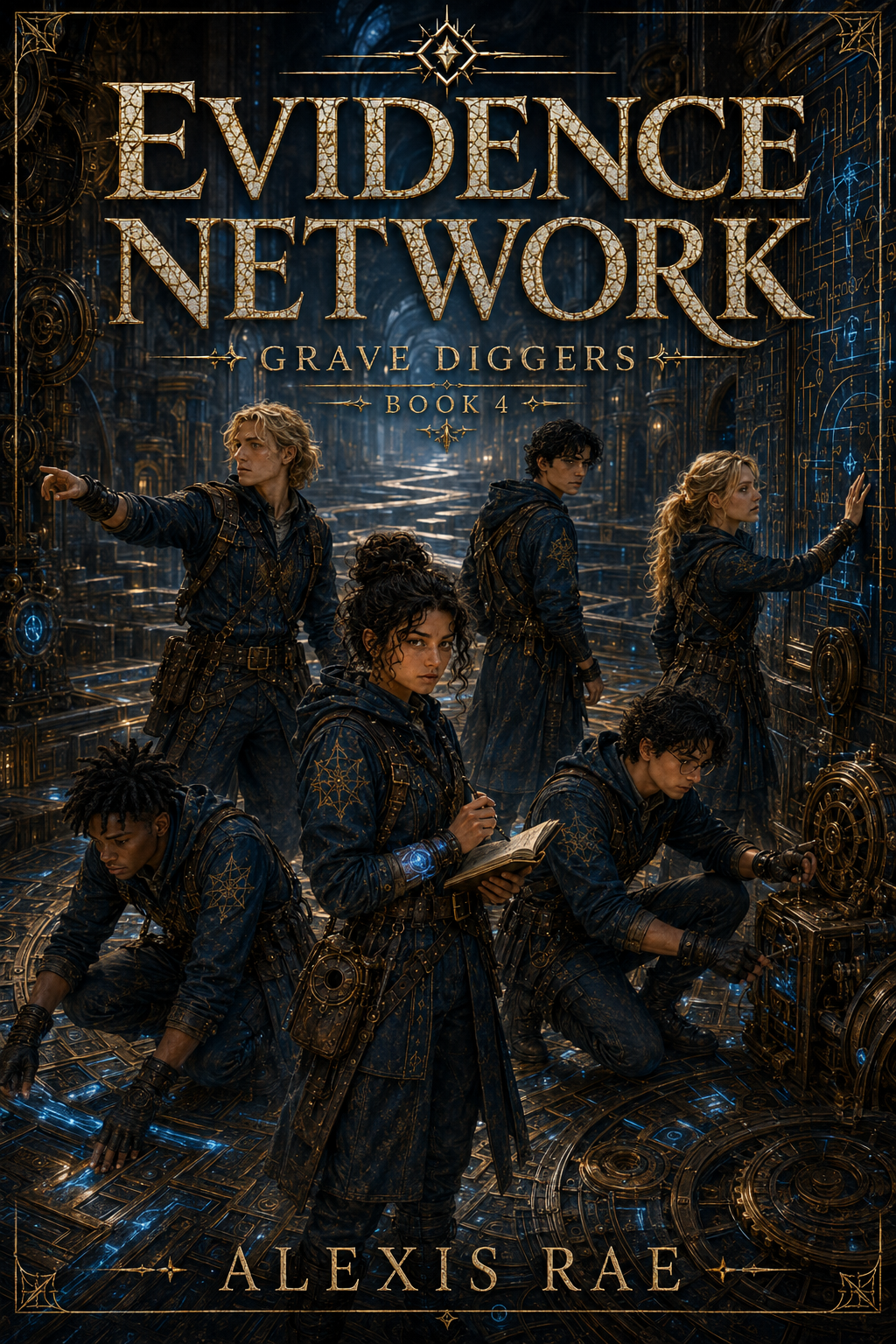
David crossed the threshold first.
The open dark did not stay dark for long. Three narrow marks appeared along the left wall as he entered, each one no brighter than a fingernail of white crystal. The triangular mark behind him dimmed but did not vanish.
Melody followed with her notebook already open to CURRENT STATE ONLY.
She asked for changes while she crossed. Loria gave her the three new route marks and the still-active triangle; Bram confirmed the threshold floor was clear.
Joss leaned toward the wall without touching it. “Nothing moving yet.”
Lucan looked past Melody to the others. “Keep the spread. Do not bunch at the opening.”
David had stopped four paces ahead. He was looking toward the left half of the passage.
Melody wrote the reports in the spaces beside their initials.
L: three marks. Prior mark dim, present.
B: threshold floor clear.
J: no mechanism motion.
Lu: spread maintained.
D: attention left.
Then she added her own line.
M: no interpretation required yet.
That was harder to write than it should have been.
The passage ahead widened just enough to offer two plausible lines around a shallow central ridge. Neither looked like a proper branch. The left side ran beside the new wall marks. The right gave them more room but no visible signal at all.
Loria lifted one hand. “First mark changed.”
The nearest white stroke had split into two short bars.
Bram crouched without stepping closer. “Center floor is roughening.”
A faint texture spread along the ridge between the two lines, subtle enough that Melody might have mistaken it for ordinary stone if Bram had not been watching for it.
Joss pointed toward the wall below Loria’s marks. “Seam underneath them.”
He traced the line in the air. A narrow break in the stone ran beneath all three marks and disappeared around a shallow plate no wider than his palm.
“Pressure plate?” Melody asked.
“Could be. Could also be a cover. It has travel room.”
David looked left again. “That side.”
Melody wanted one clean variable.
The maze gave her five.
Lucan stepped sideways, measuring the width between the roughening center and the marked wall. “If everyone takes David’s line together, spacing collapses.”
Melody wrote each report without ranking it.
Route mark altered.
Center texture active, low intensity.
Mechanism seam visible, state unknown.
David favors left.
Left line compresses formation.
She looked up before the pencil could keep going.
Loria pointed at the nearest mark and summarized what had changed: it split after David entered, while the triangle behind them remained dim but active. Bram added that the rough floor was still confined to the center. Joss confirmed the seam had not moved. Lucan said the stagger still fit if they avoided forming one line.
Melody turned to David. “Give me the route claim and the basis together.”
“Left is still better. It feels like the way through even though it is tighter.”
Melody wrote:
D claim: left route. Basis unresolved.
She did not add unreliable.
That was new too.
The center texture advanced another inch.
Bram saw it first. “Spreading now.”
The second wall mark brightened.
Loria tracked the stronger left response while Joss kept off the plate and reported no mechanical travel. Lucan measured the remaining width and laid out an offset stagger: David forward, Loria behind and right, Melody center-left, Bram rear-right, Joss rear-left off the wall, Lucan last to correct gaps.
Melody checked the geometry.
It kept everyone away from the central roughening. It kept Joss from brushing the seam. It let Loria watch the marks. It left David enough room to commit without pulling everyone after him at once.
“Do it. Leave the plate alone while it stays stable.”
Joss gave the plate one last look and kept his hands off it.
Lucan moved him a half-step farther from the wall with one flat hand against his shoulder. “Rear-left means farther from the seam.”
Joss adjusted.
Melody’s mouth tightened against a smile as David moved first.
The left route marks brightened one after another as he passed them.
“One. Two. Three,” Loria called.
The roughened center strip spread after him, then stopped short of the line Lucan had chosen.
“Center still active,” Bram said. “Not crossing our path.”
Melody moved when Lucan signaled her.
The wall seam stayed closed beside her shoulder.
Joss watched it instead of touching it.
“Still static,” he said.
“Spacing good,” Lucan called from behind.
Melody wrote only what mattered while she walked.
Left marks respond to D advance.
Center texture contained.
Seam unchanged.
Spacing usable.
The urge to stop and prove which observation caused which response was still there. She could feel the shape of the experiment she wanted. Send David back. Hold everyone else. Repeat the movement. Test whether the marks followed him or the group. Then isolate the floor response. Then the seam.
The center texture gave a faint ripple.
Bram said, “Keep moving.”
Melody closed the imagined experiment before it became an instruction.
“Continue the stagger.”
Loria passed the third mark. It dimmed behind her but stayed visible.
David reached the end of the narrow segment and stopped beside a widening in the passage.
The others followed one at a time. Nobody touched the seam. The roughened center never reached their chosen line. Lucan maintained enough distance that the formation did not collapse even when the passage pinched near the end.
When Melody stepped into the widening, she turned back.
All three route marks still glowed faintly.
The central texture remained behind them.
The seam had never opened.
No universal rule presented itself.
They had still made the move.
Melody opened a fresh line beneath CURRENT STATE ONLY.
Provisional move successful under current state.
She paused, then added:
Not proof of route rule.
David read it over her shoulder. “You could just write that the route choice held.”
Melody tapped each initial on the page. “It held because five other conditions held with it.”
The wall beside Joss clicked.
His head turned immediately.
The seam they had left untouched began to open.
The seam opened another inch.
Joss shifted away from it before Lucan had to tell him.
A narrow black channel appeared inside the wall, running forward beneath the stone surface. Something moved within it, not toward them but parallel to the passage.
“Passive opening,” Joss said. “No contact.”
Melody wrote:
J seam opening. Internal travel forward. No contact.
Loria raised her hand.
“New marks ahead.”
Beyond the widening, four pale strokes had appeared on the right wall beside a narrower section of passage. The first three leaned forward. The fourth stood vertical.
David looked at them.
The central floor between the group and the marks darkened by a shade.
Bram crouched.
“Roughness starting center-left.”
Melody looked down.
The texture was faint, but it was moving. Not spreading evenly from anyone’s foot. A crescent of granular stone traveled across the floor toward the wider opening on the left side of the obstacle.
Loria watched the marks.
“The second stroke is brighter.”
The crescent changed direction.
Bram pointed. “Hazard tracking the signal change, not us.”
Melody wrote the two observations beside each other.
L mark 2 +.
B hazard redirects after mark change.
She did not draw a cause arrow.
Ahead, the passage narrowed around a waist-high block of stone that split the route into two channels. The left channel looked wider. The right passed closer to the wall marks.
David had already turned his shoulders toward the right.
Lucan noticed. “Hold the commitment until we know where the floor goes.”
David stopped.
The right-wall marks dimmed slightly.
Loria saw it. “Signal dropped when he stopped.”
David looked at Melody.
She wrote:
D commitment reduced. R marks -.
Bram’s crescent continued toward the left channel.
“Left side is getting worse,” he said.
The granular texture thickened, then lifted in a low ridge across the wider route.
The obvious path was closing.
Joss leaned toward the opening seam behind them, following its internal channel with his eyes.
“It continues under the wall beside the right channel. If the plate ahead opens, leave it alone; loading it could redirect whatever is moving inside the channel.”
He pointed to a hairline rectangle beneath the pale route marks. “Same housing.”
Bram looked at the rising ridge across the left route.
“Could that redirect across the floor?”
“Could.” Joss kept his hands at his sides.
Melody recorded:
Linked mechanism possible.
Right wall plate: no contact.
Potential hazard redirect if loaded.
The left-side granular ridge rose another inch.
David stepped toward the right channel.
The first three pale strokes brightened together.
“Right response,” Loria said.
Bram tracked the floor.
“Left ridge still rising. Right lane clear for now.”
Melody looked at the geometry.
The right channel was narrow enough that all six could not enter in a simple line without compressing near the wall plate. Lucan was already measuring the available space.
He pointed to positions as he spoke. “David first. Loria after him but half a pace left so she can keep the marks in sight. Melody behind her. Bram stays wide enough to see the floor. Joss passes the plate last among you and stays off the wall. I close.”
Melody checked each constraint.
Right route responding.
Left route becoming hazardous.
Wall plate untouched.
Spacing possible if staggered.
“Use it,” she said.
David moved.
The pale strokes brightened in sequence as he entered the right channel.
Loria followed.
“First three full. Fourth still vertical.”
Bram watched the left ridge.
“It crossed the wide lane.”
The granular strip surged across the route they had not chosen and struck the base of the central stone block. The surface there lifted in sharp scales.
Melody wrote while moving.
Avoided lane now active hazard.
David’s route still responsive.
Loria stopped short of the wall plate.
“Fourth mark changed.”
The vertical stroke had tilted forward.
At the same moment, the rectangular plate beneath it shifted outward a fraction.
Joss’s voice sharpened. “Nobody touch the wall.”
Lucan widened the rear of the formation before anyone brushed it.
Melody looked at Joss.
“Passive movement?”
“Yes. Let it move.”
The plate extended another half inch.
Inside the open seam behind them, the black channel clicked.
Bram pointed to the floor on the right.
“New roughness under the plate.”
A narrow granular line appeared at the wall base and began creeping toward the center of the right channel.
They no longer had much room.
Lucan adjusted immediately. “David forward two. Loria one. Melody hold. Bram forward after the floor clears his step.”
David moved two paces.
The route marks advanced with him, appearing farther along the wall.
The granular line near the plate turned toward his previous position instead of his current one.
Bram saw the delay.
“It follows where the cluster was. Move through before it catches up.”
Melody wrote only:
Hazard lags formation.
Then she stopped writing.
“Lucan, use Bram’s lag.”
He nodded.
“Loria forward. Melody with her gap. Bram after. Joss waits until the plate retracts or the floor line passes.”
Loria moved.
Melody followed.
The wall marks stayed bright.
Bram crossed the narrow point as the granular line reached the space behind him.
Joss waited beside Lucan, both of them clear of the wall.
The rectangular plate extended fully.
Joss watched its movement.
“Do not touch it. Internal runner is still traveling.”
The floor line beneath the plate thickened, then swept across the right channel behind Bram.
Lucan held Joss back one more count.
The line passed.
“Now,” Bram called from ahead.
Joss moved through.
The plate began retracting as he cleared it.
Lucan came last.
The granular line turned toward his previous position but found empty floor.
He stepped into the wider space beyond the obstacle.
The pale route marks dimmed to a steady glow.
Behind them, the left lane was fully covered in raised scales.
The right wall plate settled flush again.
Joss listened to the internal channel.
“No movement.”
Bram looked back. “Hazard stopped at the split.”
Loria checked the wall. “Signal stable.”
David was already facing forward.
Lucan counted the six of them with a glance and let the spacing relax.
Melody opened her notebook.
The page held six different observations that had all mattered.
Loria had caught the signal shift.
Bram had predicted the hazard path before it became impassable.
Joss had identified the plate they could not afford to load.
David had committed to the route that kept responding.
Lucan had turned the narrow channel into a sequence the group could physically use.
Melody had done none of those things herself.
She had held them in one decision.
She wrote:
Obstacle cleared.
No single decisive input.
Then, beneath it:
L signal.
B hazard.
J mechanism restraint.
D route commitment.
Lu spacing.
M synthesis.
The wall behind them clicked once.
Nothing opened.
Melody looked at the list before the next state could make it harder to read.
“Keep that sequence,” she said. “I want to compare it while it is still clean.”
Melody kept walking while the click behind them faded.
“Same sequence,” she said. “Only what mattered.”
Nobody needed the categories repeated.
Loria had caught the first route-state change.
Bram had seen the hazard move before the wider lane became unusable.
Joss had identified the wall plate they could not afford to load.
David had committed to the responsive route.
Lucan had made the narrow line physically usable.
Melody turned to a clean page and wrote the order down again.
L signal.
B hazard.
J restraint.
D route.
Lu spacing.
M synthesis.
She drew no arrows.
The obstacle was behind them now, but the sequence was still recent enough that she could compare what each contribution had changed.
She started with Loria.
Without the second wall stroke brightening, they would still have had David’s preference for the right channel.
But they would not have known the maze was strengthening its response in the same direction.
Melody wrote:
Remove L → route state less legible.
Then Bram.
The left channel had remained visually wider even as the granular ridge began rising across it. Bram's call was what made that developing hazard part of the decision before the route closed.
Remove B → hazardous option remains plausible too long.
Joss next.
The wall plate had looked like a control because it moved. Touching it would have been the obvious test.
Joss had supplied the reason not to test it while the group was inside the narrow channel.
Remove J → mechanism intervention may contaminate safe line.
David.
The right-side marks had weakened when he stopped and strengthened when he committed again. Without the commitment, Loria’s marks would have remained less informative and the group would have had two incomplete routes instead of one increasingly responsive route.
Remove D → directional response remains ambiguous.
Lucan.
The right channel had been usable only because he staggered the six across its width and controlled who moved when the granular line lagged behind them.
Remove Lu → correct route may still be physically unusable.
Melody looked at the last initial.
M.
She had not seen the first signal change.
She had not predicted the granular ridge.
She had not read the plate.
She had not chosen the route.
She had not designed the spacing.
What had she done?
She looked back over the notes from the crossing.
She had kept each report inside its scope.
She had refused to turn David’s route claim into proof of safety.
She had let Bram’s hazard prediction eliminate an option without requiring him to explain the mechanism.
She had let Joss’s restraint matter without asking him to solve the whole wall system.
She had accepted Lucan’s formation because it satisfied several constraints at once.
She wrote:
M → keep partial reads in same decision without forcing common explanation.
The passage ahead bent gently right.
David slowed.
Melody looked up before he said anything.
A single pale mark had appeared at knee height on the inside wall of the bend.
Loria saw it too and identified one new signal while Bram checked the floor and Joss scanned the wall base. No roughness or exposed seam had appeared yet.
Lucan checked the width ahead. “Spacing can hold.”
David tilted his head toward the bend. “Still forward.”
Melody recorded the five reports in abbreviated form.
Signal: single mark.
Hazard: none visible.
Mechanism: none visible.
Route: forward.
Formation: stable.
She looked at the list.
Five separate observations.
No one of them carried the decision.
Together they supported continuing without changing anything.
“Forward,” she said. “Same spacing. Call change.”
They moved.
The single pale mark slid along the wall with David’s advance.
Loria tracked it while Bram kept the floor in view and Joss stayed a handspan off the wall. The mark moved with the front; the floor stayed clear; no mechanism responded.
Lucan kept the gaps open.
Melody added:
Network remains usable under new state.
The word stopped her.
Network.
She looked at the six initials again.
It was not a model of the maze.
It was a model of how they were seeing it.
Each channel incomplete.
Each useful at a different moment.
The result did not come from agreement between them. Bram’s hazard read did not confirm Loria’s signal. Joss’s mechanism restraint did not prove David’s route. Lucan’s spacing did not explain any of it.
The value came from combination and timing.
Melody wrote a heading beneath the initials.
PROVISIONAL EVIDENCE NETWORK.
Then, because the phrase looked more certain than the evidence deserved, she added:
Observed successful under one full obstacle + one continuing state.
The pale mark at the bend split into two.
Loria raised a hand as the signal changed. Bram's gaze dropped to the outside edge where the floor had begun darkening, and Joss pointed toward a shallow line that had appeared beneath the lower mark.
David stayed facing forward. “Route has not changed.”
Lucan widened the spacing before Melody asked.
The reports arrived fast enough that Melody did not finish drawing the seam.
She stopped trying.
“Current state.”
Melody took the reports in one pass: two marks, the lower tied to a visible but inactive seam; the outside edge changing while center stayed clear; the route still forward; spacing still passable.
She wrote all five lines.
Then she looked at the combined state rather than any one report.
The center remained clear.
The route had not contradicted itself.
The seam was inactive.
The signal had changed but not in a way that blocked movement.
Spacing could hold.
“Center line. No contact. Keep moving.”
David advanced.
The paired marks stayed lit.
The outside floor darkened farther behind them instead of crossing inward.
The seam remained closed.
Lucan kept the group centered until all six were past the bend.
Melody added one more note beneath the heading.
Network produced second usable decision under changed state.
She left the heading provisional.
Lucan read it as he passed near enough to see the page.
“Evidence network.”
Melody nodded.
He glanced at the six initials beneath it.
Then at the passage ahead.
“Looks like jobs.”
Melody looked at him.
Lucan was already watching the group’s spacing again.
She wrote nothing yet.
Melody looked at Lucan.
He was already watching the group’s spacing again.
He glanced at the notebook. “You wrote the same six functions twice: signal, hazard, mechanism, route, spacing, synthesis. Call them channels if you want. They are still useful functions.”
Melody looked down at the six initials. “Useful does not make them fixed.”
The passage ahead widened into a low chamber with a shallow trough cut through the floor. Pale marks ran along the far wall in uneven groups. Nothing moved yet.
Lucan slowed the group before the trough.
“Which part of that last obstacle worked because nobody knew what they were supposed to watch?”
Melody did not answer immediately.
He pointed at the notebook without touching it.
“Loria saw the signal. Bram saw the hazard. Joss knew the mechanism. David picked the route. I kept us from stacking into the wall. You held the reports together.”
Melody looked at the trough. “The reports interacted. Bram’s read changed after Loria’s signal changed, and Joss’s restraint mattered because of the route geometry.”
Lucan nodded toward the floor and wall. “And Bram still handled the floor. Joss still handled the mechanism.”
The distinction was too neat.
It was also difficult to dismiss while nothing contradicted it.
Lucan stepped to the center of the chamber and pointed without raising his voice.
“Loria, far-wall marks. Bram, trough and floor. Joss, any hardware. David, route. Melody, combine. I’ll keep spacing and movement.”
Nobody objected.
Melody wrote:
Default functions proposed by Lu.
Then beneath it:
Provisional.
Loria moved far enough left to see the whole wall without approaching it.
Bram crouched near the trough.
Joss scanned the edges where the floor met the wall.
David stayed near the front, looking through two shallow exits beyond the chamber.
Lucan kept all six separated enough that nobody blocked anyone else’s view.
The arrangement was efficient.
Loria spoke first. “Three groups of marks. Left group steady. Center pulsing. Right dim.”
Bram ran his gaze along the trough. “No texture change. Trough depth increases toward center.”
Joss pointed to a narrow metal-colored line just above floor level. “Mechanical seam on the right wall. Closed.”
David looked at the exits. “Left exit weaker. Right feels open.”
Lucan checked the geometry. “Right exit gives us more spacing.”
Melody wrote the reports in five lines.
Signal favors center activity.
Hazard state quiet.
Mechanism right wall, inactive.
Route pull right.
Formation easier right.
The first decision arrived faster than the ones before it.
“Right side,” Melody said. “Keep off the wall seam. Bram keeps the trough in sight. Loria keeps calling the mark groups.”
Lucan moved them.
David advanced toward the right exit.
The right-side wall marks brightened.
Loria called the rise while Bram confirmed the trough stayed stable and Joss reported no mechanism movement.
Lucan adjusted Melody half a pace left so Joss had more clearance from the wall.
They reached the right exit without triggering anything.
Melody wrote:
Role structure reduced duplicate scanning.
Decision faster.
She stared at the words.
Lucan saw them. “Useful?”
“Yes.”
He nodded once, as if that settled only the question he had asked.
The exit narrowed into a short corridor. A single white shape appeared ahead at shoulder height.
Loria raised her hand.
“New signal.”
Joss looked at the same shape. “Maybe a mechanism indicator. It changed with David’s movement, but it is also sitting over a recessed plate.”
Loria studied the shape while Joss leaned sideways to catch the recess in the light.
Melody stopped writing.
Lucan kept the same assignment: Loria on the visual change, Joss on the plate.
Melody looked from one to the other. The same object occupied both channels, but each of them was reading a different part of it.
Loria stayed focused on the white shape.
Joss stayed focused on the recess.
David shifted his weight toward the far end of the corridor.
The white shape rotated a fraction.
Loria spoke. “Signal rotation with route commitment.”
At the same instant, a soft click came from behind the recessed plate.
Joss said, “Mechanical response with the same movement.”
Melody wrote both.
Signal + mechanism overlap.
David held position.
The white shape stopped rotating.
The clicking stopped too.
Bram checked the floor. “No hazard change.”
Lucan looked at the corridor width. “Spacing is still good.”
Melody looked at the overlap note.
The maze had not respected Lucan’s division.
But the division had not failed either.
Loria had caught the visual response.
Joss had caught the internal one.
The fact that both belonged to the same object did not make either report less useful.
Lucan pointed down the corridor. “David holds. Loria watches the mark. Joss watches the plate. If the plate begins moving, call it before you cross the assignment unless immediate action is the only safe option.”
Joss kept his eyes on the recess. “That condition matters.”
Melody wrote:
Overlap unresolved. Role boundary may not match maze boundary.
Then she drew a second line beneath it.
Role structure still efficient under low pressure.
David relaxed his forward lean.
The white shape returned toward its original position.
The click inside the plate receded.
Loria and Joss both reported the reset, one visual and one mechanical.
Lucan treated the paired reset as another success for the same functions.
Melody marked the distinction in her notebook: two low-pressure successes supported default responsibilities, but they did not prove the boundaries were correct.
Lucan glanced at the passage ahead. “Defaults can change when the evidence changes.”
Melody could not argue with that without pretending the efficiency was not real.
She wrote:
Lu proposes default responsibilities.
Then under it:
Efficiency gain observed.
Overlap unresolved.
Ahead, the corridor opened again.
A second recessed plate was already moving before Joss had a clear view of it.
His attention snapped forward.
Lucan was still speaking.
“Keep your functions until we have a reason to change them.”
Joss took one step toward the moving plate.
Joss took one step toward the moving plate.
Lucan’s hand came up.
“Call it first.”
Joss did not stop looking at the recess.
“The plate is already past neutral. If it reaches the outer stop, the internal runner will lock against the wall channel.”
Melody looked at the plate.
It was moving faster than the first one had.
“How long?”
“Not enough for a vote.”
Joss stepped in.
Lucan shifted with him, preserving a path back instead of blocking him.
“Minimal input,” Melody said.
Joss pressed two fingers against the plate’s lower edge and arrested its travel before it reached the stop.
A hard click sounded inside the wall.
The plate shuddered once, then held.
“Runner stabilized,” Joss said.
The white route-shape Loria had been tracking vanished.
She turned sharply. “Signal gone.”
Melody wrote both changes.
J intervention → plate holds.
L signal extinguished.
No verdict.
Joss eased his fingers back without releasing the plate entirely.
“If I let it go now, it may finish the lock.”
Lucan watched the wall, then Joss, and marked the cost plainly: Joss had stopped a local mechanism lock by changing Loria’s signal state before the group finished reading it.
Melody looked from the extinguished signal to the held plate.
Both facts fit the evidence.
She wrote:
J action threshold: imminent local mechanism loss.
Then:
Cost: signal state changed before coordinated handoff.
Lucan pointed at the note. “Then the rule is not ‘do whatever you want.’ It is define the trigger.”
Joss’s fingers stayed on the plate. “A trigger only helps if the person watching the mechanism is allowed to act when it happens.”
Lucan’s jaw tightened.
Melody kept writing.
Default role retained.
Timing authority unresolved.
The plate gave another small pulse under Joss’s hand.
He adjusted pressure by less than an inch.
The internal click receded.
Loria stared at the blank wall where her signal had been.
Then a pale crescent appeared three feet farther ahead.
“New signal,” she said. “Not the same position.”
Melody turned.
David had already seen it.
He was facing a narrow continuation on the right side of the passage.
The left route remained wider and better lit.
Lucan looked at both paths. “Hold until we have the rest.”
David did not move.
The crescent stayed faint.
Bram checked the floor. “No immediate hazard on either side.”
Joss kept the plate stabilized. “Mechanism still wants to close if I release.”
Loria watched the crescent. “Signal is present but weak.”
Melody wrote the four reports.
David kept his eyes on the right passage. “The route evidence needs commitment. If I stay neutral, this is all we get.”
Melody looked at him.
His route channel had always required movement or intention strong enough to make the maze answer.
Lucan’s role structure expected the report before the decision.
David’s method sometimes required the decision before the report existed.
She wrote:
D route evidence may require commitment input.
Lucan saw the line.
“Then declare the test and keep it bounded.”
David nodded once.
He stepped toward the right passage.
The pale crescent brightened immediately.
A second crescent appeared beyond it.
Loria tracked two right-side marks while Bram confirmed the floor stayed stable and Joss reported no change in the held plate.
David took another half-step.
The two crescents joined into a narrow vertical stroke pointing deeper right.
Melody wrote:
D commitment → route signal strengthens right.
Lucan watched the new mark, then David. The response was useful, but it existed only because David had changed the state before the group finished evaluating it. David held the position that had produced the answer.
Melody drew a line between Joss’s note and David’s.
J: act when mechanism crosses local threshold.
D: commit when route evidence requires commitment to appear.
Different unilateral rules.
Same problem.
The passage ahead answered David again. The vertical stroke brightened, then extended another inch down the wall.
Lucan looked at Melody. “Can we use that without turning every assignment into permission to act whenever someone feels sure?”
Melody looked at Joss first.
His fingers were still holding the plate at the exact depth that had prevented the lock.
Then David.
His route commitment had produced a clear directional response no one else had been able to generate.
Neither action was random.
Neither had waited for consensus.
“Not with one rule yet,” she said.
Lucan looked dissatisfied, but not surprised.
Melody pointed to the right route. “We use the information we have. Joss holds the plate until Lucan has a movement order. David keeps the commitment where it is. Loria tracks the right signal. Bram watches for hazard onset.”
Lucan took over the geometry.
The right passage narrowed quickly after the first bend. He staged the group so Joss could release the plate only after the others had cleared its wall line.
“Loria first after David. Bram next. Melody. Joss releases on my call. I close.”
They moved.
David’s vertical route mark stayed bright.
Loria followed it.
Bram kept the floor clear.
Melody watched the plate and the passage at once.
When four of them were through, Lucan looked back.
“Release and move.”
Joss lifted his fingers.
The plate snapped outward.
The internal runner struck its stop.
A deep vibration passed through the wall.
The route mark ahead flickered but did not vanish.
Joss moved immediately.
Lucan came behind him.
The wall plate locked flush after they cleared it.
They were all through.
The right-hand passage opened into another shallow chamber.
Nobody celebrated.
Melody looked at the page.
Joss’s intervention had preserved the local mechanism state long enough to move.
David’s commitment had produced the route signal that got them through.
Both actions had also changed the shared evidence state before the group reached consensus.
Lucan’s default-role system had survived only because he had adapted around both violations after they happened.
Melody wrote:
Useful cooperation ≠ shared initiative rule.
Then two lines beneath it.
Mechanism threshold action.
Route-commitment action.
She left space under both.
Loria was already studying a new set of wall marks.
Bram had turned toward a faint ripple crossing the floor.
Melody looked up before either spoke.
The evidence network was still working.
Its rules were multiplying.
The shallow chamber narrowed again within twenty paces.
Loria stopped beside a pale vertical mark that had appeared on the left wall.
“Do not move yet.”
Lucan checked the floor before answering. “Spacing is stable.”
Joss looked for a seam beneath the mark and found none.
David stayed centered in the passage.
Bram watched a faint ripple moving along the floor near the right wall.
Melody opened the page beneath the two initiative rules she had just written.
Mechanism threshold action.
Route-commitment action.
Loria leaned closer to the wall without touching it.
The mark brightened.
She stepped back.
It dimmed.
Melody wrote:
L approaches mark → intensity +.
L withdraws → intensity -.
Loria looked at the others. “Watch this.”
She did not move closer again.
Instead she pointed toward a shallow notch farther down the wall. “What if that is connected?”
David turned his head toward the notch.
Joss looked at it too.
Melody followed their attention.
The pale mark brightened without anyone changing position.
Bram’s floor ripple continued unchanged.
Loria lowered her hand and had everyone look away from the notch.
The light faded.
Melody wrote:
Group attention to notch → mark +.
Attention withdraws → mark -.
Loria indicated the entry. The response had changed without anyone moving, and she framed that as evidence that deliberate investigation itself was one of the maze’s inputs.
Melody kept her pencil on the page. “Observed: intensity tracks directed attention under fixed positions.”
Loria nodded. “And my interpretation is that directed investigation is a distinct input the maze recognizes.”
Melody added the second sentence beneath the first.
The distinction held.
Loria had not claimed the mark was telling them where to go. She had identified a repeatable relationship between what the group deliberately examined and how the signal behaved.
David glanced back toward the notch.
The mark brightened again.
Loria saw it. “There. That is data before we know the mechanism.”
Melody wrote:
L standard: patterned relational response can be actionable before cause known.
The ripple on the right floor shifted.
Bram raised one hand.
“Different problem.”
The ripple had become a dark crescent moving slowly toward the center of the passage.
Lucan spread the group by a half-step.
The crescent bent away from the wider gap he created.
Bram tracked it.
“Again.”
Lucan restored the earlier spacing.
The crescent curved back toward the center.
Melody looked from the wall mark to the floor.
Loria’s signal changed when attention changed.
Bram’s floor behavior changed when spacing changed.
Two channels. Two input conditions.
Bram pointed toward the right-center floor. “Nobody stands there. I do not know the cause, but it keeps moving into compression and backing off when we widen.”
Melody watched the patch he indicated.
“That gives you a bounded action?”
“It gives me a place to keep clear before the explanation catches up.”
He did not sound bothered by the missing explanation.
Melody wrote:
B standard: repeatable behavior sufficient for bounded hazard action; cause unresolved.
Loria glanced at the dark crescent. She marked the difference between them: Bram was willing to act on a repeatable prediction without claiming what the floor meant, while she was treating the wall’s patterned response as information before its mechanism was known.
Melody looked up.
The difference mattered.
Loria was willing to say the wall mark carried information because its behavior tracked what the group chose to investigate.
Bram did not need to say what the floor meant. He only needed the behavior to repeat strongly enough to support an avoidance call.
Lucan pointed toward the open left half of the passage. “We can satisfy both. Keep our attention on the notch. Move left with spacing.”
David studied the route ahead. “Left works for now.”
Joss checked the wall. “No mechanism conflict.”
Melody wrote the current decision state.
L: directed attention on notch keeps mark bright.
B: compression predicts floor crescent advance.
J: no active mechanism.
D: route pull compatible left.
Lu: left-side spread maintainable.
M: no channel currently contradicted.
“Use the left side,” she said. “Keep the notch in view. Preserve spacing. Nobody crosses the right-center patch.”
They moved.
Loria kept watching the mark and notch relationship.
The light held.
Bram watched the crescent.
It stayed right of center.
Lucan maintained the gaps.
David advanced along the left line without needing a commitment test.
Joss kept scanning for hidden hardware.
The passage widened after six paces.
The wall mark split into two shorter bars.
Loria stopped. “Attention response changed.”
Bram looked down. “Floor crescent stopped.”
Lucan held the group exactly where they were.
Melody checked the page.
Both methods had produced useful constraints.
Neither depended on the same evidence threshold.
Loria had acted on patterned relation without mechanism.
Bram had acted on repeatable behavior without meaning.
They had used both successfully in the same move.
She added them beneath Joss and David.
J: act when local mechanism crosses threshold.
D: commit when route evidence requires commitment to appear.
L: treat patterned response to investigation as information.
B: act on repeatable hazard behavior without causal theory.
Four rules.
She looked at Lucan.
His rule was different again.
He wanted actions visible to the group, spacing preserved, and unilateral changes bounded enough that everyone else could continue reading the state.
Then she looked at her own notes.
Her standard was not the same as his either.
She wanted claims kept inside the scope the evidence supported and uncertainties named before they became assumptions.
Melody added two more lines.
Lu: preserve shared visibility + coordinated movement.
M: scope claims; separate observation, inference, unknown.
Six people.
Six standards that overlapped without matching.
The two wall bars changed again.
One brightened while the other dimmed.
Loria tilted her head. “The notch is no longer the strongest target.”
Bram looked at the floor. “Right-side crescent is moving again.”
David turned toward a shallow opening ahead on the left.
Joss raised a hand toward a narrow seam newly visible near the floor.
Lucan widened the formation before any of them committed farther.
Melody felt the old impulse to choose one rule that would make the others subordinate.
Mechanism first because it was physical.
Hazard first because it threatened bodies.
Signal first because it might describe the maze’s response.
Route first because movement itself revealed evidence.
Coordination first because unbounded action could destroy every channel at once.
Independent validation first because otherwise the page could become a record of shared guesses.
The hierarchy would have been clean.
The evidence was not.
Loria wanted to test the brighter bar’s attention response, but Bram would not support doing it from their current position while the crescent advanced, and Joss would not let anyone cross the newly visible seam until he knew whether it was loaded.
David kept his eyes on the shallow opening. “The route is pulling left again.”
Lucan looked at Melody. “We need one move.”
Melody looked at all five reports.
No single rule could absorb the rest without losing useful information.
She wrote:
Shared result does not imply shared standard.
Then she underlined it once.
“Loria, keep the attention test where you are. Bram, call the floor boundary. Joss, no contact, just tell me loaded or not. David, hold the route commitment at observation only. Lucan, give us a formation that preserves all four reads.”
Lucan moved Bram left and David half a step back. Joss stayed clear of the seam. Loria kept the brighter wall bar in view.
The dark crescent bent away from the group.
The seam remained closed.
The brighter bar steadied.
David’s shallow opening did not disappear.
Nothing had been resolved.
Everything was still usable.
Melody added one more line beneath the six standards.
Temporary compatibility observed.
The wall ahead clicked.
Two route marks appeared at once, one beside the left opening and one farther right.
Bram’s floor crescent divided toward both sides.
Loria inhaled sharply.
David shifted his weight toward the right.
Lucan raised a hand before anyone moved.
Melody looked at the two new options and the six rules already on her page.
The next problem was not whether they could share information.
They could.
It was what happened when useful information told them to do different things.
The left mark brightened first.
The right one answered a heartbeat later.
Neither stayed brighter.
Bram’s divided floor crescent moved toward both openings at once, thinner on the left and darker on the right.
Lucan kept his hand raised and took the reports without allowing anyone to commit. Loria favored the left because it continued the investigation pattern they had already established. Bram reported that the darker right-side hazard was also slower and might be traversable if the timing held.
David looked at the right opening. “Right is the route.”
Joss crouched near the seam without crossing it. “Nothing here disqualifies either side mechanically. The seam is loaded, but it is holding.”
Melody wrote four lines.
L: left signal continuity.
B: right hazard pattern slower / repeatable.
D: right route pull.
J: both mechanically possible for now.
Lucan measured both passages with his eyes. “Spacing works on either. Left is easier. Right needs a stagger.”
Melody added:
Lu: both formations viable.
The page did not narrow the choice.
It made the conflict cleaner.
Melody asked Loria for the recommendation itself, not just the signal report. Loria wanted to investigate left and would move that way if the mark kept strengthening under the test.
Melody wrote:
L recommendation depends on continued signal response.
Bram’s recommendation was narrower: right remained traversable if the floor lag held. He did not call it safer, only predictable enough to use.
Melody wrote:
B recommendation: right usable under current hazard timing.
David did not wait for the question.
“Right. Same basis as before, and the stronger evidence probably will not appear unless I commit.”
She added:
D recommendation: right. Stronger evidence may require commitment.
Three recommendations.
Two directions.
No common threshold.
Lucan stepped between the openings without blocking either one. He wanted a temporary rule that would let them move without everyone changing the state at once.
Joss looked up from the seam. “That can coordinate the choice, but it does not tell us which route is right.”
David kept his body angled toward the right opening instead of resetting to neutral. Loria stayed fixed on the left mark, preserving the investigation state she had been testing. Joss returned his attention to the loaded seam as it gave a faint internal tick.
Bram kept the floor prediction active, tracking both crescents without asking anyone else to stop reading their own channel.
Lucan’s gaze moved across all of them.
“This is exactly why we need a rule.”
Melody wrote:
Conflict has moved from reports → authority.
The right floor crescent advanced one inch.
Bram saw it. “Right timing changed. Shorter interval.”
Loria’s left mark brightened at the same time.
“Left signal increased.”
David leaned toward the right.
Lucan’s hand stayed up.
“Hold.”
The right mark brightened with David’s lean.
Loria looked across the chamber. “Now both signals are active.”
Melody wrote the new state.
Delay is changing evidence too.
That removed the easiest fiction.
Waiting was not neutral.
She looked at the two openings again.
Left had the cleaner active signal history.
Right had Bram’s repeatable floor timing and David’s route pull.
Joss could not eliminate either.
Lucan could move them through either.
The disagreement was real.
Melody asked each of them for the rule they would use. Lucan prioritized the route the whole group could execute with the fewest uncontrolled state changes. Joss prioritized preserving local intervention authority when a mechanism crossed threshold. David prioritized the route that answered commitment. Loria prioritized the most coherent response to deliberate investigation. Bram prioritized the behavior that remained predictable far enough ahead to move through.
Melody looked down at the page.
Her own answer would have been different again.
Choose the claim with the narrowest supported scope and the least unmarked uncertainty.
That did not solve the route choice either.
She wrote all six rules side by side.
None had authority over the others.
The left mark split into two bars.
The right mark became a short vertical line.
Bram’s crescents stopped moving.
Joss’s seam clicked once.
Everyone looked at him.
“Still loaded,” he said. “Not advancing.”
Lucan looked back to Melody. “We cannot keep all six standards equal and still make one move.”
Melody hated the sentence because it was probably true in this decision, with one route required now.
She turned the notebook sideways and drew two columns.
LEFT.
RIGHT.
Under LEFT:
L signal continuity.
Lu easier spacing.
No mechanism disqualifier.
Under RIGHT:
B predictable hazard timing.
D route pull.
Lu stagger viable.
No mechanism disqualifier.
Then she wrote across the bottom:
No current standard authorized to break tie.
David read the line and looked at her. “The evidence is tied. We still have to choose.”
The right mark brightened again.
Loria’s left bars did not dim.
Bram crouched lower and warned that the floor would move in two counts, maybe three.
Lucan looked at both routes, then at the six of them. He proposed a temporary rule: choose an option with enough support to move, preserve the ability to revise after the next state change, and use execution cost to break the tie. Left required less compression.
David’s mouth tightened.
Loria watched the left bars.
Bram looked at the right floor.
Melody understood what Lucan was doing.
He was not claiming left was truer.
He was using movement cost to break a tie the evidence had not resolved.
She wrote:
Temporary decision rule: sufficient support + lowest execution cost when evidence conflict unresolved.
Then beneath it:
Tie-break limited to this decision state.
The floor crescent moved.
“Left,” Lucan said. “Now.”
David did not move.
The right mark brightened hard enough to cast a pale edge across his sleeve.
For one count, Melody thought he might commit anyway.
Then he stepped left with the group.
The right mark stayed bright.
That mattered.
Loria entered the left opening first, watching the two bars.
They merged into one longer stroke.
“Signal coherent.”
Bram followed far enough to see the floor behind them. “Right hazard advancing. Left floor clear.”
Joss crossed the seam without touching the wall.
It clicked twice but did not open.
Lucan staggered the remaining four through the wider left passage.
Melody followed David.
He looked back once at the right mark.
It was still visible from the new passage.
She wrote while moving:
Chosen left by temporary tie-break.
Right signal persists after non-selection.
The sentence made her slow.
Lucan caught it immediately. “Keep moving.”
She did.
The left passage curved sharply and widened after ten paces. The right mark disappeared from view behind the bend.
The left wall stroke remained.
Bram checked the floor. “Clear here.”
Joss found no exposed mechanism.
Lucan let the spacing relax.
David looked back toward the bend. “Right did not fail.”
“No,” Melody said.
Loria looked at the left stroke. “Left did not fail either.”
Bram shrugged once. “We moved.”
That was the only result all three statements shared.
Melody opened the notebook to the two-column page.
The group had made a decision.
They had not resolved the standards behind it.
The temporary rule had worked because Lucan added execution cost to an evidence tie.
That did not tell them what to do when the cheaper route had weaker support, or when a mechanism threshold demanded action during a signal test, or when commitment itself created the evidence that another person wanted evaluated first.
She wrote:
Decision succeeded.
Conflict unresolved.
Melody boxed the two lines and left room beneath them for the next exception.
Ahead, the passage opened into a wider section where wall marks, floor texture, and two moving seams became visible at once.
Lucan saw them and stopped free movement before anyone crossed the threshold.
“Nobody advances. Reports first. One movement test at a time.”
Melody looked at him.
He had not solved their disagreement.
He had built a temporary container for it.
She drew five parallel columns on a fresh page instead of one route model.
Signal.
Hazard.
Mechanism.
Route.
Formation.
Then she looked up as the first wall mark changed.