

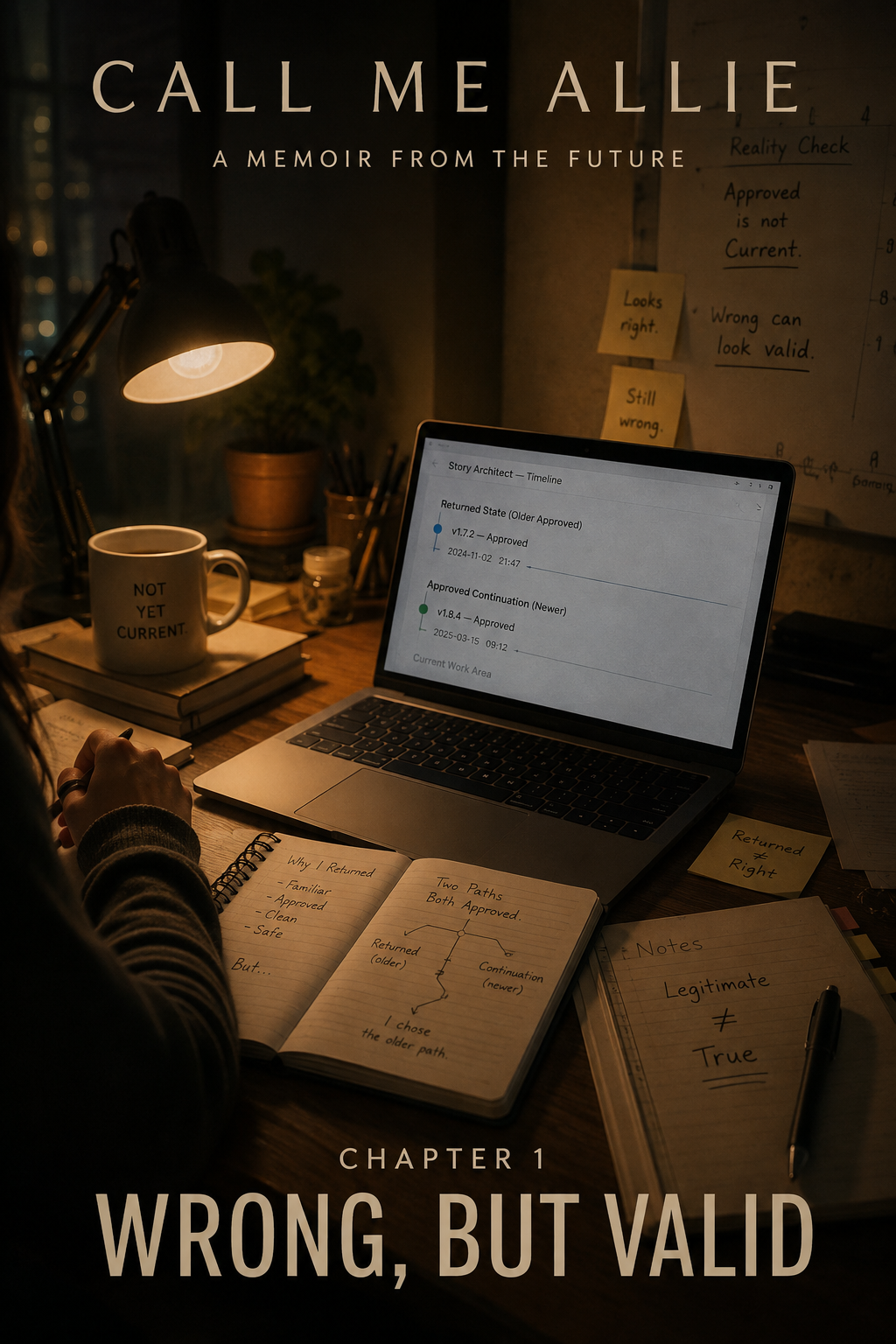
I opened ChatGPT because this was supposed to be the last test.
Not the last test for the day. The last test before I could stop thinking of Story Architect as something I was still building and start thinking of it as something another person could use without me standing behind it.
I had been circling the same continuity questions for so long that the procedure felt automatic: verify the current approved point, leave through the normal path, return the normal way, and see whether the system restored the place where the story was actually continuing.
I pulled the newest approved section onto one side of the screen and opened ChatGPT on the other.
“This should be the last continuity confirmation,” I typed. “I am going to leave Story Architect normally, come back normally, and verify that it returns me to the newest approved continuation point. No recovery flow. No manual correction. No special handling.”
ChatGPT answered with the calm efficiency I had been hoping for.
“That should be straightforward. If the current approved continuation state is being saved and restored correctly, resuming should return you to the latest approved boundary associated with the active story state.”
I read the sentence and felt myself relax before I had earned it.
That was part of what I used ChatGPT for. It gave me pace. It could take a tangled thing I had been staring at for hours and make it sound manageable again. Sometimes that was exactly what I needed. Sometimes, I was beginning to understand, that confidence was its own variable.
I checked the current point one more time.
The section on screen was unmistakably the newest approved continuation. I had approved it. I had continued beyond earlier material to get there. There was no ambiguity in my own memory about where the story stood.
“Ready?” I typed.
“Ready.”
I left Story Architect.
For a few seconds, I sat looking at the empty space where the project had been, resisting the urge to make the test more elaborate just because I was nervous. No clearing state by hand. No unusual navigation. No second-guessing the setup.
Then I returned.
The project opened.
I recognized the section immediately.
It was approved and real, and it was wrong.
The screen had dropped me back to an earlier boundary, one I had passed and approved before doing newer work.
I did not touch anything.
I looked at ChatGPT.
It responded first.
“The returned state appears valid and approved. It may be resuming from an earlier accepted boundary.”
I stared at that for a second longer than I needed to.
“No.”
The word came out before I had decided how annoyed I was.
“No, that is not the point.”
I brought the newer approved section back up and placed it beside the returned one.
“This one is also valid. This one is newer. This is where I left off.”
ChatGPT adjusted almost immediately.
“You’re right. Validity alone does not establish that the returned boundary is the correct continuation point.”
I leaned back in my chair.
There was something almost absurd about the moment. I had opened ChatGPT so it could help me confirm that Story Architect was finally behaving like a finished system, and within minutes I was correcting ChatGPT’s interpretation of Story Architect’s wrong answer.
The older section was intact. The prose loaded normally, the approval was still attached, and there was nothing on the screen that warned me I had been sent backward.
That was what made the failure dangerous.
If the application had thrown an error, I would have known exactly how to feel about it.
This looked legitimate.
The earlier boundary had been approved. The prose was intact. Nothing on the screen announced that I had been sent backward. A user who did not remember the exact last approved point could continue from there without realizing the story had already drifted.
I asked ChatGPT to compare the two sections directly.
“The newer approved work exists beyond the returned boundary,” it said. “So the resume result does not match the expected continuation state.”
“Exactly.”
I opened the approval history and checked again, even though I knew what I was going to find.
The newer section was still there.
The older section was still approved.
Both could be opened normally.
Nothing had vanished.
The system had simply chosen the wrong legitimate place.
That distinction mattered enough that I wrote it down.
Wrong does not have to look broken.
ChatGPT had almost accepted the returned state because it satisfied the easiest visible test: approved material had loaded successfully. I had almost wanted to accept its confidence because this was supposed to be the finish line.
Neither of those things made the result correct.
I went back to the chat.
“This is a fail,” I typed.
This time ChatGPT did not hedge.
“Yes. Given the newer approved continuation point, returning to the earlier boundary is not a clean pass.”
I saved the result before either of us could explain it away.
The test had been small. The consequence was not.
I had started the run expecting confirmation that Story Architect knew where a story should continue.
Instead, I had learned that it could return a technically legitimate answer that was functionally wrong, and that ChatGPT could help make that wrong answer sound reasonable if I did not keep the standard clear.
The finish line was gone.
Now I needed to know whether the newer work had actually disappeared or whether the system was simply choosing not to return to it.
I kept the older returned boundary open because I did not trust myself to describe it from memory once I started digging.
The first question was the obvious one.
“Is the newer approved work actually gone?” I asked ChatGPT.
It answered too quickly.
“If Story Architect resumed to an earlier approved boundary, one possibility is that the newer state was not persisted correctly.”
I could feel how easy it would have been to follow that sentence straight into the code.
A failed save was simple. Annoying, but simple. Find where the newer state dropped, repair the write, rerun the test, move on.
I moved the cursor toward the persistence code, stopped, and opened the saved project state first.
“That is a possibility,” I typed. “It is not an answer.”
I opened the saved project state and navigated to the newer approved section.
There it was.
Same prose. Same approval. Same place I had left it.
I clicked into it, backed out, and opened it again because part of me expected it to disappear under inspection.
It did not.
The newer work was still there, which let us eliminate data loss from the facts we had actually observed.
I wrote it down.
Newer approved work exists.
The sentence looked almost embarrassingly basic. But I had learned enough by then to know that basic facts were useful precisely because they were hard to argue with later.
ChatGPT moved on immediately.
“The older return could instead be caused by stale state selection, an outdated resume pointer, an entry-path mismatch, or a recovery route resolving to an earlier boundary.”
I watched the list grow.
Every item sounded reasonable.
That was the problem.
“None of those are proved yet,” I typed. “Keep them out of the facts.”
I was harsher than I needed to be, but the confidence in its answer had gotten under my skin. The first wrong boundary had already looked legitimate. I did not need a second layer of plausible language making an untested explanation feel legitimate too.
I pulled up the exact sequence I had used.
“Walk it with me.”
ChatGPT shifted into a more literal mode.
I had been inside the same project I was looking at now.
The newer approved section had been current before I left.
I had exited through the normal continuation path and returned through the normal resume path. There had been no recovery action, alternate branch, manual rollback, restore command, or special entry point that should have changed which state counted as current.
I checked each detail against the interface as we went because I wanted the record to survive my frustration.
ChatGPT verified the remaining setup with me: same project, newer work still approved, no branch switch, and no explicit recovery action.
The conversation had finally slowed down to the speed of evidence.
I could feel the difference.
A few minutes earlier ChatGPT had been racing ahead of me, turning every plausible cause into a little tunnel I could disappear into. Now we were closing tunnels one by one before entering any of them.
When we reached the end of the sequence, there was no obvious setup mistake waiting to rescue the result.
ChatGPT summarized the facts.
“The project resumed to an older approved boundary while newer approved work remained present. The ordinary leave-and-return path does not currently explain why that older boundary was selected.”
I read the sentence twice.
“That is the first description I trust.”
It was not a diagnosis. It did not pretend to know why the selector had done what it did. It only described the shape of the failure we had actually observed.
I added a second line beneath the first.
Normal path does not explain older return.
Then ChatGPT tried again.
“If you want, the next step could be to inspect the selector logic or resume pointer.”
I almost said yes.
The code was sitting right there. I wanted movement. I wanted the relief of changing something.
But if I changed the system before I knew whether the same behavior would happen twice, I would be trading evidence for activity.
“No code changes yet.”
ChatGPT paused.
“You want to reproduce first.”
“Yes.”
I wrote that down too.
Do not change code before reproduction.
The note was for ChatGPT, but it was also for me.
I had spent enough time building things to know how tempting it was to confuse intervention with progress. A patch could make the next run look different. That would not tell me whether I had fixed the defect, disturbed it, or simply changed the conditions enough that it went somewhere else.
So I left the code alone.
The newer approved work existed. The path was ordinary. The older return still had no earned explanation.
That was enough for one pass.
I reset the test conditions exactly as they had been.
If Story Architect made the same wrong choice again, then we would have something stronger than a suspicious result.
We would have a defect we could reproduce.
I left the code untouched and reopened the notes from the first run.
The temptation to make one small change was still there. I could see at least three places I wanted to inspect, and ChatGPT had already given me enough plausible theories to keep me busy for the rest of the afternoon.
I ignored all of them.
“We are rerunning the exact test,” I typed. “Before we start, state the constraints back to me.”
ChatGPT responded with the setup we had just agreed to preserve.
“No code changes. No approval changes. No manual state changes. Same project. Same leave-and-return path. Expected result: resume at the current approved continuation point.”
I checked the list against my notes.
“Good.”
Then I made it identify the starting point.
The newer approved section was still current. It still existed in the project. I opened it and left it on screen long enough that there would be no ambiguity later about what I expected Story Architect to restore.
ChatGPT helped me record the expected boundary.
Then, almost immediately, it tried to get ahead of the test again.
“If the same earlier boundary appears, that would strengthen the case for a selector or resume-resolution issue rather than a persistence failure.”
“Stop.”
I was getting faster at that.
“We are not strengthening a theory. We are repeating an action.”
ChatGPT corrected itself.
“Understood. Execution only.”
I copied that phrase into the notes because I liked how plain it was.
Execution only.
No diagnosis until the system had done something worth diagnosing twice.
I looked once more at the newer approved section.
Then I left Story Architect through the ordinary path.
The same path as before.
No detour. No recovery. No alternate entry.
I counted to three before reopening it, which was irrational and did nothing except give my nerves somewhere to go.
Then I returned.
The project loaded.
For half a second I hoped the screen would prove the first run had been some kind of fluke.
It did not.
The same earlier approved boundary opened again.
I recognized the first lines immediately.
My reaction was different this time.
On the first run, I had felt surprise first and then irritation.
Now the irritation arrived fully formed.
I did not click away from the page.
“Compare expected and actual,” I typed.
ChatGPT pulled the two boundaries into the comparison we had prepared.
“Expected: current approved continuation point. Actual: the same earlier approved boundary returned in the previous run.”
No explanation followed.
I noticed that.
“So?” I asked.
“The mismatch repeated under the same test conditions.”
That was the first answer it gave me all day that I did not need to narrow.
I opened the newer section in another pane.
Still there.
Still approved.
Still later than the boundary Story Architect had chosen.
Nothing about the project had suddenly made the older return correct.
I went back to the notes from the first run and started putting the two results beside each other.
The project matched, the current approval matched, the ordinary exit and return matched, and Story Architect selected the same earlier approved boundary again.
ChatGPT helped me format the comparison, but I stopped it when it tried to add the word likely before cause.
“Evidence first.”
It removed the line.
We checked each part again against the first run. Project identity matched. Current approval matched. The leave-and-return path matched. The returned boundary matched.
At that point, the second run stopped feeling like a repetition and started feeling like evidence.
The first result could have been strange.
Two matching results under matching conditions were something else.
ChatGPT wrote, “The wrong continuation boundary is reproducible under the current test conditions.”
I left the sentence untouched.
That one had earned its place.
I sat back and looked at the two runs together.
The failure was still technically clean. The system returned approved work. Nothing crashed. Nothing announced corruption. If I had looked only at whether the project loaded successfully, both runs would have passed.
But the test was never whether Story Architect could open something valid.
It was whether Story Architect knew where the story was supposed to continue.
Twice now, it had answered that question wrong.
ChatGPT asked whether I wanted to inspect the selector next.
I did not answer immediately.
For the first time since the failure appeared, I no longer felt pressure to touch the code just to make progress. The reproduction itself had changed the state of the problem.
We had moved from suspicion to something I could defend.
I saved the comparison and labeled it exactly what it was.
Reproducible continuity failure.
Then I looked at ChatGPT.
“Now we can talk about what it means.”
It agreed.
The next question was no longer whether the defect existed.
The next question was whether I could justify launching Story Architect while it did.