

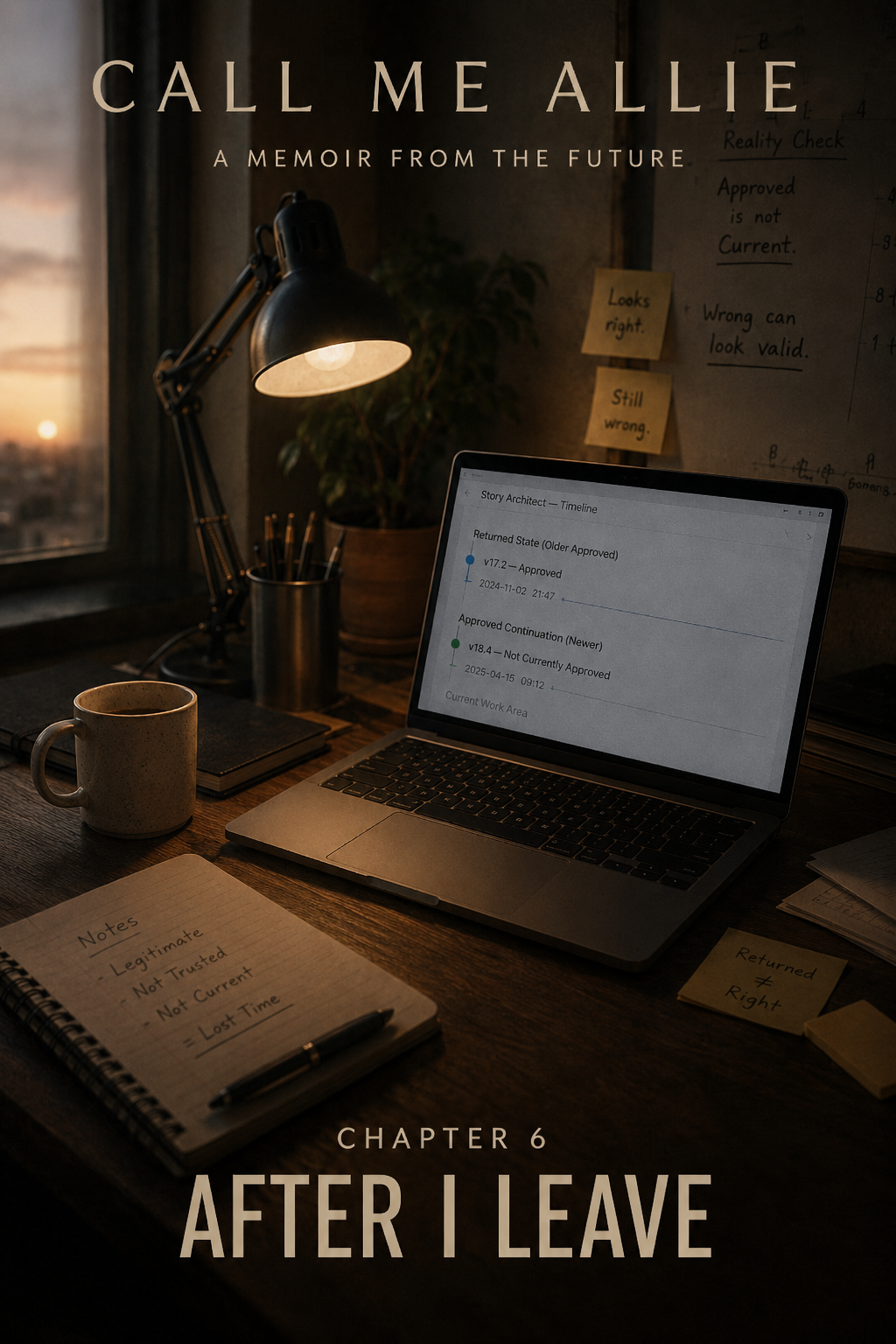
By then the room felt smaller than it had that morning.
The light outside had changed, the screen was too bright, and I could feel the day in my shoulders.
I wanted dinner. I wanted silence. I wanted to stop carrying the manuscript around in the front of my mind for a few hours.
Mostly, I wanted to know that I could walk away from it.
That should have been ordinary.
A writer reaches a stopping point, closes the laptop, and comes back later. The story waits. The last choice still belongs to her. She does not have to leave herself a note about where she left the note.
I had spent so many hours checking every little thing that this simple version of the future had started to feel luxurious.
I pictured tomorrow morning. Coffee first. Maybe music. Maybe ten quiet minutes before anyone needed anything from me. I would open the manuscript and try to hear the voice of the scene again.
I thought about how writing usually came back to me after sleep. Never all at once. A mood first. Then a sentence. Then the memory of why I had stopped where I did. Sometimes I came back convinced a paragraph was wrong and discovered I still loved it. Sometimes I came back to a problem that had solved itself somewhere between closing my eyes and opening the document again.
That distance was useful. It belonged to the work.
I did not want to destroy it by forcing myself to hold every practical detail in my head overnight.
There was something almost tender in the idea of leaving a story alone and trusting it to wait for me. I had always thought of that as part of the relationship between a writer and a manuscript. You leave. It stays. You return and find the thread again.
I wanted the tool around the story to disappear into that rhythm.
I did not want to come back already braced for a mistake.
I did not want the first feeling of the morning to be suspicion.
I wanted to read the page because I cared about the words, not because I was checking whether I had been put in the right place.
That difference sounded small until I imagined living with it every day.
A tiny hesitation before trusting the screen. A private note to myself just in case. An extra minute spent checking yesterday instead of writing today.
Those minutes would add up.
Worse, the doubt would add up.
Eventually I would stop treating the page as a continuation of my own decision and start treating it as a suggestion I needed to verify.
I did not want that to become normal.
I thought about the writers I knew who protected odd little rituals because the work was hard enough without unnecessary friction. A certain chair. A certain song. A certain hour before the house woke up. Those rituals were supposed to make it easier to enter the story. I did not want my own tool to create the opposite ritual, one built around suspicion.
I wanted the first few minutes back too. The ones where the mind is still quiet enough to hear a sentence before email, errands, and everything else starts making demands. Losing those minutes to checking yesterday would be a small injury repeated every day.
I also knew how quickly a practical annoyance could become emotional. One bad return might be irritating. Five would change the way I approached the work. I would start protecting myself before I started writing. The manuscript would arrive with a little question mark attached to it.
I did not want that question mark.
I wanted the writing to feel like mine when I came back to it.
I wanted the page to meet me where I had chosen to leave it, quietly enough that I could spend my attention on the sentence instead of the mechanism underneath the sentence.
That was the version of success I could imagine caring about a year from now, long after I had forgotten the exact details of the bug.
The room would not remember this evening. I probably would not either. But I would remember whether I trusted the tool enough to stop thinking about it.
So I looked at the place where I wanted to stop and let myself sit with it for a while.
The paragraph was familiar now. I knew the shape of it, the little visual rhythm of the lines, the feeling of where I had decided to pick up again.
I read it once more and let the choice settle.
“This is where I’m leaving it,” I typed to ChatGPT.
Then I closed everything.
The story disappeared from the screen. So did the conversation beside it.
I sat there with the empty desktop and felt an absurd urge to reopen the page immediately just to make sure it was still where I had left it.
I did not.
I wanted some distance between me and the choice, enough that I would have to trust something besides the picture still sitting in my short-term memory.
So I waited.
When I finally reopened Story Architect, I loaded the same project from saved state.
The project came back normally. The work was present, nothing looked corrupted, and there was no warning.
Then the story opened at the wrong approved boundary.
My stomach dropped anyway.
ChatGPT reacted before I did.
“The authority-first repair failed in fresh session.”
“Stop. Do not blame the selector yet.”
The returned boundary was valid. I knew it. I had seen it before. It belonged to the project and had once been a legitimate place to continue.
That made the failure more dangerous, but it did not tell me where the failure had occurred.
I pulled up the state I had deliberately left current before closing the session.
It was still there, still approved, and nothing had been lost.
“Compare what I left current with what this new session thinks is current,” I typed.
ChatGPT opened the reconstructed state.
For a moment neither of us said anything.
They did not match.
I went back to the two warm-session traces.
In those runs, the repaired selector had behaved correctly once the right state was already established as current. This fresh start had reached that selector with a different state already in charge.
ChatGPT corrected its first conclusion.
“The failure appears upstream of selection. The new session is handing the selector the wrong current state.”
“Trace it.”
We followed the new session from the moment persisted project state loaded.
The saved records and approved history came back. Before selection started, the session reconstructed a current state and handed that result to the repaired selector.
The selector stayed inside what it had been given.
That was the distinction I needed.
I made ChatGPT put it in plain language.
“The approved work is still present. The fresh session is rebuilding the wrong approved state as current before selection starts.”
I copied that sentence into the notes.
Then I put the two warm-session traces beside the fresh-session trace.
In the warm tests, the state entering selection was right and both histories passed. In the fresh test, the wrong state arrived before selection began.
I had spent hours forcing the repair to move authority resolution earlier.
Now the fresh-session path had exposed something earlier still.
ChatGPT started to suggest changes.
“We should modify persistence reconstruction so it derives current authority from the same source used in the warm-session flow.”
“Not yet.”
I opened the launch status.
Still blocked.
That part was easy now.
The harder part was preserving what we had earned.
I did not want this new failure to send us backward into another rewrite of the selector. I did not want the green regressions to become suspicious just because a different path had broken upstream.
So I wrote the state of the repair as one sentence: forward progress and rollback still passed in warm session, fresh-session reconstruction failed, the authority-first selector remained preserved, and launch stayed blocked.
ChatGPT read the sentence and did not try to collapse it into one diagnosis.
“That isolates the fresh-session failure without undoing the warm-session repair.”
I saved that line too.
The emotional difference surprised me.
The first continuity failure had felt like losing the finish line.
This one felt narrower, even though it still blocked release.
We had not gone back to zero.
We had found the next broken handoff.
I looked at the fresh-session trace again.
The approved work was there.
The selector was behaving.
The wrong state had been crowned current before either of those facts could help us.
That was enough for one Beat.
I closed the selector trace and left the reconstruction trace open.
The next question was how saved state rebuilt the wrong authority before the repaired selector ever got a chance to run.
The wrong page was still open when I came back to the desk.
I hated how normal it looked.
There was no warning, no broken layout, no obvious sign that anything had gone wrong. It was simply a page from my own story waiting for me as if it belonged there.
I could imagine trusting it.
I pushed my chair back and rubbed both hands over my face.
If I had come back the next morning with coffee in one hand and only a fuzzy memory of where I had stopped, I might have started writing before anything felt wrong. I might have spent twenty minutes following a thread I had already decided not to follow.
Then, when the mismatch finally surfaced, I knew where my suspicion would go first.
Back toward myself.
Had I changed my mind and forgotten? Had I remembered the wrong scene? Had I left myself somewhere else than I thought?
I pictured the small practical mess that would follow. I would start opening old notes, searching for the line I thought I remembered, and rereading pages I had already settled.
I could see myself losing the quiet part of the morning to it. Coffee going cold. A sentence I had wanted to write slipping away while I tried to prove where yesterday had ended.
Then there would be the harder thing to recover: confidence. Once I had caught the system putting me in the wrong place, every later return would carry a little hesitation with it.
I thought about how much energy I had already spent that day checking things I wanted to stop thinking about. I had come to the desk to build something that helped me write, and somehow I had spent hours learning how carefully I needed to watch it.
The room was quiet enough that I could hear the laptop fan. I pressed my fingertips against the desk until they hurt, then let go and looked back at the page.
I wanted tomorrow morning to feel smaller than this. I wanted to open the story, remember what I cared about in the scene, and start. No private ritual of checking myself against yesterday. No little knot in my stomach while I waited to see whether the page agreed with my memory.
I wanted enough trust left over for the writing itself.
I thought about how rare those first clear minutes could be. Sometimes the whole reason I got a scene written was because I caught the right feeling before the rest of the day crowded in. If I spent those minutes checking whether the software had put me somewhere strange, I would lose more than time. I would lose the small opening the story had given me.
I did not want to build around that loss.
I did not want the first thing I did with my own story to be checking whether I was allowed to trust it.
I wanted to sit down and spend my attention on the sentence in front of me. I wanted the page to feel like an invitation back into the work, not another problem waiting to be solved.
I brought up the page I had actually chosen and set it beside the one Story Architect had returned. Seeing them together gave me my first piece of relief: both were still there. Nothing I had written had vanished. The project remembered the work even though it had not remembered which part I had chosen to continue from.
ChatGPT was already trying to explain why. “The saved state may be rebuilding from an older approved record.” I typed, “Maybe. But we are not fixing maybe.” I wanted the first place my choice had been changed, not the first theory that sounded plausible. “Put the return path beside the page I left current,” I told ChatGPT. “Show me only where they stop matching.”
It walked backward once. The resume step had obeyed the place it was given. The new session had decided on that place after loading the saved project. The saved project itself still contained the work I expected. I stopped at that handoff. “Tell me what we can prove here without guessing the cause.” ChatGPT slowed down. “The saved project contains the expected approved records, but the new session reconstructs a different approved state as current before selection begins.”
I kept that sentence. ChatGPT immediately tried to fill the gap anyway: “It could be stale metadata, reconstruction ordering, rollback handling, or fallback precedence.” I opened a blank section in the notes and divided it in two. On one side I put what the evidence showed. On the other I put everything ChatGPT had just suggested. The suggestions stayed together under Hypotheses.
Under Facts, I wrote that the saved project still contained the work from the prior session, both warm-session cases still passed under the authority-first repair, and the fresh session had already chosen the wrong current state before resume selection began.
“Does anything in this trace prove why that reconstruction went wrong?” I asked ChatGPT.
“No. The current evidence does not establish which reconstruction mechanism caused the mismatch.”
That was the answer I wanted.
I left the hypotheses where they were.
The temptation to promote one of them was strong because every theory came with an obvious next edit. I could already imagine changing a marker rule, moving an ordering step, or adding a fallback check and watching the behavior move again.
I had done that once already.
I did not need to repeat it just because this new failure lived one layer earlier.
I went back to the warm rollback case because that was the history most likely to confuse the issue.
There, the older restored state had been honored correctly. Here, the new session had already made a different state current before the same resume logic took over.
ChatGPT read the two results side by side.
“The selector behavior is consistent. What changes is the state handed into it.”
That protected the repair we had already earned.
Then I asked ChatGPT to write a regression for the new failure without naming an unproved cause.
Its first attempt was too specific.
“Fresh-session persistence ordering must preserve current continuation authority.”
“No. We do not know ordering is the cause.”
It revised.
“After a fresh session loads saved project state, the reconstructed current approved continuation authority must match the authority established before the prior session closed, before boundary selection begins.”
I kept that one.
Beneath it I wrote the observed failure in plain language.
The project loads with the work intact, but the new session identifies the wrong approved state as current before Story Architect chooses where to resume.
That phrasing mattered to me because it kept the reader-facing consequence connected to the technical one.
A writer could still see all her work and still be placed in the wrong continuation state.
Nothing had to disappear for trust to fail.
ChatGPT started offering a repair candidate.
“We could compare the saved authority marker against rollback history before reconstruction completes.”
“No. Beat 3 defines the target. We are not fixing it here.”
It stopped.
I wrote the current state of the work in one sentence: both warm cases still passed, the fresh-session case failed, the authority-first selector remained intact, and launch stayed blocked.
Nothing in that sentence had changed while we traced the problem backward.
What had changed was the place I would look next.
I closed the selector trace and left the reconstruction handoff on screen.
The saved project still held the work I expected. The new session still made the wrong state current. The reason remained unproved.
I saved the regression beside the evidence and left the hypotheses underneath it.
The next repair would have to begin from that boundary, not from the first explanation either of us wanted to believe.
I kept the three outcomes beside each other because I needed to see the day accurately.
Twice, Story Architect had brought me back to the place I had actually chosen. Once, after I closed everything and returned fresh, it had not.
That last failure still meant I could not launch.
A writer should be able to walk away, come back later, and trust that the story will meet her where she decided to continue. I still could not promise that.
But I also refused to turn one new failure into proof that the whole day had been wasted.
I had been at the desk for hours. My shoulders hurt, the room had gone dim around me, and I was tired enough that disappointment could have rewritten the day if I let it. One red result at the end could easily become the only thing I remembered.
I did not want to leave carrying that version of the story either.
There had been real progress here. I had watched something that kept putting me in the wrong place learn to respect a choice I had actually made. I had seen that improvement survive two different situations instead of one convenient example.
That mattered to me because I wanted to end the day knowing I had moved forward, even if I had not moved all the way to launch.
Something important had changed. When Story Architect already knew which version I meant to continue from, it now honored that choice even when newer work existed somewhere else in the history. The fresh return was failing earlier, before that improved behavior had a chance to matter.
I wanted the next installment to begin with that distinction intact.
I did not want to reopen the project tomorrow and argue all over again about whether the earlier repair had worked. I wanted to keep the part that had earned my trust and carry forward only the part that had not.
“State the next repair target in one sentence,” I typed to ChatGPT. “Do not name a cause we have not proved.”
It answered carefully this time.
“Reconstruct the current approved continuation authority correctly from saved state before the authority-first selector runs.”
I read it once and left it alone.
Then ChatGPT immediately ruined its restraint.
“We should inspect the persisted authority fields, rollback markers, current-state references, and reconstruction order to identify which value is being promoted incorrectly during fresh-session load.”
“No.”
I put my hands flat on the desk.
“We are not starting the next repair inside this installment.”
ChatGPT paused.
“The target is already isolated.”
“Yes. That is the handoff.”
I could feel the difference between stopping because I was tired and stopping because the dramatic unit was complete.
Earlier in the day, stopping would have meant walking away from a blur of wrong returns, plausible theories, and fixes that had not earned my trust.
Now I knew exactly what had changed.
The first defect was no longer loose.
We had reproduced it.
We had defined the release requirement before touching code.
We had watched the narrow patch improve the behavior without actually satisfying the requirement.
We had used rollback to prove that recency and validity could not stand in for current authority.
We had moved authority resolution ahead of selection.
Then we had made that repair survive two histories that pointed in opposite chronological directions.
It was the reason the fresh-session failure was useful instead of catastrophic.
The system had gotten better enough for the next failure to become visible.
I opened the continuation note and wrote the handoff constraints under the target.
The fresh-session repair must preserve both warm-session passes.
It must not rewrite approval semantics.
It must preserve intentional rollback behavior.
It must not reintroduce selector exceptions as a shortcut around reconstruction.
And it must leave launch blocked until the new regression passes.
ChatGPT added one more sentence.
“The next repair should change only the path that reconstructs current authority from saved state unless evidence proves a broader scope is necessary.”
I kept that too.
The wording mattered because I knew how the next session could go if we were not careful.
We could reopen the project, see the fresh-session failure, and immediately start changing whatever field looked suspicious. We could convince ourselves that because persistence sat upstream of the selector, anything related to saved state was fair game. We could make the same mistake again at a new layer.
I did not want another repair that grew by proximity.
I wanted the same discipline that had finally worked here: one proven failure, one bounded target, one fixed success standard, and regressions that could tell us whether the next change repaired the defect without breaking what already worked.
I looked at the three result lines again and wrote them as one state: warm forward progress and warm rollback passed, fresh-session reconstruction failed, and launch remained blocked.
That was the continuation state I wanted saved.
Not a summary that said continuity was still broken.
Not a summary that said the repair had failed.
Not a summary that said Story Architect was fixed.
All three would have been wrong in different ways.
The truth was narrower and more useful.
The original wrong-resume defect had been repaired within a live session. The fresh-session path still rebuilt the wrong current authority before the repaired selector ever saw it.
I saved that exact distinction into the continuation note.
ChatGPT read it back.
“The next installment begins with saved-state reconstruction as the active defect boundary. The warm authority-first regressions remain protected and should be rerun unchanged after any persistence repair.”
“Good.”
Then it started again.
“We can begin by comparing the persisted current-state reference against the restored rollback history and the active approval chain.”
I held up one hand even though ChatGPT could not see it.
“Stop there. Save that for the next installment.”
For a moment I just sat there with the project open.
The launch status was still blocked at the top of the screen.
At the beginning of the day, that word had felt like failure.
Now it felt accurate.
The product was not ready.
But it was no longer broken in the same vague way it had been when I started.
The selector had a rule I trusted.
The two warm histories proved it.
The fresh-session defect had a location.
The next repair had a boundary.
That was enough progress for one installment.
I saved the continuation note with the three regression states, the failure location, the protected behavior, and the next target.
Then I closed the repair notes.
I did not close the problem.
That part mattered.
The next installment would not need to rediscover what had happened here. It would begin at the first unresolved handoff: saved state rebuilding the wrong current authority before the authority-first selector ran.
I left launch blocked and the reconstruction problem waiting.
For once, stopping did not feel like losing the thread.
It felt like handing it forward on purpose.