

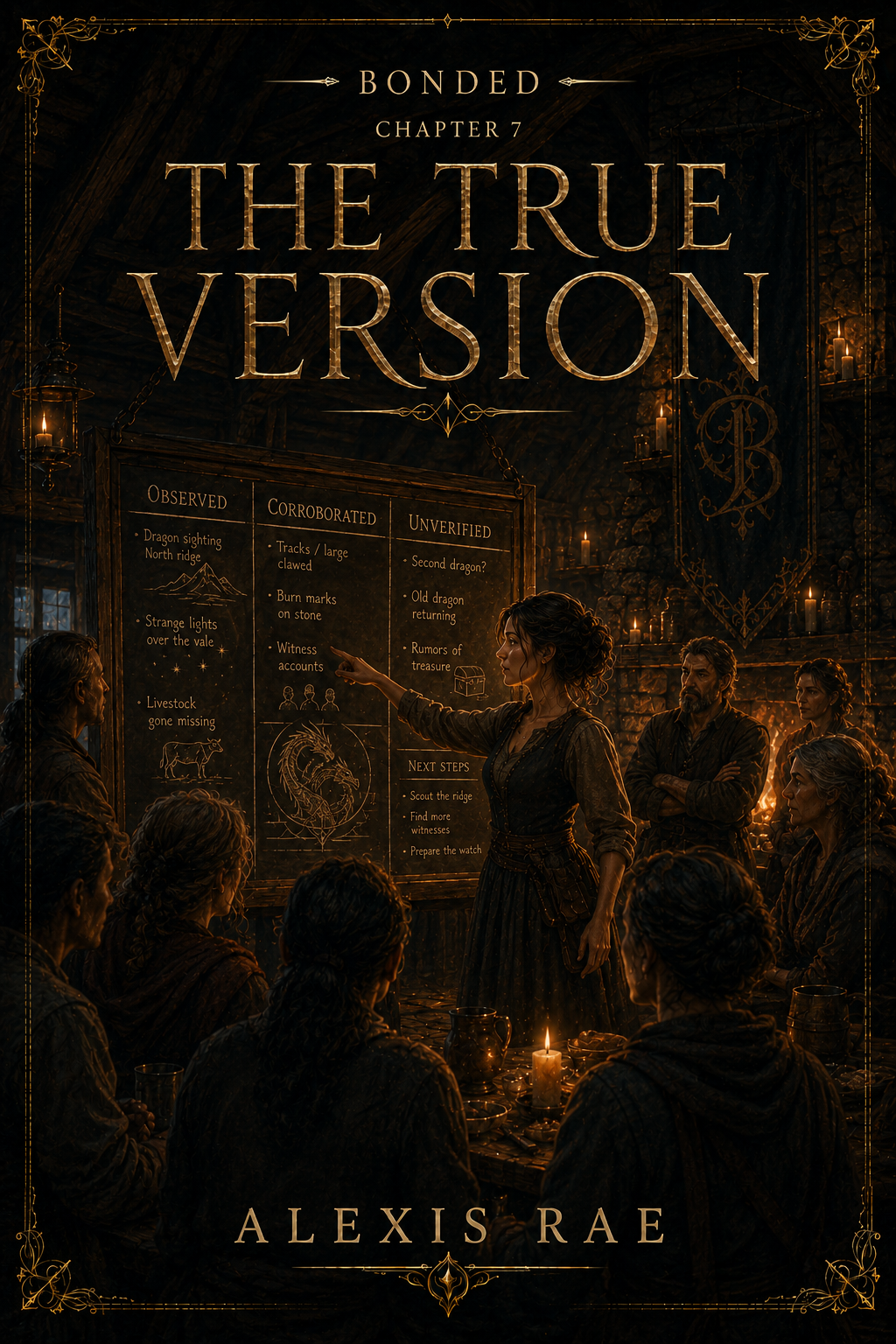
By the time the Hearthstone opened its front door, Alderwick had already improved the story twice.
The first man through the door stopped with one hand on his coat clasp and asked, “Is the south road still closed?”
Nairis was carrying a basket of yesterday’s bread toward the kitchen.
“It was never closed.”
He frowned.
“That is not what I heard.”
“Then you heard wrong.”
Nairis kept walking.
Behind him came two women from the cooper’s lane, then a farmer with mud to his knees, then Orren’s cousin with a wrapped bundle under one arm. The morning brought cold air in with them, and questions followed faster.
One woman wanted to know whether raiders had been seen. The farmer had heard that something followed the warriors as far as the west marker.
Nairis set the bread basket on the kitchen table.
Mara looked at her over a pot of oats.
“That was quick.”
“Too quick.”
Nairis turned back toward the common room.
The returning warriors were not all awake yet. Teren had not come downstairs. Pell was somewhere above them, judging by the heavy step that crossed the ceiling and stopped. Davin sat near the hearth with his mother, looking as though sleep had helped without doing enough. Rowan was not in sight.
That suited Nairis.
The morning had enough people speaking for him already.
At the long table, the farmer was telling the two women from cooper’s lane that the warriors had found men hiding in the brush.
Nairis crossed the room before the sentence reached the next table.
“No one found men hiding anywhere.”
The farmer looked up.
“I said they might have.”
“You said they had.”
His mouth tightened.
One of the women leaned forward. “So no raiders were seen. Then why did they leave the road?”
“No raiders were seen,” Nairis said. “And why they left the road is a different question.”
Nairis took the empty cup from in front of the farmer and replaced it with a clean one from the tray beside her.
“If you do not know the answer, do not turn a guess into a sighting before breakfast.”
The farmer looked faintly offended.
“I was repeating what I heard.”
“That is how it arrived here.”
She moved on.
At the front table, another villager was saying something about a thing in the trees.
Nairis stopped beside him.
“What thing?”
He blinked.
“I do not know. The thing they heard.”
“They heard brush move in bad weather. No one saw what caused it.”
The man looked toward the door.
“Jessa said Rowan told everyone it was serious.”
“He said the signs were serious enough not to dismiss. That is not the same as saying he knows what caused them.”
The man’s mouth opened, then closed. His gaze shifted toward the dark windows as though searching them for something he had only just realized no one had described.
Nairis let go of the chair.
“Serious is his judgment of the pattern. It is not a description of a creature, a raiding party, or anything else no one saw.”
Across the room, someone said, “I heard the south fields were unsafe.”
Nairis closed her eyes for half a second.
Then she opened them and turned.
“Who told you that?”
The speaker, a woman standing near the peg wall, looked toward a younger man beside her.
“He said the ditch was near the south fields.”
The younger man shook his head. “I said the west marker is on an approach people use for the south fields. I did not say the fields were unsafe.”
Nairis faced them both.
“That distinction stays attached to the story.”
The common room had not gone quiet. It had become attentive in pieces.
People were still ordering breakfast. Mara was still calling for bowls from the kitchen. Someone near the hearth laughed at something Davin’s mother said. Yet every few breaths another fragment of the road story surfaced from a different direction.
Tracks became tracks from armed men.
A damaged ditch became a blocked road.
Brush moving in rain became something following the warriors.
Rowan’s caution became certainty.
None of the changes required anyone to lie.
That was worse in its own way.
Nairis took a pitcher from Orren and began filling cups.
She asked the woman by the peg wall where the blocked-road story had come from. It had passed from her sister to her sister’s husband, then through Pell’s cousin before reaching the Hearthstone.
Pell’s cousin was not in the room.
Nairis filled another cup.
“And did any of them see the road?”
The woman hesitated.
“No.”
“Good. Keep that part attached to the story.”
She moved to the next table.
A boy of perhaps fourteen caught her sleeve.
“Did they really find tracks? Were they big?”
“Deep,” Nairis said. “That is what was established. I do not know how big.”
He seemed disappointed by the answer.
Nairis tugged her sleeve free.
“Learn to like that sentence. It will save you trouble.”
Mara came out of the kitchen carrying a stack of bowls.
“Nairis.”
There was something in her voice.
Nairis crossed to her.
Mara kept walking toward the nearest table as she spoke.
“A woman at the back door said the warriors were chased off the ridge. She heard it from someone at the mill, but she could not say by what.”
Nairis stopped.
The mill was already open.
So the story had crossed the square before breakfast was finished.
Nairis looked toward the room.
Three conversations had become five. People were asking each other questions instead of asking her now, and every answer had the chance to pick up another edge before it reached the next pair of ears.
Correcting one sentence at a time was not going to hold.
Orren came past with another pitcher.
“Someone outside says the west road is closed.”
Nairis stared at him.
“It is not. Did you tell him that?”
“I did. He did not look convinced.”
Nairis looked toward the hearth.
The board was still where she had left it the night before, angled toward the wall beside Rowan’s chair.
For one moment she considered leaving it there.
Then the woman by the peg wall asked the farmer whether the tracks had reached the south fields.
Nairis crossed the room.
She took hold of the board and turned it toward herself.
The chalk marks were still there.
Rain. Ridge marker. Split pine. West marker. South bend. Close order. Sound.
Nothing on the board said raiders.
Nothing said pursuit.
Nothing said the road was closed.
Nothing said the south fields had been reached.
Behind her, conversations kept moving.
Nairis picked up the chalk from the ledge.
She turned to face the room.
“Enough.”
The word did not need much volume.
People nearest her stopped first. The quiet spread outward.
Nairis waited until most of the room was looking her way.
“Before anyone argues about what Alderwick should do, we are going to make sure we are all arguing about the same thing.”
A man near the door opened his mouth.
Nairis raised the chalk.
“No guesses first.”
He closed it again.
Nairis turned back toward the board.
She did not write yet.
Not until the room was ready to hear what had actually happened.
Nairis turned the board fully toward the room.
The chalk marks looked smaller in daylight.
“Start here,” she said.
She tapped the first word.
“Rain.”
A man near the door folded his arms.
“We know it rained.”
“Yes. And it matters because the rain did slow them.”
Nairis looked across the room.
“It made the road difficult. It did not close it.”
The woman from cooper’s lane frowned.
“Then why did they leave it?”
“We will get there.”
Nairis moved the chalk to the next marks.
“North of the ridge marker. Before the old split pine.”
Davin had come closer to the hearth but stayed beside his mother.
Nairis did not call on him yet.
“The returning group found fresh tracks crossing the road from north to south. No one established whether they were human or animal.”
Nairis let the silence after that do some work.
“They were deep. There was more than one set. The rain had not blurred them enough to make them old.”
She tapped the board again.
“The road was still usable, and they left it because of what they saw there before later returning to it.”
She moved the chalk down the board.
“Farther west, near the west marker before the south bend, there was another disturbed place.”
The room had gone quieter now.
Nairis continued.
“The ditch bank was torn down through the mud. Brush was flattened. Ground beyond it was churned.”
The same woman from cooper’s lane raised a hand.
“Blocked?”
“No. The road itself was still passable there too.”
Orren set a tray on the side table and stayed where he was.
Nairis could feel people trying to fit the pieces together faster than she was giving them.
She did not speed up.
“After those signs, the group changed how they traveled. They tightened their spacing. They kept everyone in sight. After the ditch, no one went ahead alone.”
A boy near the wall raised his voice. “Because they thought something was following them?”
Nairis shook her head.
“They changed how they moved because they did not understand what they were seeing.”
She tapped the final mark.
“Sound.”
Several heads turned.
“Pell heard brush moving off the road. Harlan heard it too. Jorin heard the second time.”
A woman near the window pulled her shawl tighter.
Nairis continued before anyone could turn the sound into a creature.
“They could not place the source. There was wind. No one saw what caused it.”
The woman loosened one hand from her shawl.
“So that part tells us nothing?”
“It tells us they heard something they could not identify.”
Nairis put the chalk down on the ledge.
“That is not nothing. It is also not proof of pursuit.”
The man near the door shifted his weight.
“And Rowan?”
Nairis looked toward the stairs.
Still no Rowan.
“He gave an assessment of the whole pattern.”
Several faces turned toward her.
“He said the signs were serious enough that he would not dismiss them as ordinary frontier trouble.”
The farmer at the back rubbed one hand across his beard.
“So he thinks something dangerous is out there.”
Nairis looked at him.
“He thinks the pattern is serious. You added a thing he has not identified.”
The farmer’s mouth closed.
Nairis turned back to the board.
“Rowan could not tell us what caused the signs or whether all of them came from the same source. Raiders and animals are both still possible, but possible is not the same as proven.”
Nairis picked the chalk back up.
“What he could say was narrower.”
She drew no new marks.
“Fresh disturbances at more than one place. A usable road abandoned more than once. Trained travelers changing how they moved because the uncertainty did not go away.”
Mara stood in the kitchen doorway with both arms folded.
Nairis looked over the room.
“That is the version we start from. If someone heard something else, they say who saw it. If no one saw it, they call it what it is: a report, a guess, a fear, something second-hand.”
She pointed toward the board.
“Not a fact just because it frightened somebody on the way here.”
The boy near the wall looked at the marks.
“So the road is open. The south fields are not known to be unsafe. No one saw raiders, and no one saw what made the tracks.”
Nairis nodded once.
“That is correct.”
She let that sequence settle.
The board had not become less troubling in daylight.
It had become cleaner.
That mattered more.
She set the chalk down again.
“If you have questions, ask them from this version.”
The room stayed quiet for one breath longer.
Then Jorin’s voice came from the stairs behind them.
“And if you get one of the details wrong, ask someone who was there.”
Nairis turned.
Jorin stood on the lower step, awake enough to look irritated by the whole village.
Nairis looked back at the room.
She rested one hand against the board.
“Then we do that next.”
Jorin came down the rest of the stairs.
He looked as though sleep had done little more than make him less muddy.
Nairis stepped aside from the board.
“Specific questions,” she said. “Ask about something that happened. If you want a theory, save it.”
Jorin stopped beside the hearth and folded his arms.
The farmer at the back spoke first.
“Those tracks near the ridge. You saw them yourself, and they were still fresh?”
“Yes. The rain had not softened the edges much. They crossed the road north to south, more than one set, deep in places.”
Nairis tapped the ridge marker on the board.
“And the road?”
“Usable.”
The farmer glanced around as if checking whether anyone else had heard that word.
A woman near the window lifted her hand.
“Then why leave it? Because Rowan knew what made the tracks?”
Jorin’s answer came flat.
“No. We did not know what made them. That was the problem. The ground beside the road gave us room to move without walking straight through the crossing. We used it. That was caution, not recognition.”
The farmer rubbed his beard.
“So Rowan did order you off the road.”
Jorin’s eyes narrowed.
“He made the call. That is different from knowing what we were avoiding.”
Nairis touched the chalk to the board.
“Keep those two things separate.”
A chair scraped near the hearth.
Davin had stood.
His mother looked up at him immediately.
“I can stand for one question,” he said before she could object.
Nairis almost told him to sit anyway.
Instead she pointed toward the first crossing on the board.
“Only what you saw.”
Davin nodded.
The boy near the wall leaned forward.
“Was there really broken brush beyond the tracks, and how much could you see?”
“Enough that I noticed it from the road. Stems bent apart. Mud pushed under them. It looked like something had gone through.”
The boy opened his mouth.
Davin raised one hand.
“I did not see what.”
The boy closed his mouth again.
Nairis looked over the room.
“That last sentence stays attached to the first one.”
Davin sat back down before his mother had to make him.
A woman from cooper’s lane turned toward him.
“Did the tracks continue into that brush?”
“I saw marks leave the road toward it. After that, I could not read enough in the rain to tell you exactly what happened.”
Nairis gave him a small nod.
The room was beginning to hear how narrow a true answer could be.
Footsteps sounded on the stairs again.
Sella appeared with one hand on the rail and her shawl wrapped around her shoulders.
Nairis looked at her.
“You do not have to do this.”
“I know.”
Sella came down anyway.
She chose the chair nearest the board and sat.
The woman by the peg wall spoke before anyone else could.
“The ditch near the west marker. Was the road blocked or flooded there?”
“The ditch was running hard. The road was still passable.”
Sella glanced at Nairis’s chalk mark.
“The bank was pushed down through mud. Brush on both sides was flattened. The ground beyond it was churned.”
“Toward Alderwick?” someone asked.
Sella’s mouth tightened.
“I could not tell you that. Some stems were flattened toward the road, some away. Water was running through it, and rain had worked the whole place. I could tell something had disturbed the bank. I could not read a clean direction from it.”
Nairis watched the woman by the peg wall nod slowly.
She was no longer reaching for a direction Sella had not seen.
At the long table, the man who had asked about raiders the night before cleared his throat.
“So nobody saw raiders or an animal. What did you actually see?”
Davin looked at him.
“We saw the road. We saw the tracks. We saw the brush. Sella saw the ditch. We saw enough to change how we traveled. We just did not see what caused it.”
Nairis looked at him.
That was the cleanest sentence he had given them.
She let it stand.
The front door opened.
Cold air moved through the room.
Rowan stepped inside carrying a folded cloak over one arm.
He stopped when he saw the board turned toward the room and half the Hearthstone watching Jorin, Sella, and Davin.
Nairis met his eyes.
“Good morning.”
His gaze moved across the room.
“That depends.”
A few people smiled despite themselves.
Nairis did not give the moment room to turn lighter than it should.
“We are checking facts against witnesses.”
Rowan hung the cloak on a peg.
“Better than checking them against breakfast tables.”
The farmer at the back raised his voice.
“Then answer one. Was something following you, or did you think something was?”
The room tightened again.
Rowan did not hesitate.
“We do not know. I thought the signs were serious enough that we should keep behaving carefully until we understood more. If I had evidence of pursuit, I would say pursuit. We did not have that.”
The farmer looked dissatisfied.
“What about raiders, animals, or something worse?”
Rowan’s expression barely changed.
“All possible. None established. Possible is a large word. It is not evidence.”
The room went still enough that Nairis heard Mara set down a ladle in the kitchen.
Rowan looked toward the board.
“The returnees can tell you what they saw. I can tell you why the pattern concerned me. Neither of those gives anyone permission to turn a guess into a name.”
Nairis picked up the chalk again.
“That is the rule.”
She faced the room.
“If you have a question about the road, attach it to a place, a sign, or a person who was there. If you have a theory, call it a theory before you say it aloud.”
The man near the door raised one hand.
“What if the theory changes what we should do?”
Nairis looked at him.
“Then we will argue about what the facts justify, not about which guess frightens us most.”
The quiet that followed had weight now. People had stopped trying to repair the story and were waiting to hear what the verified version required of them.
Jorin was standing beside the hearth. Sella sat under her shawl. Davin had returned to his chair. Rowan remained near the board, tired and watchful.
Four people who had been on the road were now in front of the village.
None of them had given the rumor anything new to feed on.
Nairis set the chalk on the ledge.
“Good. We know what happened well enough to stop fighting over that part.”
She looked across the room.
“Now we can decide what those facts justify.”
Nairis kept one hand on the board.
“Now we can decide what those facts justify.”
The answer came from the far side of the room before anyone else could speak.
“Nothing yet.”
The farmer who had challenged Jorin leaned back against the wall.
“We still do not know what caused any of it. The road is open. No one saw raiders. No one saw a beast. Until somebody finds something real, changing how the village lives is how you frighten people over mud and broken brush.”
Several heads nodded.
Then the woman by the peg wall turned on him.
“And if whatever did it is already near the south fields? I say we close the approaches until we know more.”
The farmer spread one hand toward the room. “That would keep half the village from its ordinary work.”
The room began to rise around the argument.
Nairis lifted the chalk.
“Stop.”
The two sides quieted by degrees.
She looked first at the farmer.
“You want no change until the danger is clearer. Then tell me what fact makes that safe.”
His jaw tightened.
“I said it was normal.”
“Normal is what we were doing before we had this information.”
Nairis tapped the board.
“Now we have it.”
The farmer crossed his arms.
“So what? We invent danger because the road looked strange?”
“No. We admit that doing nothing also depends on a guess.”
He frowned.
“What guess?”
“That whatever caused these signs is gone, far enough away, or harmless enough that Alderwick can ignore it.”
The room went quieter.
Nairis waited.
“Do you have evidence for that?”
The farmer looked toward Rowan.
Rowan did not help him.
“No,” the farmer said at last.
Nairis nodded.
“Then doing nothing is not the absence of a choice.”
She turned toward the woman by the peg wall.
“You want the approaches closed because you want people kept safe. Tell me what fact shows that closing them answers the danger we actually have.”
The woman hesitated.
“The ditch was close.”
“Close enough to matter. Not close enough to prove direction.”
The woman’s mouth tightened.
Nairis kept going.
“What fact tells you there is an attack coming?”
No answer.
“What fact tells you the returnees were pursued?”
Still none.
“What fact identifies a threat that closing roads would actually solve?”
The woman looked down.
Nairis lowered the chalk.
“That does not mean your fear is foolish. It means fear is not evidence either.”
Rowan shifted near the board.
A man by the hearth looked at him.
“You heard all that last night. What do you think?”
Rowan’s expression stayed level.
“I think the evidence supports concern and caution. It does not support certainty about cause, direction, or when, or whether, anything reaches Alderwick itself.”
The woman by the peg wall folded her arms.
“So we wait?”
“No,” Nairis said before Rowan could answer.
The room turned back to her.
“We stop pretending the choices are panic or sleep.”
She set the chalk on the ledge.
“We know enough that ordinary routine may need to change.”
The farmer pushed away from the wall.
“You just said it may need to change. What changes?”
Nairis let his frustration sit in the room.
“That is the next question. We are not choosing measures yet. We are deciding what problem we are solving.”
She looked from one side of the room to the other.
“The problem is not whether the warning is real. That part is settled.”
No one contradicted her.
“The problem is not whether Rowan can name what caused it. He cannot.”
Rowan gave one small nod.
“The problem is how much of Alderwick’s normal life should change while we have serious evidence and incomplete answers.”
The sentence sat differently in the room.
People who had been arguing began looking at the board instead of at each other.
The farmer rubbed one palm over the back of his neck.
“So how do you measure that?”
Nairis looked at him.
“Against what we know, what we do not, and what the village actually depends on.”
The woman by the peg wall looked toward the front door.
“If we choose too little, people may be exposed. If we choose too much, we may damage the village trying to prevent something we have not identified.”
Nairis nodded once.
“That is the problem.”
Mara came out of the kitchen with a tray tucked against her hip.
“That sounds unpleasantly reasonable.”
Nairis glanced at her.
“It usually is.”
A few people smiled, though the tension did not leave.
Jorin had moved closer to the hearth. Davin remained seated. Sella watched the board. Rowan stood with his shoulder near the wall, letting Nairis keep the room.
Nairis picked up the chalk again.
She did not add a new fact.
Instead she drew a short line beneath the existing marks.
“Serious enough to matter,” she said.
Then another line beneath it.
“Not clear enough to justify pretending we know the threat.”
The farmer squinted at the board.
“That is not a plan.”
“No.”
The woman by the peg wall looked at him.
“It is better than shouting two bad ones across the room.”
He gave her a look, but did not argue.
Nairis faced them all.
“Now the question is narrower.”
No one interrupted.
“What level of readiness fits facts that are serious, close enough to matter, and still incomplete?”
This time the silence did not come from confusion.
It came from people thinking about the same problem.
It came from people thinking about the same problem.
For once, no one rushed to fill the silence.
Nairis let them have it.
Then the farmer by the wall said, “It still came from the road they were on.”
He nodded toward Jorin, Sella, Davin, and Rowan.
“The seven of them brought this back. That does not make every road in Alderwick part of it.”
A few people looked toward the returnees again.
Nairis saw the movement and understood what bothered her about it.
The room was still placing the warning in the travelers’ hands.
She turned toward the board.
“Who uses the ridge road?”
The farmer frowned.
“What?”
“Who uses it?”
No one answered immediately.
Nairis looked toward the long table.
“Orren?”
Orren shifted the pitcher in his hand.
“Traders coming from the north. Carters if the lower road is too wet. Sometimes drovers.”
Nairis nodded.
“And the west approach?”
A man near the hearth lifted his hand. “South fields. Hunters cut through there too, and woodcutters use it in season.”
A woman by the window said, “My sister uses the west track when she goes to the old shrine.”
The room began to look less at the returnees and more at one another.
Nairis did not interrupt it.
The woman by the peg wall stared at the board.
“The ditch is near where the lower path breaks off.”
Sella looked up from her cup.
“My brother uses that track when the lower field floods.”
The woman turned toward her.
“How close?”
“Close enough that he passes the west marker first.”
Nairis watched several people glance toward the west-marker line on the board, then toward Sella.
No one had learned anything new about what made the signs.
But the map inside their heads had changed.
The west marker was no longer a place seven tired travelers had passed.
It was a place somebody’s brother used.
The farmer by the wall rubbed his jaw.
“So what are you saying? That because we all use roads, whatever happened out there belongs to all of us?”
Nairis looked at him.
“I am saying the roads do.”
He waited.
“The roads, the field tracks, the ditches, the crossings people use to reach work or family. Those belong to Alderwick whether the danger does or not.”
Rowan shifted beside the board.
Nairis glanced at him, then back to the farmer.
“We do not know whether whatever made these signs is moving toward us, moving away, stopped somewhere, crossed elsewhere, or left a pattern we still cannot read cleanly.”
The woman by the peg wall folded her arms.
“But we know people from here use those places.”
“Yes.”
Nairis let the word stand.
A hunter at the near table leaned forward.
“I cross south of the split pine twice a week when the weather holds.”
Another man said, “My eldest takes hides to the ridge road when the traders come through.”
The woman by the window looked at him.
“Mine walks to her mother’s along the west track.”
The farmer by the wall glanced around as each person attached someone they knew to the places on the board.
The discussion changed shape.
People stopped asking what the seven had brought back and started measuring the roads against their own routines.
Nairis could feel the difference before anyone named it.
Davin’s mother put one hand over his on the table.
“They came through it,” she said quietly. “But they are not the only ones who will.”
Davin looked at her and nodded.
Several people at the nearest tables heard them and looked toward the door.
Jorin sat down on the edge of the hearth bench.
“Yesterday, we were deciding whether a patch of road was worth trusting.”
He looked toward the board.
“People here do that every day without thinking about it.”
Nairis picked up the chalk again.
She drew no new route.
Instead she circled the west marker.
“This is not a border between their journey and our lives.”
She circled the ridge marker too.
“Neither is this.”
The farmer watched her.
“You keep saying we do not know where the danger is. How can you still say this is ours?”
Nairis set the chalk down.
“Because uncertainty does not make the roads stop being ours.”
The farmer opened his mouth, then closed it.
Nairis continued.
“If the signs had been three days west on a road no one here used, that would be different. Rowan said as much last night.”
Rowan gave one small nod.
“But the last disturbances were close enough to sit on approaches Alderwick depends on. That does not prove danger is coming here. It does mean we do not get to call the problem someone else’s because the seven made it through the door.”
Sella looked down at her hands.
“My brother will use that track again because that is how he reaches the field when the lower ground is bad.”
A man near the window added, “And traders will still come through the ridge road unless somebody tells them otherwise.”
Nairis looked at the board rather than following that sentence into a decision about what anyone should tell them.
“That is the point. Ordinary life keeps touching the same places whether we have an answer or not.”
The room quieted again.
This silence was different from the one that had followed the argument.
People were not choosing sides now.
They were counting dependencies.
Nairis saw it in the way the hunter looked toward the door. In the way the woman from cooper’s lane murmured something to her companion. In the way the farmer’s expression lost some of its resistance without becoming agreement.
Rowan had stopped being the center of the room.
So had Jorin, Sella, and Davin.
That mattered.
The warning did not become more certain because of it.
It became more shared.
Mara came around the end of the bar with a cloth over one shoulder.
“You are going to need more oats.”
Nairis looked at her.
Mara nodded toward the tables.
“No one is leaving.”
Two men near the door took off the coats they had already put on and sat back down.
Nairis almost smiled.
“Then make more oats.”
Mara disappeared back into the kitchen.
The ordinary request helped.
Bowls still needed filling. Cups still needed washing. Someone near the door had tracked mud across the floor. Davin’s mother pushed another piece of bread onto his plate and folded her arms until he picked it up.
Alderwick had not stopped being Alderwick because a warning had entered the room.
But the warning had entered it all the same.
Nairis looked across the gathered faces.
“The seven brought us the facts,” she said.
No one spoke over her.
“They brought us Rowan’s judgment with them.”
She rested one hand against the edge of the board.
“But the roads on this board do not belong to seven people.”
The hunter nodded first.
Then the woman by the window.
The farmer by the wall looked across the room before speaking.
“So the problem is Alderwick’s.”
Nairis met his eyes.
“Yes.”
Mara came back out with a fresh pot of oats, and the farmer moved his chair aside so she could pass. As she set the pot down, his gaze went to the circled west marker on the board instead of to Rowan.
Nairis picked up the chalk and rested it against the ledge. The room had one problem now. The question of what to do with it remained open.
Mara began filling bowls again.
The scrape of the ladle against the pot gave the room something ordinary to do with its hands while the question stayed unanswered.
Nairis watched the farmer take a bowl without looking away from the board.
The woman by the peg wall did the same.
No one seemed ready to leave now.
A man near the door broke the silence first.
“So we change something.”
Nairis looked at him.
“Yes.”
The word landed harder than she expected.
Several people shifted in their seats. The farmer’s shoulders tightened. The hunter near the front table leaned forward.
Nairis rested both hands on the edge of the board.
“We know enough that pretending this morning is exactly like yesterday would be foolish.”
She tapped the circled west marker.
“The signs were fresh. There was more than one disturbed place. The people who saw them changed how they traveled. Rowan says the pattern is serious enough not to dismiss.”
The farmer lifted his spoon but did not eat.
“So normal is over.”
“No.”
Nairis shook her head.
“Normal does not vanish because we learned something unpleasant. People still need food. Fields still need tending. Traders still need roads. Children still need carrying from one end of the village to the other when they decide mud is deeper than their legs.”
A few mouths softened.
Nairis continued before the room could mistake the humor for reassurance.
“But none of that means we should behave as though the warning changed nothing.”
The woman by the peg wall looked toward Rowan.
“What would you change?”
Rowan had stayed near the wall, one hand resting over the back of a chair.
He answered without moving toward the center of the room.
“That depends on what Alderwick can sustain and what you are trying to protect.”
She frowned.
“You do not have a recommendation?”
“I have several possibilities. None of them becomes correct just because I say it first.”
Nairis glanced at him.
People were listening for his judgment, but the choice still belonged to Alderwick.
The farmer finally took a bite of oats.
“If you think some change makes sense, say how much.”
Rowan looked at Nairis instead.
She almost smiled.
“Coward,” she said.
His mouth moved faintly.
“Local authority.”
The farmer looked between them with open impatience.
Nairis let the exchange end there.
“How much is exactly what we have not decided.”
She turned toward the room.
“What we have decided is narrower.”
No one interrupted.
“We are not going back to yesterday’s assumptions.”
She lifted one hand before the woman by the peg wall could respond.
“And we are not pretending an attack is on its way because fear would rather have a shape than a question.”
The hunter rubbed one thumb along the rim of his cup.
“So the change has to prepare us without treating the worst possibility as fact.”
Rowan nodded. “That is the distinction. Readiness leaves room for uncertainty. Alarm does not.”
The hunter considered that.
“That sounds expensive.”
“It can be,” Nairis said.
She looked over the room.
“So can getting it wrong.”
Mara set another bowl in front of someone and wiped her hand on the cloth at her shoulder.
“Then the question is what Alderwick can afford to change without breaking the work that keeps Alderwick fed.”
Nairis pointed the chalk at her.
“Exactly.”
Mara gave her a look.
“I was hoping you would disagree.”
“You know better.”
This time a few people did laugh.
The sound did not erase the strain. It made room for it.
Nairis turned back to the board.
The circled markers looked different now that half the room had attached names and routines to them.
The ridge road carried traders.
The west approach carried farmers, families, and hunters.
The warning belonged to those paths because Alderwick did.
Nairis set the chalk down.
“Any change we make has to satisfy two things.”
She held up one finger.
“It has to take the warning seriously.”
A second.
“It has to leave the village able to function.”
The farmer by the wall squinted at her.
“And if those two things disagree?”
“Then we argue honestly about the cost.”
The woman by the peg wall folded her arms.
“I would rather lose a day’s work than lose someone.”
“So would I.”
Nairis looked at her.
“But if you shut every road for ten days because of a danger we have not identified, that choice has consequences too.”
The woman’s expression tightened, but she nodded.
A man near the hearth said, “And if we do too little, we may not get a second chance.”
Nairis turned toward him.
“Correct.”
The word settled into the room without comfort.
There was no version of this that let everyone keep every ordinary thing and also remove every risk.
The farmer lowered his spoon. The woman by the peg wall looked toward the board instead of the door. Neither reached for another immediate answer.
Rowan shifted his weight.
“You are choosing between costs you can see and risks you cannot measure cleanly.”
The farmer looked at him.
“That is supposed to help?”
“No.”
Rowan’s answer was calm.
“It is supposed to be accurate.”
The farmer’s mouth twitched despite himself, and he looked back to the board.
Nairis looked toward Jorin.
He had finished his bowl and was staring at the circled west marker.
“Yesterday,” he said, “we changed how we moved before we knew what the signs meant.”
Nairis waited.
“We did not stop moving. We just stopped moving the same way.”
The room stayed quiet.
Nairis looked at Rowan.
He gave Jorin a small nod.
“That is about as far as the evidence takes us right now.”
Nairis turned back to the room.
“Then that is where we stop pretending there is a simpler answer.”
She moved the chalk ledge so it sat square beneath the board.
“Some change is justified.”
No one argued.
That mattered more than agreement on any particular measure.
The farmer by the wall looked at the woman beside the pegs.
She looked back at him.
Neither of them had won the argument from before.
They had both lost the easy version of it.
Nairis looked toward the windows.
Morning had brightened while they talked. People crossed the square outside carrying baskets, tools, and bundles. A cart rolled past slowly enough that one wheel dropped into a rut and came out with a wet crack of mud.
Alderwick was already moving.
It would keep moving.
The question was what had to change in the way it moved.
Nairis faced the room again.
“We are done deciding whether this matters.”
The hunter nodded.
The farmer did too, this time without hesitation.
Nairis touched the edge of the board.
“Next we decide how much readiness the facts justify, what it costs, and what Alderwick can actually sustain.”
No one offered an answer.
That was fine.
The board stayed where everyone could see it while Mara carried out another pot of oats and the room began eating again.