

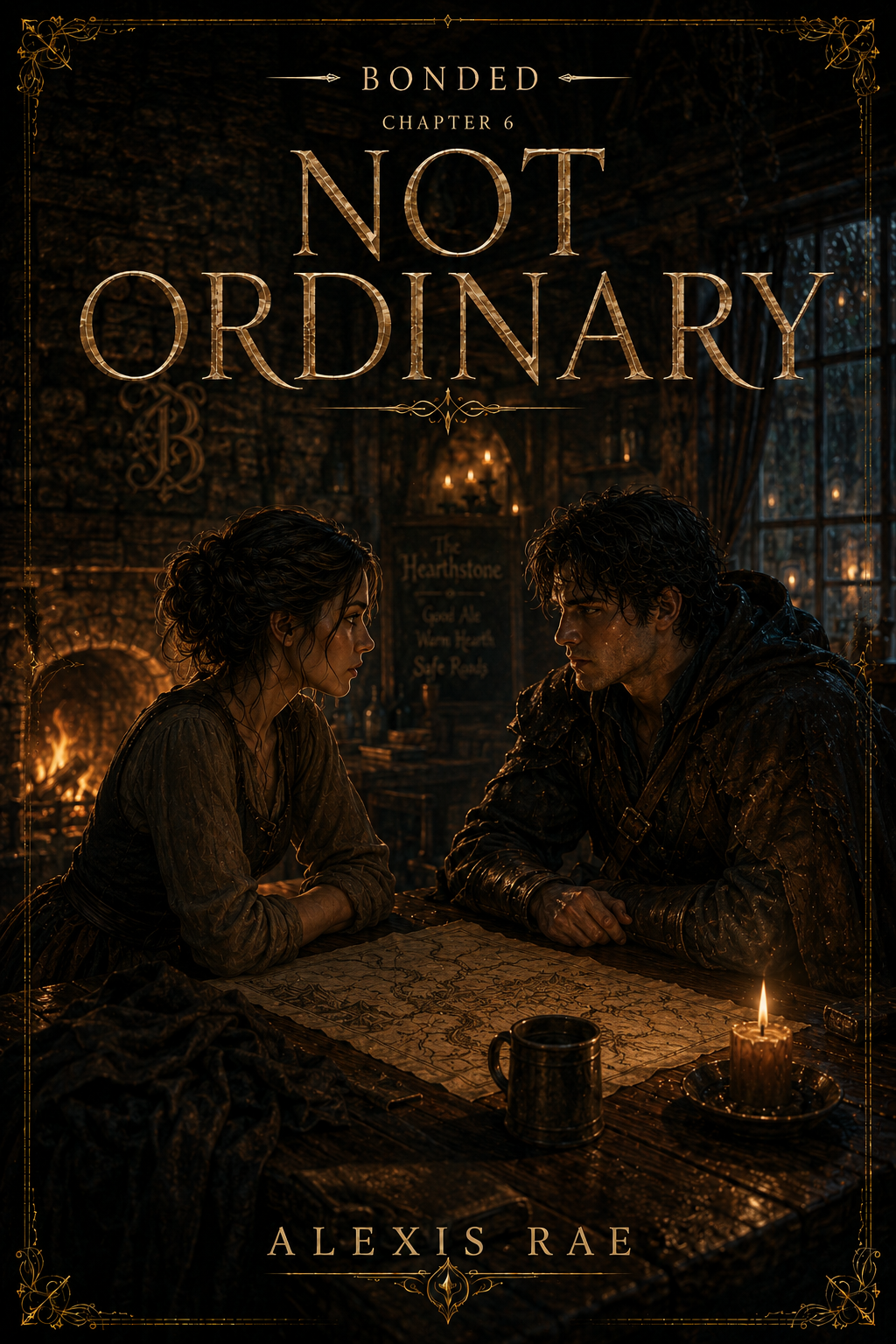
Rowan nodded.
Nairis turned away before anyone could mistake that nod for the beginning of his answer.
Teren was the first problem.
He had slipped deeper into sleep against the wall, his sister still beside him, one hand wrapped around his wrist.
Nairis crossed to them.
“Can he manage the stairs?”
Teren’s sister looked down at him.
“If he wakes enough to know what stairs are.”
Nairis touched Teren’s shoulder.
“Teren.”
He opened one eye.
“Unfair.”
“You can complain upstairs.”
He made a sound that might have been agreement.
His sister got one arm under his and Nairis took the other side until he was standing.
Teren swayed once.
Jorin half rose from his chair.
“I’ve got him,” Teren’s sister said.
Nairis looked at Teren.
“Do you?”
He blinked at her. “Enough to reach the stairs.”
Nairis let his sister steer him toward them.
“Slowly. If he misses one, bring him back down and put him by the hearth.”
Teren lifted one hand without turning.
“I heard that.”
A little of the room’s strain loosened with the answer.
Nairis went to Sella next.
“The quiet room is open.”
Sella looked toward the stairs, then toward the woman beside her.
“I’ll stay here a little longer.”
“Your choice.”
Nairis adjusted the shawl over the back of Sella’s chair.
“Tell Mara if you change your mind.”
Pell was still barefoot on one side, his damp boot lying under the bench.
Nairis pointed at it as she passed.
“Still off.”
Pell looked wounded.
“I know.”
“Good. I would hate to waste another argument.”
By the time she reached the hearth again, the room had begun to thin without emptying.
Some villagers gathered coats from pegs near the door. Others stayed beside the returned warriors but lowered their voices. A few moved toward the far tables with cups and plates, close enough to remain present without crowding the hearth.
The warning had not dispersed with them.
It had only lost its audience.
Nairis preferred that.
The man who had suggested raiders lingered near the long table.
“So are we staying?” he asked.
Nairis looked at him.
“For food, yes. For guessing, no.”
He exhaled through his nose.
“I was asking whether you needed us.”
“Not for this part.”
Several people within earshot glanced over.
Nairis raised her voice just enough to save herself from repeating it.
“If you did not see the road signs yourself and you do not need to hear Rowan’s judgment directly, finish your food and let the returned breathe.”
No one argued.
That did not mean they liked it.
It meant they were tired enough to accept the boundary.
Mara came out of the kitchen carrying two bowls.
“Do you want me here?”
“I want you doing exactly that.”
Mara looked at the bowls.
“Useful. Cruel.”
“Frequently the same thing.”
Mara gave her a narrow look and kept moving.
Orren passed behind her with a pitcher and did not slow.
Nairis turned back toward the returned warriors.
This was not a council.
Nairis refused to let it become one by accident.
She looked toward the returned warriors.
Davin had gone quiet beside his mother and child. His account was already clear enough. Pell had contributed what he saw at the ditch. Harlan had confirmed both stretches of disturbed ground and looked one breath from falling asleep over his cup.
Jorin was still awake.
Still facing the door.
Sella remained alert enough to answer if needed.
Rowan had not moved from his chair.
Nairis crossed first to Harlan.
“Go lie down.”
His eyes lifted.
“I can stay.”
“You can also fall asleep sitting up and break another cup.”
His mouth twitched.
“I heard the second sound.”
“Jorin heard it too.”
Harlan looked toward Jorin.
Jorin nodded once.
Nairis put a hand on the back of Harlan’s chair.
“If we need your eyes, I know where to find you.”
Harlan let Orren take his cup and stood carefully.
Sella watched him go.
Nairis looked at her next.
“You stay only if you want to.”
Sella glanced toward the board. “I saw the ditch first, and I want to stay.”
Nairis nodded.
That left Rowan, Jorin, Sella, and Nairis closest to the hearth.
Pell sat two chairs farther back, close enough to correct something if he had to, but no longer part of the center.
Davin had turned toward his family again.
The village remained in the room in small clusters, but their attention had loosened enough that every whisper no longer belonged to the road.
Nairis went to the board.
She turned it back just far enough to see her own chalk marks.
The route notes still showed the rain, the ridge marker and split pine, the west marker and south bend, then the close order and the unplaced sound.
She did not add anything.
She did not erase anything either.
Jorin watched her hand.
“That enough?” he asked.
“For what you saw, yes.”
Nairis let the board rest against the wall at an angle instead of opening it toward the room.
“We are not doing that part again.”
Jorin nodded.
Rowan said nothing.
He had waited through Teren’s climb upstairs, through Harlan leaving, through villagers drifting back toward their own conversations. He had not offered one word beyond what he had already promised.
Nairis looked at him.
His cup sat untouched where she had refilled it.
“The people who need settling are settled enough,” she said.
He looked past her once, checking the room.
Teren was gone upstairs. Harlan had disappeared toward the back passage. Davin was speaking quietly with his mother. Pell leaned against the wall with both boots off now. Sella stayed beneath her shawl. Jorin had shifted his chair away from the door by half a turn, though not enough to lose sight of it.
Rowan’s gaze returned to Nairis.
She pulled one chair closer but did not sit.
“This stays here,” she said. “No speech to the whole room. No guesses dressed up as answers. If one of us has a fact wrong, Jorin or Sella corrects it.”
Jorin folded his arms while Sella nodded, and Rowan’s expression barely changed.
“That works.”
Nairis rested one hand on the back of the chair.
Behind them, Mara set down a bowl hard enough to make a spoon jump, then muttered at someone to eat before it went cold.
People kept eating, moving bowls, and speaking softly around the inn.
That mattered too.
Nairis looked at Rowan.
The smaller circle was as quiet as she could make it without emptying her own inn.
The witnesses were close.
The board was there if they needed it.
Nairis kept the question bounded to what Rowan could actually judge.
“Tell me what does not fit.”
Rowan looked at the board, then at Nairis.
“The weather fits part of it.”
Nairis waited.
“The rain was bad before the ridge. Mud slowed us. Visibility dropped. None of that is unusual.”
Jorin gave a small nod.
Rowan continued.
“But the road stayed open.”
Nairis rested both hands on the back of the chair in front of her.
“You’re certain of that, even at the west marker?”
Sella gave a confirming nod. “We could have stayed on it there, and the same was true at the first crossing.”
Nairis looked at the angled board.
“So the rain slowed you, but it did not put you off the road.”
“Correct.”
Rowan leaned back slightly, careful of his leg.
“If weather had been the whole problem, we would have kept moving and arrived late. Wet, cold, tired, probably angry at the road. We would not have left a usable route twice because the ground beside it told us something had moved through recently.”
Nairis let that settle.
“What about flooding?”
“The ditch was full.”
Sella’s eyes lifted.
“Running hard,” she said.
Rowan nodded.
“But water does not cross its own flow and flatten both banks in opposing directions.”
Nairis looked at Sella, who gave a confirming nod.
“Then road damage?” Nairis asked.
Rowan shook his head.
“Road damage stays with the road unless something causes it elsewhere. Ruts, washout, a fallen tree, a bank giving way. We know what those look like.”
His eyes moved briefly to Jorin.
Jorin said, “The first road surface was soft. It was not broken.”
Rowan continued without hurry.
“The marks crossed it. Whatever caused them came from one side and left on the other.”
Nairis looked at the board again.
“Animals.”
Rowan’s expression shifted.
“Possible in the broadest sense, but I would not trust that explanation yet.”
He reached for his cup, then stopped before lifting it.
“Deer cross roads. Boar tear ground. A herd can churn mud into overlapping hoof cuts and collapsed edges until individual tracks disappear. A frightened animal will break brush. A heavy one can push through things that look too dense to pass.”
Nairis said nothing.
Rowan looked toward the dark window beyond the hearth.
“What we saw did not fit those patterns. The first tracks were too deep in places and too irregular in spacing for horses moving normally. They were not a herd trail. They did not fan out. They crossed hard and direct.”
Jorin unfolded one arm.
“North to south.”
Rowan nodded.
“And they left the road through brush that had been forced apart, not browsed down or trampled gradually.”
Sella shifted beneath her shawl.
“The ditch was worse.”
Rowan looked at her.
“Yes.”
Nairis kept her attention on him.
“Worse how?”
Rowan took a moment before answering.
“An ordinary animal crossing leaves you some sense of what kind of movement happened. Hoof pattern. Paw marks. Body height against brush. Repeated use if it is a known game trail.”
He tapped one finger against the side of his cup.
“We had none of that cleanly enough to trust.”
Nairis watched his face.
“But you cannot say it was not an animal.”
“No.”
The answer came without reluctance.
“I can say I would not explain it away as routine animal passage.”
That was different.
Nairis understood why he chose the words carefully.
A spoon scraped a bowl at one of the far tables.
Mara said something low to Orren in the kitchen doorway.
The smaller circle held.
Nairis moved to the next explanation.
“The room already raised raiders. Does that fit?”
Rowan finally picked up his cup.
“Not well. Raiders use roads when they can. They avoid being slowed by bad ground unless they are hiding from someone or approaching a target. They leave boot marks, horse sign, wheel sign, cut brush, camp traces, something with intention in it.”
Nairis glanced toward the board.
“And none of that?”
“Nothing I would trust.”
Jorin rubbed a thumb across his forearm.
“No cut brush.”
Sella added, “No wheel ruts off the road at the ditch.”
Rowan nodded to both without breaking his explanation.
“A raiding party large enough to tear that much ground would usually leave more evidence than we found. A small party would not produce what we saw unless they were doing something very specific.”
Nairis heard the opening in the sentence.
“So a human cause, including raiders, is still possible.”
“In theory,” Rowan said. “I would not tell anyone they were impossible. I would tell them the signs do not match ordinary raider movement closely enough to make that our working answer.”
Nairis looked toward the room beyond them.
The man who had suggested raiders sat at the far end of the long table with a bowl in front of him and another villager beside him, their heads bent toward their own conversation.
Nairis turned back.
“What does that leave?”
Rowan did not answer at once.
Jorin looked toward him.
Sella’s fingers tightened around the edge of her shawl.
Rowan set his cup down again.
“It leaves the facts.”
Nairis frowned slightly.
“That is not much of an answer.”
“It is the only honest one yet.”
He looked at the board.
“Bad weather fits the delay before the first sign. Flooding does not explain the direction of the damage. Simple road failure does not fit because the road remained usable. Routine animal movement does not fit cleanly enough for me to trust it. Ordinary raider movement does not fit the signs we found or the way they were distributed.”
Nairis watched him.
“The easy explanations are still possible. You would not trust any of them as the working answer.”
“Correct.”
Nairis let her grip loosen on the chair back.
That distinction mattered as much as anything else he had said.
Jorin leaned forward, forearms on his knees.
“If you had found only the first crossing?”
Rowan looked at him.
“I would have marked it, tightened the line for a while, and kept moving.”
Sella asked, “Only the ditch?”
“I would have avoided the ground and watched the trees.”
Nairis looked from one to the other.
Neither answer sounded like what had actually happened.
Rowan had stopped before saying why.
The restraint was deliberate.
Nairis saw it now.
He had ruled out enough to make the warning heavier without pretending he had named its source.
She shifted the chair aside and sat for the first time.
“Then tell me this much.”
Rowan waited.
“Would you call what happened ordinary frontier trouble?”
His eyes stayed on hers.
“No.”
The word landed quietly.
No one in the smaller circle moved.
Nairis looked at the board again.
The chalk marks had not changed.
The meaning attached to them had.
She turned back to Rowan.
“You would not trust the easy explanations. Then tell me what makes the rest of it worse.”
Rowan kept his eyes on Nairis.
“What makes it worse is that nothing happened only once.”
Nairis stayed seated.
Rowan leaned forward, forearms resting on his knees.
“If we had found one set of strange tracks in bad weather, I would have marked the place and moved on. If we had found one torn ditch bank, I would have given it space and watched the tree line. If Pell had heard one sound in brush during a storm, I would not have built anything from it.”
He glanced toward the angled board.
“But that is not what happened.”
Nairis followed his gaze.
The chalk marks sat where she had left them.
“Freshness first,” Rowan said. “The tracks had not softened under the rain. The ditch damage was sharp enough that Sella could still see where the bank had been pushed down. The brush was not settling back upright. Whatever made those signs had passed through recently enough that we had to assume it might still be close.”
Sella shifted under her shawl.
“The stems were still leaking sap where they had split. I did not think to mention it before.”
Rowan looked at her. “That supports the same point.”
Nairis gave one nod and returned her attention to Rowan.
He tapped two fingers against his knee.
“Then distance. The first crossing was near the ridge. The ditch was farther west. The crushed brush Davin described was between those places. I cannot tell you whether they were connected, but each new place forced us to reconsider the last one.”
Jorin uncrossed his arms.
“At the first crossing, we tightened up.”
Rowan nodded.
“At the ditch, we stopped sending anyone ahead alone.”
Sella added, “After the second sound, nobody wanted the rear out of sight either.”
Nairis looked from one to the other.
“That was not on the board.”
Jorin rubbed one hand over his jaw.
“We did it without discussing it.”
Rowan’s eyes moved to him.
“That is part of what matters.”
Nairis frowned.
“The fact that you were frightened?”
“No.”
Rowan sat back slightly.
“The fact that experienced travelers kept changing behavior after each new sign.”
Nairis waited.
He continued.
“People make one bad decision when something startles them. They overreact. They imagine danger where there is none. But seven people do not keep changing spacing, route, pace, and watch pattern over hours unless the uncertainty keeps surviving each new look.”
Jorin nodded once.
“We kept expecting the next stretch to make sense of the last one.”
“And it did not,” Rowan said.
Sella looked toward the hearth.
“No.”
For a moment, Nairis heard only the inn around them.
Someone upstairs crossed the floorboards above the common room. A spoon struck ceramic at the far table. Orren opened the back door long enough to let in a breath of wet air, then shut it again.
Nairis looked at Rowan.
“So every sign stayed unresolved, and each new one made the earlier signs harder to dismiss.”
Rowan nodded. “At the first tracks, there were several harmless explanations. At the ditch, fewer of them fit comfortably. By the time we heard movement off the road after changing our route twice, I had less confidence in every ordinary explanation than I had at the beginning.”
He looked toward the dark window, then back to her.
“You would rather find something definite, even if it is bad,” Nairis said.
“Especially if it is bad.”
Jorin gave a quiet breath through his nose.
Rowan continued.
“A known threat gives you rules. You know how close to stand, what ground to avoid, whether to run, hide, fight, or simply wait for it to pass.”
Nairis looked at the board again.
The chalk no longer felt like separate marks.
The line between them mattered more.
She turned back to Rowan.
“You are using your own behavior as part of the evidence. How do you know you did not simply reinforce your first fear?”
Rowan rubbed his thumb against the edge of his cup.
“Because I am not saying our caution proved the threat. I am saying the caution survived repeated checks. Jorin saw the first crossing. Sella saw the ditch. Davin saw the crushed brush. Different people, different places. We kept trying to reduce the problem to something ordinary, and nothing we found let us do that safely.”
Nairis looked toward Jorin.
“Did you ever think Rowan was being too cautious?”
Jorin considered before answering.
“At the first crossing, yes. By the ditch, no. The first sign had not stayed alone.”
Nairis looked back to Rowan.
He spread one hand, palm up.
“That.”
Sella shifted her cup between both hands.
“If it had ended at the ditch, would you have relaxed?”
Rowan looked toward her.
“After enough clean road.”
Nairis caught the phrase.
“You never got enough.”
“No.”
That answer landed harder than the others.
Nairis sat back.
The return route had not given them a clear enemy. It had given them a sequence of fresh disturbances far enough apart to force repeated judgment and close enough together that none could be dismissed comfortably.
She looked at Rowan.
“So any one sign might have been nothing. Then another one appeared before you had enough clean road to dismiss the last.”
Rowan held her gaze.
“And each time, we had to behave as though the next one might matter too.”
Nairis looked toward the front door.
Jorin’s chair still gave him a clear line to it.
Sella still kept her shoulders tucked beneath the shawl, but her eyes were awake and fixed on Rowan.
The pattern had followed them into the room in the habits they had not put down.
Nairis turned back.
“Then I understand why you are concerned.”
Rowan’s expression did not ease.
“Concern is the right word.”
Nairis rested one hand on the chair beside her.
“It is also a broad one.”
“Yes.”
She studied him.
“You have told me why the pattern matters.”
Rowan waited.
Nairis leaned forward.
“Now tell me exactly how much of it you actually understand.”
Rowan did not answer immediately.
He looked at Nairis as if measuring how narrow she wanted the question.
Then he said, “I understand enough to be concerned. I do not understand enough to name what caused it.”
Nairis stayed forward in her chair.
“Start with what you know.”
“The disturbances were fresh.”
She nodded.
“They happened at more than one point.”
Another nod.
“They changed how we moved, and the ordinary explanations fit less well the farther we went.”
Jorin shifted his chair a fraction, keeping the door in view.
Rowan continued.
“That is what I know from the road.”
Nairis held his gaze. “Now separate that from what you suspect.”
Rowan rubbed one thumb along the rim of his cup.
“There are possibilities, but none I would stand behind. Every one of them requires me to fill in something we did not see.”
Nairis glanced toward the far tables.
No one there was looking openly toward them now, though that did not mean no one was listening.
She lowered her voice.
“That includes animals, raiders, and anything worse you have considered?”
“Yes.”
Nairis felt the word settle differently from the others.
She kept her face still.
“If I pressed you for a name, would you give me one?”
“No. That would be pretending certainty I do not have.”
The answer stopped her.
Rowan leaned back a little.
“If I give you a name now, people will start fitting every later sound and broken branch to that name. Then the next fact will have to fight the story we told ourselves first.”
Nairis looked toward the angled board.
“You have seen that happen before.”
“Yes.”
He did not elaborate.
She did not ask him to.
“What would move you from concern to identification?”
Rowan looked toward Jorin, then Sella, as though checking whether either wanted to answer first.
Neither did.
He counted nothing on his fingers. He simply spoke.
“Tracks clear enough to read instead of just measure. A direction that repeats. Damage that tells us height, weight, tool use, or method. Remains. Blood. Hair. Cloth. Camp sign. Something that places an actual kind of presence on the road instead of only its effects. An encounter would matter too, but only if it were clear enough to survive questioning. A shape through rain is not enough. Movement in brush is not enough. Another broken bank is not enough unless it adds a pattern we can distinguish from the old one.”
Sella lifted her cup but did not drink.
“If we find another crossing exactly like the first, especially in the same direction, how much does that change?”
“It matters,” Rowan said. “A repeated direction would be more useful, but not enough by itself to tell me what made it.”
Sella frowned, tired more than frustrated.
Jorin leaned forward.
“What about raiders with animals? That could explain churned ground and broken brush.”
“It could,” Rowan said. “But it would not explain why we found no clean boot sign, no horse pattern I trusted, no cut passage, no discarded gear, and no purposeful use of the road. It remains possible. It does not become likely just because it can explain two details.”
Jorin nodded once.
Nairis looked between them.
“So possible is not the same as supported, and supported is not the same as proven.”
“Yes.”
Nairis sat back.
Mara crossed behind them carrying a tray of emptied bowls. She did not slow, though her eyes flicked once toward Nairis before she disappeared into the kitchen.
The common room had grown quieter with the hour.
Some villagers had left. Others had folded into family groups around the returned warriors. The relief was still there, visible in hands resting on shoulders and cups being refilled without asking.
The warning sat inside that relief now.
Nairis looked at Rowan.
“You said uncertainty itself is part of the problem. Explain that.”
“Because a known threat tells you what kind of mistake will get someone hurt.”
Nairis waited.
“If it is floodwater, you stay off the low crossing. If it is raiders, you think about roads, sight lines, numbers, intent. If it is an injured animal, you give it ground and stop cornering it.”
His gaze moved briefly toward the front windows.
“If you do not know which set of rules applies, the wrong caution can be as dangerous as no caution.”
Jorin’s mouth tightened.
Sella lowered her cup.
Nairis kept her voice low.
“So not knowing makes a safe response harder. I am not asking you to plan that response yet.”
Rowan inclined his head. “Good. That is the next question, not this one.”
Nairis almost smiled, but let the moment pass.
“One more time, then. I want the answer clean.”
Rowan waited.
“You cannot tell me what made the signs, whether the same thing caused all of them, or whether the source was animal, human, or something else.”
“No.”
Nairis held his gaze.
“What can you tell me without guessing?”
Rowan answered immediately.
“The signs were fresh. They repeated across distance. They changed how trained people moved. The easy explanations do not fit well enough to trust. And I would not dismiss what happened as ordinary frontier trouble.”
No one corrected him.
Nairis looked toward Jorin.
He gave one slow nod.
Sella did the same.
Nairis turned back to Rowan.
The warning did not feel smaller for having boundaries.
It felt harder to argue with.
She let one hand fall from her knee.
“All right.”
Rowan waited.
“I believe the limit, and I believe the concern.”
The Hearthstone moved quietly around them.
Nairis looked toward the front door, then back at Rowan.
“Now tell me whether this belongs to the road behind you, or whether Alderwick needs to treat it as ours.”
Rowan did not look away.
“Yes. Alderwick needs to treat it as ours, though not because I think whatever made those signs is necessarily coming here. Home does not put a wall around the road.”
He shifted his leg slightly and looked toward the angled board.
“The last disturbances were close enough that reaching Alderwick did not put a clean stretch of country between us and them. They were fresh enough that I cannot tell you they belonged to yesterday instead of tonight.”
Sella lowered her eyes to her cup.
Nairis looked toward the front windows.
Rain still worked softly against the glass.
“You could have crossed the edge of it,” she said. “Whatever it was might already be moving away.”
“That is possible. I just have no reason to believe it more than the opposite.”
Rowan rested one hand over the other.
“We never found a direction we could trust. The first crossing ran north to south. The ditch did not give us a clean direction. The sounds did not either. We cannot take our arrival here and turn it into evidence that the problem stayed behind us.”
Jorin’s gaze moved toward the door again.
Nairis noticed.
“So the reassuring answer is possible, but unsupported.”
“Exactly.”
She let out a slow breath.
“What makes that Alderwick’s problem instead of yours?”
Rowan glanced toward the room around them.
“Because we are not the only people who use those roads.”
Nairis followed his gaze.
At the far table, Davin’s mother had begun wrapping bread in cloth for him to take upstairs later. Near the kitchen door, Orren was stacking cups. Two villagers were shrugging into damp coats before stepping out into the night.
Rowan continued.
“The ridge road carries traders. The west marker sits on an approach people use to reach the south fields. Hunters cross those woods. Farmers use the ditches and tracks beyond the road more often than we do.”
Sella spoke quietly.
“My brother takes the west track when the lower field floods.”
Nairis looked at her.
“How close to the damaged ditch?”
Sella thought about it.
“Close enough that he would pass the marker first.”
Nairis nodded once and did not ask what Sella thought he should do tomorrow.
Not yet.
Rowan watched her choose not to ask.
“The signs do not have to reach the village square to matter,” he said. “They only have to touch the places Alderwick depends on.”
Nairis looked toward the front door again.
People came through it every day carrying flour, hides, letters, timber, gossip, medicine, children, tools, and sometimes nothing more than themselves.
The road outside the Hearthstone was not separate from the village. It was one of the ways the village existed.
She looked back to Rowan.
“So the distance is small enough that dismissal would be irresponsible, even if it does not prove the danger is close.”
“Yes.”
Jorin leaned back in his chair.
“If the last sign had been a day west of here, I would sleep better.”
Rowan glanced at him.
“So would I.”
Nairis looked between them.
“How much better?”
Jorin answered this time.
“Enough that I would call it somebody else’s road until we heard otherwise.”
Rowan nodded.
Nairis looked toward Sella.
“And now?”
Sella’s fingers tightened around her cup.
“Now I know my brother uses one of those approaches.”
Nairis let the answer stand without turning it into a plan.
The line mattered.
Concern could become work quickly in Alderwick. One person moved a cart. Another fetched a bell. Someone woke a cousin. By morning, a question could become three different precautions and five different rumors.
That was exactly why she had kept the larger room out of this conversation.
Nairis looked at Rowan.
“If nothing else happens tonight or tomorrow morning, does that change your judgment?”
“No. Two quiet days might, but only if the road itself stays clean. Clean time matters. Clean road matters more.”
Nairis remembered his answer from before.
Enough clean road.
The travelers had never got it.
Alderwick had not tested for it at all.
She looked at the board.
“So we do not know whether the problem moved toward us, away from us, around us, or stopped. We only know people from Alderwick use the same approaches where recent signs appeared.”
“That is right.”
Nairis rested her hands together.
“Then I cannot call this finished because you made it through the door.”
Rowan’s face stayed still, but something in his shoulders eased.
“No.”
The answer was quiet.
Nairis looked beyond him.
The Hearthstone had gone softer with the hour. The first urgency of the homecoming had burned down into low voices, full stomachs, damp clothes steaming near the fire, and families unwilling to move farther from the people they had just got back.
That was still true.
So was the road.
She turned back to Rowan.
“I am not asking for a plan yet. I am asking whether doing nothing would be responsible.”
Rowan took a breath.
His answer came carefully.
“It is responsible to avoid pretending. It is responsible to avoid panic. It is not responsible to treat fresh, unexplained signs on Alderwick’s approaches as somebody else’s problem just because we got home alive.”
Jorin looked down at his hands.
Sella closed her eyes for a moment.
Nairis sat very still.
That was the boundary she had been looking for.
Not a plan.
Not a name.
A reason the village could not simply go to sleep and forget what had arrived with the seven travelers.
Nairis looked toward the room once more.
Davin’s mother had finished wrapping the bread.
Orren had put away the last clean cup.
Mara stood in the kitchen doorway, watching Nairis now without pretending otherwise.
Nairis met her eyes for one brief second, then looked back to Rowan.
“The road did not end at the threshold.”
“No.”
Nairis nodded.
“Then neither does the warning.”
Nairis nodded.
“Then neither does the warning.”
No one answered her.
For a few breaths, the smaller circle simply held the words.
Jorin sat with his hands together between his knees. Sella watched the surface of her cup. Rowan kept his gaze on Nairis without pushing the moment forward.
Around them, the Hearthstone continued to settle for the night.
Someone carried a tray toward the kitchen. A chair scraped softly near the far wall. Above them, a floorboard creaked under a slow step.
Nairis looked toward the angled board.
The marks on it had not grown since Rowan began speaking.
They did not need to.
“We are not ignoring this,” she said.
Jorin lifted his eyes.
Nairis continued before he could speak.
“We are also not giving it a name because we dislike not having one.”
Sella nodded once.
“The tracks are real. The ditch is real. The disturbed brush is real. The changes you made on the road are real. Rowan’s judgment is real.”
She looked at Rowan.
“What made those things happen is still unknown.”
“Yes,” he said.
Nairis turned slightly so she could see Jorin and Sella together.
“That is the line we keep.”
Jorin leaned back.
“For how long?”
“Until we have more than this.”
He glanced toward the front door.
“That is not what I meant.”
Nairis knew.
Sella looked at her now too.
“What do we do?”
There it was.
The question the whole conversation had been walking toward.
Nairis rested one hand on the chair beside her.
“Not tonight.”
Jorin’s brow tightened.
Nairis held up one hand.
“I did not say we do nothing.”
Rowan’s eyes stayed on her.
“I said we do not decide the whole answer from this table while half the people who lived through the road can barely stay awake.”
Sella looked toward the stairs where Teren had disappeared.
Nairis continued.
“Whatever Alderwick does next needs to be based on the same discipline we used tonight. What was seen. What was not seen. What Rowan can support. What he cannot.”
Jorin rubbed a thumb over his knuckles.
“And in the meantime?”
Nairis did not give him a patrol route, a watch order, or a list of people to wake.
She looked toward Rowan instead.
He understood the boundary.
“A tired response can become a bad one quickly,” he said. “If people start solving the wrong problem because they are frightened, we will spend tomorrow correcting ourselves.”
Jorin gave him a flat look.
“That sounds like waiting.”
“It sounds like not mistaking motion for judgment.”
Nairis looked at Jorin.
“You are exhausted, and so am I. We are in no condition to decide the whole response tonight.”
Jorin rubbed both hands over his face.
Sella watched him over the rim of her cup.
“Tonight we keep the facts straight. We keep people from turning one warning into six stories. We let the returned sleep.”
She stopped there.
No instructions beyond that.
No plan that belonged to morning.
Rowan watched her closely enough that she knew he noticed the restraint.
Nairis stood.
The movement drew Mara’s attention from the kitchen doorway.
Nairis looked toward her.
“Hot water upstairs if they ask for it. Bread left out for anyone who wakes hungry.”
Mara nodded.
That was ordinary work.
Nairis needed it to remain ordinary.
She looked toward Sella.
“You still want the quiet room?”
Sella glanced toward the woman beside her at the farther table.
“Yes.”
“Take it.”
Sella stood carefully.
Jorin rose halfway as if to help, but Sella waved him back down.
“I can walk across one room.”
“Good,” Nairis said. “Prove it.”
Sella gave her a tired look and went.
Jorin stayed seated.
Rowan remained near the hearth.
Across the room, Davin’s mother pressed the wrapped bread into his hands despite his protest. Pell had fallen asleep against the wall with both boots off. Someone had put a folded coat behind his head.
Nairis watched the scene long enough to feel the relief in it again.
They were home.
Whatever waited beyond the roads had not taken that away.
It had changed what home required of them next.
She picked up Rowan’s empty cup.
“Do you need anything before you sleep?”
“Only sleep,” he said.
Nairis nodded and carried the cup toward the kitchen, leaving him to close his eyes by the hearth.
Jorin stood at last.
“I am going upstairs.”
Nairis pointed toward the stairs.
“A wise decision.”
He gave Rowan a look on the way past, then disappeared after Sella.
The smaller circle was gone.
The warning was not.
Nairis carried Rowan’s cup toward the kitchen.
Mara met her halfway.
“Well?”
Nairis stopped.
Mara’s face held the question without any of the guesses Nairis had spent the evening cutting away.
Nairis lowered her voice.
“It is serious, and we do not know what caused it. We do need to respond, but not by inventing an answer tonight.”
Mara’s hands tightened around the towel she carried.
Nairis looked toward Rowan.
He had leaned back in the chair with his eyes closed, one hand resting over his bad leg.
Davin was finally letting his mother fuss over him. Pell slept. Somewhere upstairs, Teren coughed once and then went quiet again.
Nairis turned back to Mara.
“Tomorrow, we decide what that something is.”
Mara searched her face.
Then she nodded.
Nairis handed her the cup.
“Tonight, we finish getting them home.”
Mara took it and went back into the kitchen.
Nairis stood alone for a moment beside the hearth.
The board remained angled toward the wall.
From where she stood, she could still read the chalk sequence: rain, ridge marker, split pine, west marker, south bend, close order, sound.
A few hours ago, they had been pieces of a late journey.
Now they were the beginning of a problem Alderwick would have to answer.
Nairis did not turn the board around.
She crossed to the front door instead and checked the latch.
Then she went back to work.